
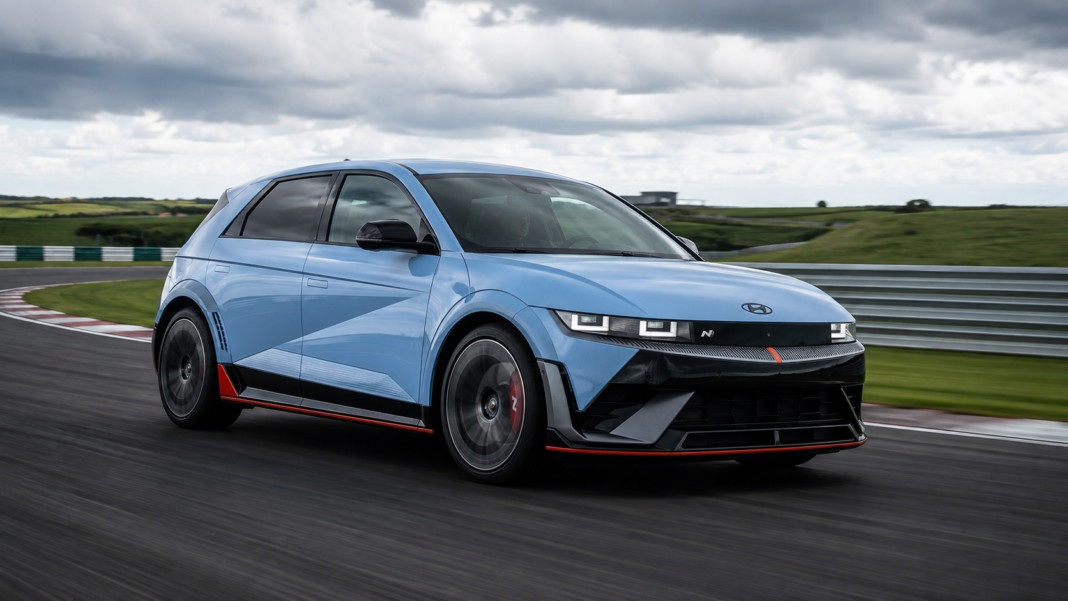
The sun is just beginning to burn through the coastal mist at the Anglesey Circuit in Wales. The track is quiet, but the air hums with anticipation. A car sits in the pit lane, its silhouette familiar yet transformed, its design unmistakably Hyundai but unlike any electric vehicle the company has built before. This is the Hyundai Ioniq 5 N, the first electric performance car that enthusiasts actually recommend, and it achieves this by doing something that should not work: it fakes a gearbox and gets away with it.
The Ioniq 5 N is the high-performance variant of Hyundai’s retro-futuristic electric crossover, and it represents a fundamental shift in how enthusiasts think about electric vehicles. It weighs 2,275 kilograms, it has a 650-horsepower dual-motor powertrain, and it can accelerate from 0 to 100 km/h in 3.4 seconds. But those figures, impressive as they are, do not explain why the Ioniq 5 N has won over the skeptics. The explanation lies in two systems: N e-Shift and N Active Sound+.
The N e-Shift System: Simulating the Real Thing
The N e-Shift system emulates the behavior of an eight-speed dual-clutch transmission. It is not a physical gearbox; it is a software layer that sits on top of the single-speed electric drivetrain. But the effect is uncanny. The system creates virtual shift points, complete with a momentary power cut, a brief surge of acceleration, and a subtle vibration that accompanies the upshift. The driver can even accelerate to the virtual redline, hitting a 7,700 rpm limiter before shifting to the next gear.
The system is controlled by paddles behind the steering wheel, allowing the driver to shift through eight virtual gears while accelerating and braking. The experience is not a gimmick; it is a genuine attempt to replicate the engagement of a traditional performance car. The system even creates a gear-specific drag torque, mimicking the engine-braking behavior of a combustion car.
This is not a feature that Hyundai has kept secret. The company has been clear about its intentions. The Ioniq 5 N is designed for drivers who adore being behind the wheel, for enthusiasts who want to take the driving of an electric vehicle to the next level. The N e-Shift system is the tool that achieves this, offering a sensory response that performance fans miss in an electric vehicle.
The N Active Sound+ System: A Soundtrack for the Drive
The N e-Shift system is complemented by the N Active Sound+ system, which provides a synthetic engine note that matches the virtual gear changes. The sound is not a generic electric hum; it is designed to mimic the sound of a four-cylinder turbocharged engine, with the pitch and intensity changing based on throttle position and virtual rpm. The system is adjustable, allowing the driver to choose between different sound profiles, including a more futuristic “electric” sound or a more traditional combustion engine note.
The combination of N e-Shift and N Active Sound+ transforms the Ioniq 5 N into something that is greater than the sum of its parts. The car’s weight, 2,275 kilograms, is still substantial. The chassis is still that of a crossover. But the experience, the engagement, the connection between driver and machine is genuinely different.
The Industry is Following
Hyundai is not alone in this approach. Porsche, which previously argued that simulated gear changes were unnecessary, has changed its position. The company has introduced an E-Shift system for the 2026 Taycan, complete with eight virtual gears, a virtual rev limiter, and a synthetic soundtrack that varies by model. Porsche’s engineers have even praised Hyundai’s system, describing it as “really, really good.”
Mercedes-AMG is also adopting the technology. The GT 4-Door Coupe features simulated gear shifts via the paddles, mimicking the company’s nine-speed automatic transmission. BMW’s electric M3, due next year, is expected to include a similar feature.
The Anglesey Morning
The Ioniq 5 N has completed its demonstration laps. Its N e-Shift system has delivered the engagement that makes it one of the most convincing electric performance cars on the road. The N Active Sound+ system has provided the soundtrack. The driver, cocooned in the performance-focused cabin, has experienced a level of engagement that is as exclusive as it is convincing.
The Ioniq 5 N is not a car for everyone. It is expensive, with a starting price of approximately €78,000. It is a car that prioritizes engagement over efficiency, and it is a car that represents a significant shift in how electric vehicles are perceived. But it is also a car that proves the electric performance car can be engaging, that the joy of driving can be found in a battery-powered crossover, and that faking a gearbox can be, against all odds, a good thing.

