
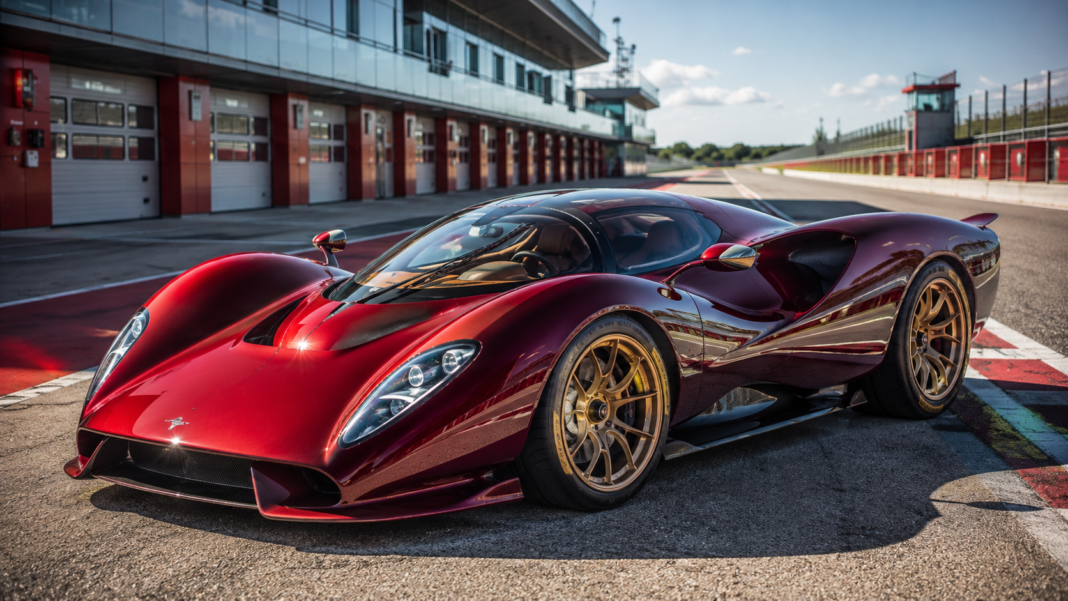
The lights of the Autodromo di Modena glow in the distance as a low, sculpted silhouette sits in the pit lane. The engine is not running, but the presence is unmistakable. This is the De Tomaso P72, a car that took seven years to go from concept to customer delivery, and it represents one of the longest waits in modern supercar history.
The P72 was first revealed as a concept at the 2019 Goodwood Festival of Speed. It was a stunning, retro-futuristic design that paid homage to the 1965 De Tomaso P70, a collaboration between Alejandro De Tomaso and Carroll Shelby. The response was immediate and enthusiastic. De Tomaso announced plans to build 72 units, each priced at approximately €1.6 million. The wait began.
The Long Road to Production
Seven years passed between the concept’s debut and the delivery of the first customer car. The project faced a series of challenges: the pandemic, supply chain disruptions, changes in manufacturing partners, and the sheer complexity of developing a clean-sheet carbon fiber chassis.
The chassis itself is a masterpiece of engineering. It is a single-piece carbon fiber monocoque with no bonded sections, extending from the central tub through the front and rear subframes. This structure enhances rigidity and reduces weight, providing a foundation for the car’s analog driving experience.
The Powertrain: A Supercharged V8 With a Manual
The heart of the P72 is a supercharged 5.0-liter V8 engine, sourced from Ford and developed in partnership with Roush. The engine produces 700 horsepower and 820 Nm of torque. It features bespoke forged internals and a De Tomaso-specific supercharger.
Power is sent to the rear wheels through a six-speed manual gearbox with short ratios, tuned for in-gear response rather than top-speed dominance. The exposed shift linkage is a tribute to De Tomaso’s racing heritage, a mechanical centerpiece that connects the driver to the car.
The Interior: A Rebellion Against Screens
The P72’s cabin is a deliberate rejection of modern supercar conventions. There are no touchscreens, no infotainment systems, no digital distractions. The dashboard features a series of gauges and physical controls, all housed in milled aluminum with a copper or rose gold finish. The only screen is the digital rearview mirror, required for the backup camera.
The interior is a study in craftsmanship. Leather is hand-stitched, metal surfaces are knurled, and every touchpoint has been considered. The P72 is a car designed to be driven, not operated.
The Customer Experience
The first customer car was delivered in 2026. It featured a dark finish with rose gold wheels and mirrors, and a blue leather interior. Each of the 72 units will be highly bespoke, tailored to the individual custodian’s preferences.
De Tomaso refers to buyers not as owners, but as “custodians.” It is a nod to the brand’s belief that the P72 is a rolling piece of art, meant to be preserved and enjoyed.
The Modena Evening
The P72 has completed its demonstration run. Its supercharged V8 has delivered the 700 horsepower that makes it one of the most engaging supercars on the road. The carbon fiber chassis and pushrod suspension have kept it planted through the curves. The driver, cocooned in the analog cabin, has experienced a level of performance that is as exclusive as it is extraordinary.
The P72 is not a car for everyone. It is limited to 72 units, priced at approximately $1.7 million each. But it represents a significant moment in De Tomaso’s history. It is the car that proves the manual, analog supercar is not dead, that there is still a market for cars that prioritize engagement over technology.
The P72 is not just a car. It is a statement. It is a reminder that even in an era of electrification and automation, there is still room for a car that is built by hand, driven with intent, and cherished as art. The wait is over. The P72 has arrived.

