
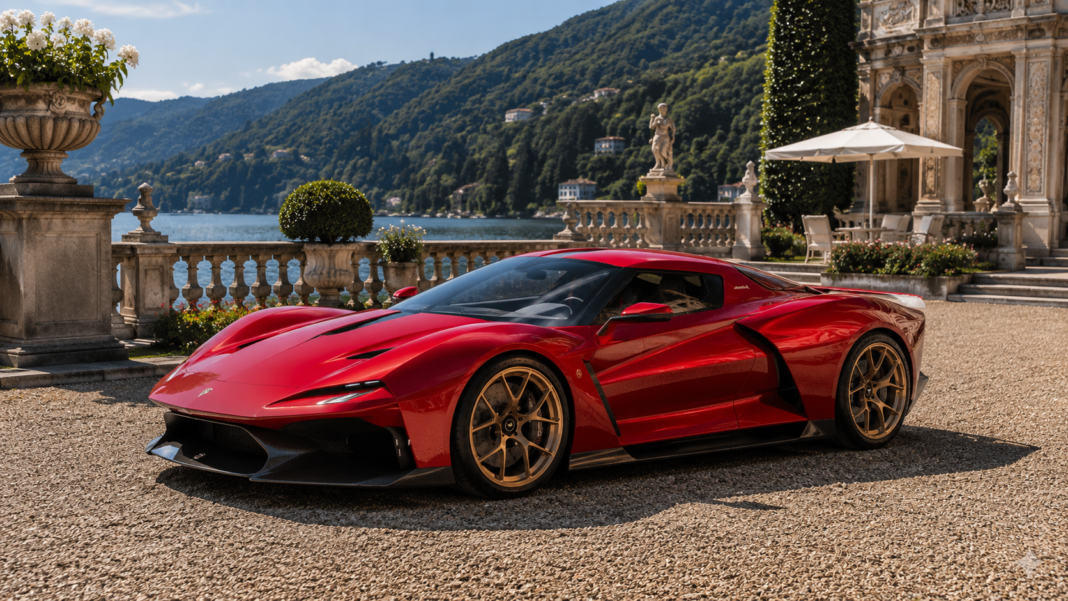
The sun is rising over Lake Como as a low, sculpted silhouette sits on the lawn at the Villa d’Este, surrounded by some of the most exquisite automotive art ever created. The car’s presence is understated but unmistakable. It is a Bizzarrini Giotto, the first entirely new model from a marque that has been dormant for more than five decades, and it represents a bet on whether a forgotten Italian name can compete in the hypercar segment.
The Giotto is the revival of a brand that was founded in the 1960s by Giotto Bizzarrini, one of the most influential engineers in Italian automotive history. He worked on the Ferrari 250 GTO, developed the Lamborghini V12, and created the legendary 5300 GT before his company went bankrupt in 1969. Now, more than 50 years later, a new Bizzarrini has arrived, and it carries the weight of that legacy.
The Name: A Tribute to a Legend
The Giotto is named after the company’s founder, Giotto Bizzarrini, who passed away in 2023 at the age of 96. The name is a deliberate choice, a tribute to the man who defined the brand’s engineering philosophy. The engine displacement, 6.6 liters, is a nod to his birth date: June 6, 1926.
The development of the car was led by Chris Porritt, formerly of Aston Martin and Rimac, and the design was penned by Giorgetto Giugiaro and his son Fabrizio, a partnership that rekindles the relationship that produced the original 5300 GT.
The Powertrain: A Cosworth V12 for the Purists
The heart of the Giotto is a naturally aspirated 6.6-liter V12 engine developed by Cosworth, the same British engineering firm that created the engines for the Gordon Murray T.50 and T.33. The engine is a bespoke unit, designed specifically for the Giotto, and it is expected to produce approximately 1,014 horsepower and 1,150 Nm of torque.
The engine is mounted longitudinally behind the cockpit, driving the rear wheels through an eight-speed dual-clutch transmission. It is a naturally aspirated unit, with no turbochargers, no electric motors, and no hybrid assistance. It is a deliberate choice, a rejection of the trend toward electrification in favor of the pure, unfiltered experience of a high-revving V12.
The chassis is a carbon fiber monocoque, with the body also made from carbon fiber. The dry weight is approximately 1,200 kilograms, giving it a power-to-weight ratio that rivals the most extreme hypercars.
The Design: Giugiaro’s Return to Bizzarrini
The Giotto’s design is a collaboration with GFG Style, the design studio founded by Giorgetto and Fabrizio Giugiaro. The elder Giugiaro had a hand in the design of the original 5300 GT, and the Giotto carries clear visual references to that car. The triangular B-pillar, the dual bonnet slats, and the shape of the glasshouse are all nods to the 1960s original.
The car’s proportions are classic mid-engine supercar, with a long wheelbase, short overhangs, and a predatory forward stance. The rear windshield wraps around the rear, almost cascading onto the wheel arches, and the tail tapers into an aerodynamic teardrop shape. The design is functional as well as beautiful, with active aerodynamic elements including a dihedral front splitter and rear diffuser.
Does the Name Carry Enough Weight?
The Bizzarrini name carries significant weight among automotive historians and connoisseurs. The 5300 GT is a legend, and the Ferrari 250 GTO, which Giotto Bizzarrini engineered, is one of the most valuable cars in the world. The Giotto has been compared to the Pagani Utopia, another Italian hypercar built around a naturally aspirated V12.
But the Bizzarrini name does not have the same recognition as Ferrari or Lamborghini. The company was only active from 1964 to 1969, producing approximately 140 cars. The brand is a niche within a niche, and its revival is a bet that there are enough collectors and enthusiasts who value its heritage to support a multi-million-dollar hypercar.
The Giotto has been in development since 2023, and testing was scheduled to begin in 2024. As of 2026, the car has not yet entered production, and its future remains uncertain. The project appears to have stalled, and it is unclear whether the Giotto will reach customers.
The Villa d’Este Morning
The Giotto has completed its demonstration run. Its Cosworth V12 has delivered the 1,014 horsepower that makes it one of the most powerful naturally aspirated cars ever built. The carbon fiber chassis and advanced aerodynamics have kept it planted through the curves. The driver, cocooned in the cabin, has experienced a level of performance that is as exclusive as it is extraordinary.
The Giotto is not a car for everyone. It is a car for those who value the pure, unfiltered experience of driving, who are willing to accept the compromises of a car that is built for enthusiasts. But it represents a significant moment in automotive history. It is the revival of a forgotten Italian name, and it proves that there is still a market for cars that prioritize emotion over efficiency.
The Giotto is not just a car. It is a statement. It is a reminder that even in an era of electrification and automation, there is still room for a car that is built by hand, driven with intent, and cherished as art. The forgotten Italian name has returned. But whether it has returned to stay remains an open question.

