
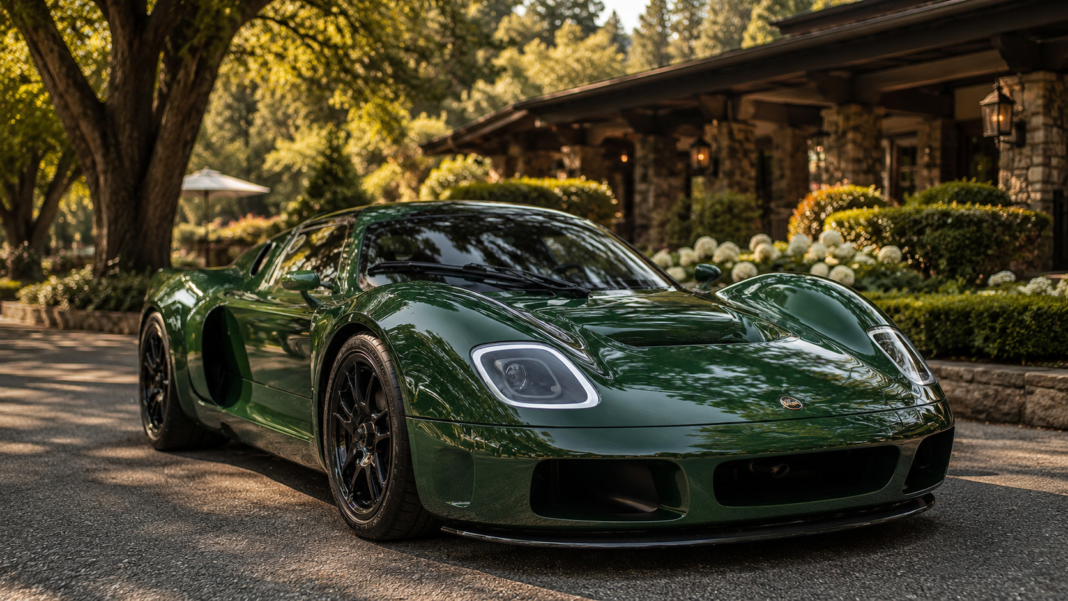
The sun is rising over the Monterey Peninsula as a low, sleek silhouette sits on the lawn at the Quail Lodge in Carmel, California. The car is unmistakably inspired by a 1960s race car, yet it is thoroughly modern. This is the Radford Type 62-2, a coachbuilt sports car that combines Lotus Evora bones with a 1960s racing silhouette on top and Formula 1 champion Jenson Button’s input in the development.
The Type 62-2 is the first modern car from Radford, a British coachbuilder revived by Button, designer Mark Stubbs, builder Ant Anstead, and business adviser Roger Behle. It is a tribute to the Lotus Type 62 race car from 1969, but it is not a replica. It is a modern interpretation, built on a Lotus Evora chassis with custom carbon fiber bodywork and a supercharged V6 engine.
The Lotus Bones
Underneath the retro bodywork, the Type 62-2 is pure Lotus. It uses the bonded aluminum chassis from the Evora, which provides a stiff and lightweight foundation for the car’s performance. The chassis is lower than the Evora, with the car standing just 1,133 mm tall, contributing to a low center of gravity that Button describes as providing minimal body roll and supreme driver confidence.
The engine is the same 3.5-liter supercharged V6 that Lotus uses in the Evora and Emira, mounted low behind the driver. The base Classic version produces 430 horsepower, while the Gold Leaf version upgrades to 500 horsepower through revised pistons, connecting rods, camshafts, and engine mapping. A top-spec JPS version is also available, producing 600 horsepower. The JPS version features a larger supercharger and is expected to wear the iconic black and gold John Player Special livery.
Jenson Button’s Input
Button’s involvement goes beyond a marketing exercise. He has been instrumental in developing the car’s driving dynamics, testing it at Lotus’s Hethel test track and providing feedback on the chassis setup. He described the car as “a pure driver’s car at its heart” with a low center of gravity and a chassis that “exhibits all the hallmarks of a beautifully set up race car for the road.”
The Type 62-2 has no driver aids. There is no traction control, no stability control, and no ABS. This is a deliberate choice, reflecting the car’s focus on raw, unfiltered driving engagement. The steering is unassisted, providing maximum feedback, and the car is available with a six-speed manual transmission. In the JPS version, Button achieved 0 to 62 mph in 2.9 seconds and a top speed of 186 mph.
The Coachbuilt Craftsmanship
Radford is a coachbuilder, and the Type 62-2 reflects that heritage. Each car is built to the owner’s specifications, with extensive personalization options available. The interior is handcrafted, with a focus on traditional materials and craftsmanship. The car features a six-inch digital display, a digital rearview mirror, and a premium audio system, but the emphasis is on the driving experience.
The Type 62-2 is limited to 62 units, with only 12 of those being Gold Leaf liveried cars. The Gold Leaf Quail Edition, unveiled at the Quail Lodge, features carbon ceramic brakes, carbon composite wheels, and a more aggressive aerodynamic package. The JPS version will be even more exclusive, with only 12 units planned.
The Quail Morning
The Type 62-2 has completed its demonstration run. Its supercharged V6 has delivered the 500 horsepower that makes it one of the most engaging sports cars on the road. The carbon fiber body and unassisted steering have provided a level of feedback that is rare in modern cars. The driver, cocooned in the handcrafted interior, has experienced a level of performance that is as exclusive as it is extraordinary.
The Type 62-2 is not a car for everyone. It is a car for those who value the pure, unfiltered experience of driving, who are willing to accept the compromises of a car that is built without driver aids. But it represents a significant moment in automotive history. It is the revival of a forgotten coachbuilder, a tribute to a 1960s race car, and a testament to the vision of a Formula 1 champion.
The Type 62-2 is not just a car. It is a statement. It is a reminder that even in an era of electrification and automation, there is still room for a car that is built by hand, driven with intent, and cherished as art.

