
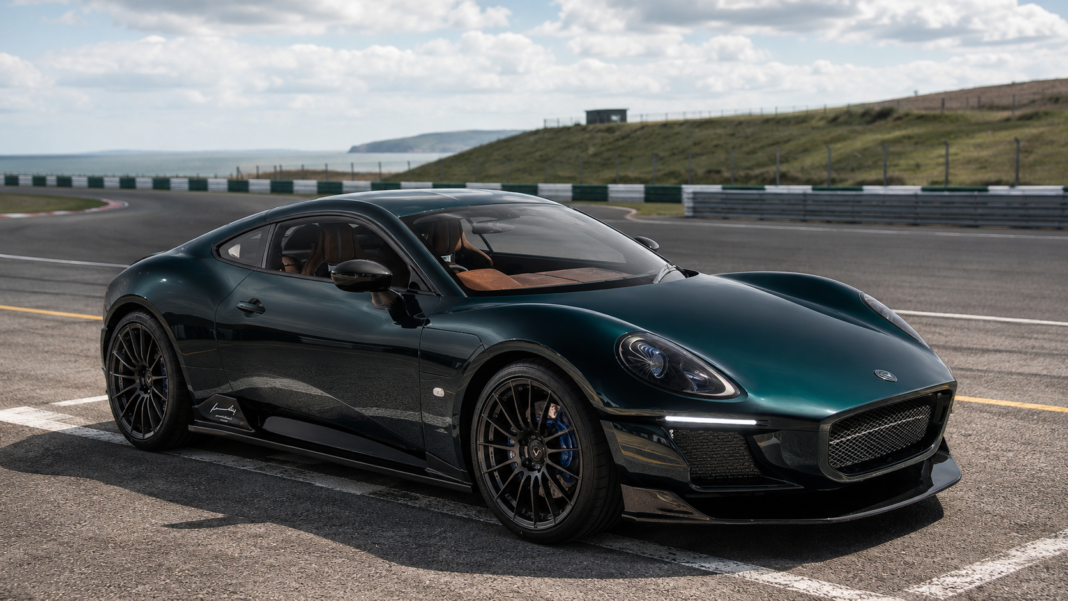
The sun is just beginning to burn through the coastal mist at the Anglesey Circuit in Wales. The track is quiet, but the air hums with anticipation. A car sits in the pit lane, its silhouette low and purposeful, its design unmistakably Caterham yet unlike anything the company has built before. This is the Caterham Project V, the British brand’s first electric car, and it represents the biggest gamble in the company’s history.
Caterham has built its reputation on a single, enduring formula: lightweight, simple, and pure. The Seven has been in continuous production for over 60 years, and it has never needed a roof, a radio, or a battery pack to deliver driving pleasure. But the Project V changes that. It is a coupe, with a fixed roof, four seats, and an electric motor supplied by Yamaha. It is a car that Caterham hopes will prove that electrification does not have to mean the end of driving engagement.
The Weight: The First Compromise
The Project V has been in development since 2022, and the journey has not been straightforward. The concept, unveiled in 2023, promised a weight of 1,190 kg and a 0-62 mph time of under 4.5 seconds. But the first running prototype, revealed at the Tokyo Auto Salon in January 2026, has told a different story.
The production-ready prototype weighs 1,430 kg, a significant increase from the target. The additional mass comes from the battery pack, which is a 47 kWh unit mounted in two packs, one behind the front seats and one ahead of the rear axle, to optimize weight distribution. The 0-62 mph time has slipped to under 5.0 seconds, a figure that is still respectable but no longer class-leading. The top speed is 143 mph, and the range is a claimed 249 miles.
The Powertrain: Yamaha Power, Caterham Tuning
The heart of the Project V is a rear-mounted electric motor supplied by Yamaha, producing 268 horsepower. The motor is a 400-volt e-axle that integrates the inverter, reduction gear, and motor into a single compact unit. It is a proven design, used in other applications, but Caterham has tuned it to suit the car’s character.
The motor’s power delivery is linear, with peak torque available from standstill. The car is rear-wheel drive, maintaining the traditional Caterham layout, and the torque vectoring system is calibrated to provide a playful, adjustable balance.
The Chassis: A New Direction
The Project V rides on a tubular spaceframe chassis, a departure from the Seven’s ladder frame. The suspension is independent, with double wishbones at the front and a multi-link setup at the rear. The body is made from carbon fiber, keeping weight to a minimum.
The design was penned by Anthony Jannarelly, a Seven owner and designer known for his work on the Ferrari SP3JC. The exterior is a modern interpretation of Caterham’s design language, with a long hood, a short rear deck, and a prominent oval grille. The interior is minimalist, with a flat dashboard reminiscent of the Seven, a circular digital display, and a 2+2 seating layout.
The Market: A Bold Price
The Project V is expected to cost approximately $135,000, placing it in direct competition with the Porsche 718 Cayman and the Alpine A110. It is a bold positioning, reflecting Caterham’s confidence in the car’s appeal. The Project V will be sold globally, including in the United States, a market that Caterham has traditionally neglected.
The Anglesey Morning
The Project V has completed its demonstration laps. Its Yamaha motor has delivered the 268 horsepower that makes it one of the most engaging electric cars on the road. The lightweight chassis and rear-wheel drive have kept it playful through the curves. The driver, cocooned in the minimalist cabin, has experienced a level of performance that is as exclusive as it is engaging.
The Project V is not a car for everyone. It is expensive, with a price that approaches that of a Porsche 911. It is a car that prioritizes driving engagement over comfort and convenience, and it is built in small numbers by hand. But it represents a significant moment in Caterham’s history. It is the car that proves the company can go electric without losing the plot, that the formula of lightweight, simple, and pure can survive a battery pack, and that the joy of driving can still be found in a car that is built by hand, driven with intent, and cherished as art.

