
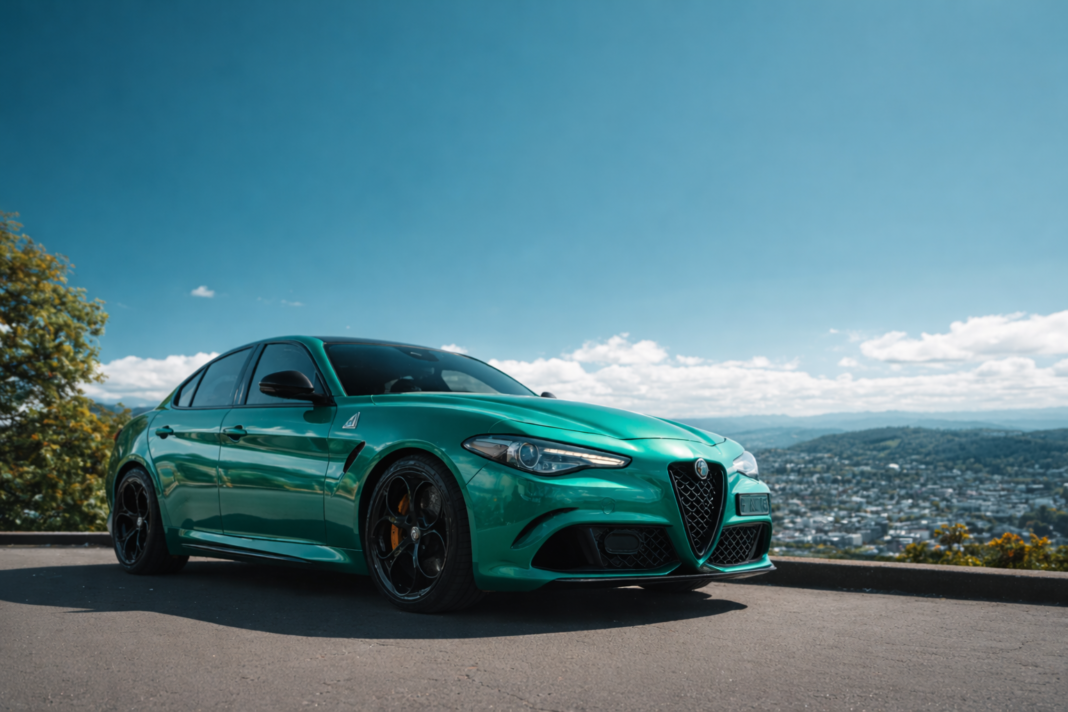
The Alfa Romeo Giulia Quadrifoglio has occupied a unique position in the sports sedan market since its debut in 2016. While German competitors from BMW, Mercedes-Benz, and Audi focused on all-wheel-drive turbocharged six-cylinder engines, Alfa Romeo took a different approach. The Quadrifoglio used a 2.9 liter twin-turbocharged V6 derived from Ferrari, rear-wheel drive, and a chassis tuned for driver engagement. It was a car that prioritized emotion over specification.
Nine years later, the Giulia Quadrifoglio remains in production, with updates for the 2026 model year that keep it competitive. The automotive world has changed significantly. Many competitors have moved toward electrification, downsizing, and all-wheel-drive defaults. The Quadrifoglio, with its Ferrari-derived V6, rear-wheel-drive layout, and Italian styling, continues to offer an alternative to the increasingly homogenized sports sedan segment.
This article provides a comprehensive examination of the Alfa Romeo Giulia Quadrifoglio, including its performance specifications, engineering, design, and why it remains one of the best driver sedans in 2026.
The Quadrifoglio Legacy
The Quadrifoglio name has a long history with Alfa Romeo. The four-leaf clover badge first appeared in 1923 on the RL driven by Ugo Sivocci, who added the symbol to his car for luck. He won the Targa Florio that year, and the badge became a symbol of Alfa Romeo’s high-performance models.
The modern Giulia Quadrifoglio is the latest in this lineage. It follows the 159, the 156, and the 75, each of which carried the Quadrifoglio badge and the expectation of class-leading performance. The Giulia Quadrifoglio was designed to compete with the BMW M3, the Mercedes-AMG C63, and the Audi RS4. It succeeded in that mission, winning multiple comparison tests and earning praise for its handling and character.
The 2026 model year updates include a new limited-slip differential, revised suspension tuning, and a digital instrument cluster. The exterior receives new headlight and taillight designs, and the interior gets updated materials and technology.
Powertrain: The Heart of the Quadrifoglio
The Ferrari-Derived V6
The Giulia Quadrifoglio is powered by a 2.9 liter twin-turbocharged V6 engine, designated the 690T. This engine is derived from the Ferrari F154 V8, with two cylinders removed. It shares the V8’s 90-degree V angle, its hot-vee turbocharger placement, and its advanced engine management systems.
The engine produces 505 horsepower at 6,500 rpm and 443 lb-ft of torque from 2,500 to 5,500 rpm. The redline is 7,000 rpm. The specific output is 174 horsepower per liter, one of the highest figures for a production six-cylinder engine.
The engine features a cross-plane crankshaft, which gives it a deeper, more traditional V6 sound than the flat-plane crankshafts used in some competitors. The sound is one of the Quadrifoglio’s defining characteristics, with a muscular growl at low speeds and a sharp, metallic wail as the revs climb.
Transmission and Drive
Power is transmitted to the rear wheels through an eight-speed automatic transmission. The transmission is a torque converter unit, not a dual-clutch, but it has been tuned for rapid shifts in dynamic mode. Shift times are measured in milliseconds, and the transmission can be operated in fully automatic mode or via paddle shifters mounted on the steering column.
The rear-wheel-drive layout is a deliberate choice. While most competitors have moved to all-wheel drive for traction and all-weather capability, Alfa Romeo has retained rear drive as a core part of the Quadrifoglio’s character. The car is equipped with an electronic rear differential that manages torque distribution between the rear wheels, maximizing traction during cornering.
Performance
The Giulia Quadrifoglio accelerates from 0 to 60 miles per hour in 3.8 seconds. The quarter mile is completed in approximately 12.0 seconds at 119 miles per hour. Top speed is 191 miles per hour.
These figures remain competitive with the latest BMW M3 and Mercedes-AMG C63, despite the Quadrifoglio’s aging platform.
Chassis and Dynamics
Carbon Fiber Components
The Giulia Quadrifoglio uses carbon fiber for several key components. The driveshaft is carbon fiber, reducing rotating mass and improving throttle response. The hood and roof are also carbon fiber, lowering the center of gravity and reducing weight.
The result is a curb weight of approximately 3,800 pounds. This is lighter than the BMW M3 Competition xDrive (approximately 4,000 pounds) and the Mercedes-AMG C63 S E Performance (approximately 4,600 pounds).
Suspension
The Giulia Quadrifoglio features a double-wishbone front suspension and a multi-link rear suspension, both constructed from lightweight aluminum. The system uses semi-active dampers that can adjust their characteristics based on driving mode and road conditions.
The suspension tuning is firm but not punishing. The car remains composed through corners, with minimal body roll and precise control over wheel motion. The steering is direct and communicative, providing feedback that is rare in modern electric power steering systems.
Brakes
The braking system uses high-performance discs with four-piston calipers at the front and single-piston calipers at the rear. Carbon ceramic brakes are available as an option, reducing unsprung weight and improving fade resistance during track use.
Drive Modes
The Giulia Quadrifoglio features four selectable drive modes: Dynamic, Natural, Advanced Efficiency, and Race. Race mode is the most aggressive, disabling the stability control system and allowing the driver full control over the car’s dynamics. In Race mode, the transmission holds gears to the redline, the throttle response is sharpest, and the exhaust valves open fully.
Design
Exterior Styling
The Giulia Quadrifoglio’s exterior design is subtle compared to its competitors. There are no massive wings or aggressive aero elements. The Quadrifoglio’s visual distinctions include larger air intakes in the front bumper, a carbon fiber hood with a central vent, side skirts, a rear diffuser with quad exhaust outlets, and a small trunk lid spoiler.
The 2026 update includes new matrix LED headlights with a revised signature, new taillights with a smoked lens, and a revised front grille. The Quadrifoglio badge remains on the front fender, and the four-leaf clover is displayed on the front fender and the C-pillar.
Interior Design
The interior of the Giulia Quadrifoglio is driver-focused. The dashboard features a digital instrument cluster with a 12.3-inch display, configurable to show performance data including horsepower and torque output. The central infotainment screen measures 8.8 inches, with wireless Apple CarPlay and Android Auto.
The seats are heavily bolstered to hold occupants during cornering, with leather and Alcantara upholstery. The Quadrifoglio logo is embroidered on the headrests. The steering wheel is flat-bottom, with a red start button and integrated controls for the car’s systems.
Materials and Craftsmanship
The interior materials are of good quality, with soft-touch surfaces and aluminum trim. However, some plastics and switchgear lag behind the best in the segment. The Quadrifoglio’s interior is more about function than luxury, with a focus on driver engagement over opulence.
Driving Experience
On Road Character
The Giulia Quadrifoglio is a car that rewards the driver. The steering is quick and precise, providing feedback that allows the driver to place the car accurately on the road. The suspension absorbs road imperfections without transmitting harshness to the cabin, but it is firm enough to control body motion through corners.
The engine is the star of the show. The 505 horsepower is available throughout the rev range, with strong low-end torque and a thrilling top end. The sound, with its deep growl and metallic wail, is engaging and distinctive. The eight-speed transmission is responsive in dynamic mode, with sharp downshifts that are accompanied by throttle blips.
On Track Behavior
When driven on a track, the Quadrifoglio reveals the depth of its engineering. The chassis is balanced and predictable, with a slight tendency toward oversteer at the limit that rewards skilled drivers. The electronic rear differential manages power delivery effectively, allowing the driver to get on the throttle early on corner exit.
The brakes provide consistent stopping power, though the optional carbon ceramics are recommended for sustained track use. The car’s weight is moderate, but the suspension tuning keeps it composed through high-speed corners.
The Sound
The Ferrari-derived V6 produces a sound that is among the best in the segment. At low speeds, it emits a deep, muscular growl. At high rpm, it produces a sharp, metallic wail that is both engaging and distinctive. The sound is not as loud as a naturally aspirated V8, but it has a character that sets it apart from turbocharged six-cylinder competitors.
How the Giulia Quadrifoglio Stacks Up Against Rivals
Against the BMW M3 Competition
The BMW M3 Competition is the Quadrifoglio’s most direct competitor. The current M3 uses a 3.0 liter twin-turbocharged inline-six producing 503 horsepower, with either rear-wheel drive or all-wheel drive.
The M3’s advantage is its technology and its refinement. The BMW’s interior is more modern, with higher quality materials and more advanced infotainment. The M3’s optional all-wheel-drive system provides traction that the rear-drive Quadrifoglio cannot match.
The Quadrifoglio’s advantage is its character and its engagement. The Alfa Romeo’s steering provides more feedback, its chassis is more playful, and its engine has a more distinctive sound. The Quadrifoglio is a car that feels alive, while the M3 can feel clinical.
Against the Mercedes-AMG C63 S E Performance
The Mercedes-AMG C63 S E Performance is a plug-in hybrid with a 2.0 liter turbocharged four-cylinder and an electric motor, producing a combined 671 horsepower.
The C63’s advantage is its power and its technology. With 671 horsepower, the Mercedes produces 166 more horsepower than the Quadrifoglio. The plug-in hybrid system also provides electric-only range.
The Quadrifoglio’s advantage is its weight and its character. The C63 weighs more than 4,600 pounds, nearly 800 pounds heavier than the Quadrifoglio. The Alfa Romeo’s V6 also provides a sound and a character that the four-cylinder hybrid cannot match.
Against the Audi RS5
The Audi RS5 uses a 2.9 liter twin-turbocharged V6 producing 444 horsepower, with standard all-wheel drive.
The RS5’s advantage is its all-weather capability and its daily usability. The Audi’s interior is more luxurious, its ride is more compliant, and its all-wheel-drive system provides traction in all conditions.
The Quadrifoglio’s advantage is its power and its engagement. With 505 horsepower, the Alfa Romeo produces 61 more horsepower than the Audi. The Quadrifoglio’s rear-wheel-drive layout also provides a more engaging driving experience.
Against the Cadillac CT5 V Blackwing
The Cadillac CT5 V Blackwing is an American sports sedan with a 6.2 liter supercharged V8 producing 668 horsepower, with a six-speed manual transmission available.
The CT5’s advantage is its power and its manual transmission. With 668 horsepower, the Cadillac produces 163 more horsepower than the Quadrifoglio. The available manual transmission is a rarity in the segment.
The Quadrifoglio’s advantage is its weight and its handling. The CT5 is larger and heavier than the Giulia, and its chassis is less agile. The Alfa Romeo’s steering and suspension tuning also provide a level of feedback that the Cadillac cannot match.
Value Proposition
Pricing
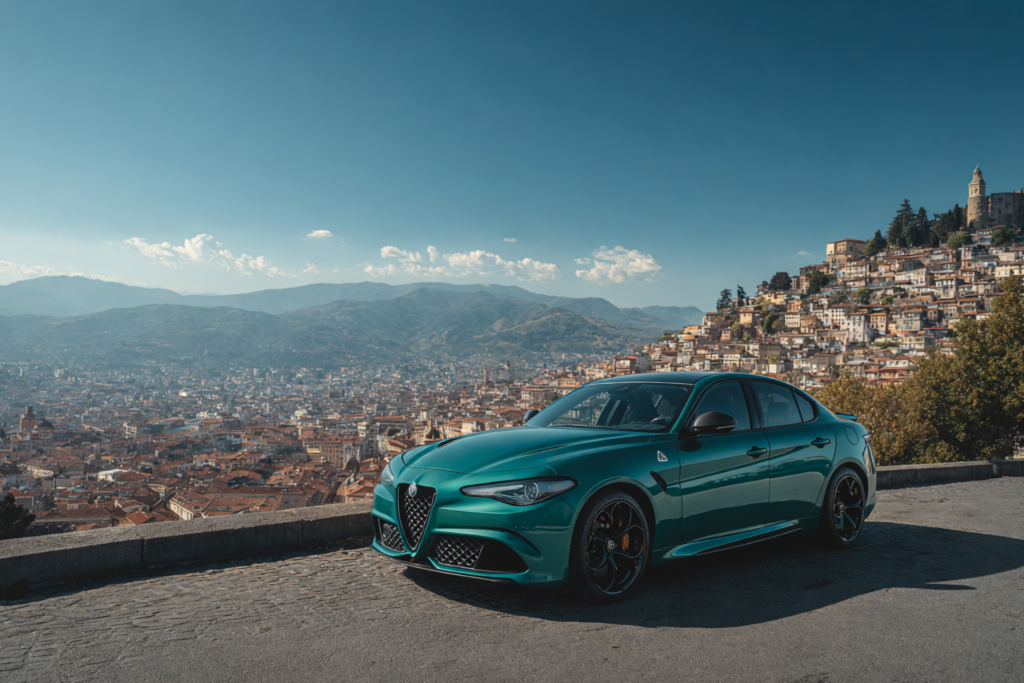
The Alfa Romeo Giulia Quadrifoglio carries a base price of approximately $80,000. This pricing places it below the BMW M3 Competition ($85,000) and the Mercedes-AMG C63 S E Performance ($90,000), making it a value-oriented option in the segment.
Depreciation
Alfa Romeos have traditionally depreciated faster than German competitors. The Giulia Quadrifoglio’s depreciation curve has been steeper than the M3’s, though recent trends suggest that the car’s character and limited production numbers may help it hold value better than standard Giulias.
Ownership Costs
Maintaining a Giulia Quadrifoglio involves higher costs than standard Alfa Romeos. The Ferrari-derived engine requires specialized service, and parts can be more expensive than for German competitors. However, the car’s relative simplicity compared to hybrid competitors may reduce long-term complexity.
The Quadrifoglio’s Future
Electrification Plans
Alfa Romeo has announced plans to transition to an all-electric lineup by 2027. The Giulia’s successor will be an electric vehicle, and the Quadrifoglio name will likely carry over to a high-performance EV.
The current Quadrifoglio is the last of its kind: a Ferrari-derived V6, rear-wheel-drive, internal combustion sports sedan. For enthusiasts who value this formula, the remaining production years represent a final opportunity to experience a disappearing breed.
Limited Production
Alfa Romeo has not announced an end date for Giulia Quadrifoglio production, but the 2026 model year is expected to be near the end of the car’s life cycle. Buyers interested in a new Quadrifoglio should consider ordering soon, as production numbers are limited.
Specifications Summary
| Specification | Value |
|---|---|
| Engine | 2.9L twin-turbocharged V6 |
| Horsepower | 505 hp at 6,500 rpm |
| Torque | 443 lb-ft from 2,500 to 5,500 rpm |
| Transmission | 8-speed automatic |
| Drive | Rear wheel drive |
| 0-60 mph | 3.8 seconds |
| Top Speed | 191 mph |
| Weight | 3,800 lb |
| Carbon Fiber Components | Driveshaft, hood, roof |
| Base Price | $80,000 |
Conclusion
The Alfa Romeo Giulia Quadrifoglio remains one of the best driver sedans in 2026. Its Ferrari-derived 2.9 liter twin-turbocharged V6 produces 505 horsepower and a sound that is among the best in the segment. Its rear-wheel-drive layout and chassis tuning provide a level of engagement that all-wheel-drive competitors cannot match. Its carbon fiber components keep weight lower than newer, larger competitors.
Against its rivals, the Quadrifoglio holds its own. It offers more character than the BMW M3 Competition, more engagement than the Mercedes-AMG C63 S E Performance, more power than the Audi RS5, and more agility than the Cadillac CT5 V Blackwing. It is not the most technologically advanced car in its class, nor the most luxurious, nor the most practical. But it is one of the most rewarding to drive.
The Quadrifoglio is also the last of its kind. Alfa Romeo’s transition to electric vehicles means that the current Giulia Quadrifoglio is the final internal combustion sports sedan from the brand. For enthusiasts who value the Ferrari-derived V6, the rear-wheel-drive layout, and the Italian character, the Quadrifoglio represents a final opportunity to experience a disappearing formula.
For buyers seeking a sports sedan that prioritizes driver engagement above all else, the Alfa Romeo Giulia Quadrifoglio makes a compelling case. It is Italy’s ultimate sports sedan, and it remains one of the best driver sedans on the market.

