
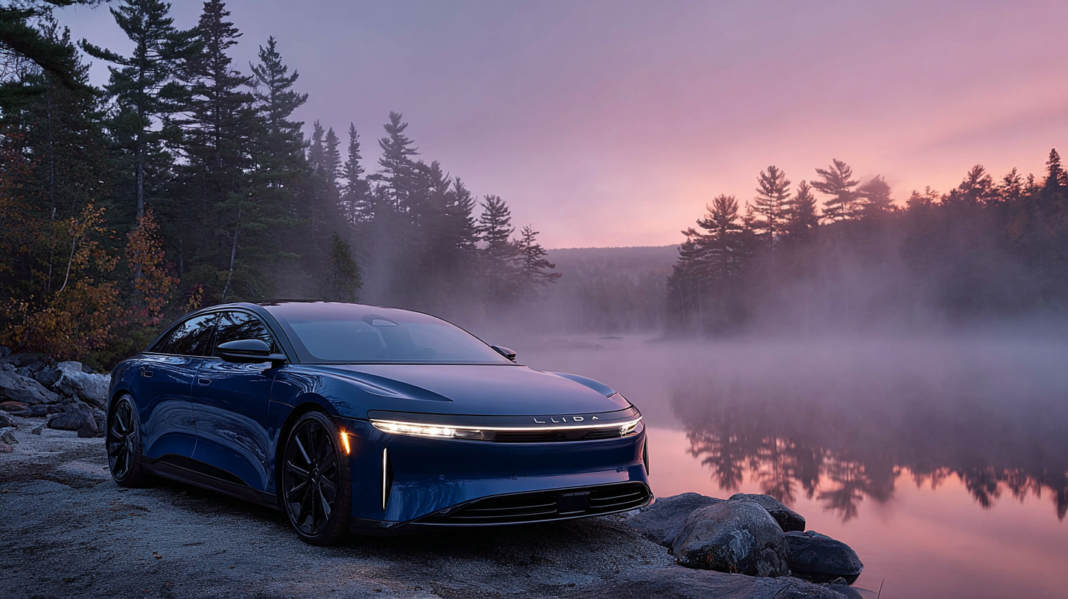
The question of whether electric vehicles can compete with traditional supercars has been debated since the first high performance EVs began appearing. Early electric performance cars offered impressive acceleration figures but often fell short in areas like sustained track performance, handling precision, and the emotional engagement that enthusiasts value. The Lucid Air Sapphire was designed to answer this question definitively.
Introduced as the high performance variant of the Lucid Air sedan, the Sapphire represents the most extreme expression of Lucid’s engineering capabilities. With 1,234 horsepower, a three motor powertrain, and a chassis tuned for track use, it is a car that challenges the notion that EVs are merely quick in a straight line. It is a car designed to compete with the best from Ferrari, Lamborghini, and Porsche, not just on paper but on the road and the track.
This article provides a comprehensive review of the Lucid Air Sapphire, examining its performance specifications, design philosophy, interior accommodations, and how it stacks up against rivals in performance, design, and value.
The Lucid Philosophy: Engineering First
Lucid Motors was founded with a clear mission: to create electric vehicles that advance the state of the art through engineering excellence. The company’s first model, the Air sedan, established a benchmark for efficiency, range, and power density. The Sapphire takes this foundation and applies it to performance, demonstrating that electric vehicles can deliver not only straight line speed but also the handling, braking, and track capability that define supercars.
The Sapphire was developed with input from Lucid’s engineering team, many of whom have backgrounds in Formula One, IndyCar, and high performance automotive engineering. The car was tested extensively on race tracks, including Laguna Seca, where it set production sedan lap records. The goal was not simply to create a fast electric car but to create a car that could compete with the best internal combustion supercars on any metric.
Powertrain and Performance
Three Motor Configuration
The Lucid Air Sapphire is powered by a three motor powertrain, with one motor at the front axle and two motors at the rear. This configuration provides all wheel drive with independent torque control at each rear wheel, enabling sophisticated torque vectoring capabilities.
The front motor produces 375 horsepower, while the two rear motors produce 860 horsepower combined, for a total system output of 1,234 horsepower. The torque figure is 1,430 lb ft, a staggering number that contributes to the car’s acceleration.
Battery and Range
Power is drawn from a 118 kWh battery pack, the same unit used in the Lucid Air Grand Touring. Despite the Sapphire’s performance focus, the car retains impressive range, with an EPA estimated 427 miles. This range figure is exceptional for a vehicle with this level of power, demonstrating the efficiency of Lucid’s powertrain.
Acceleration and Speed
The Sapphire accelerates from 0 to 60 miles per hour in 1.89 seconds, making it one of the quickest production vehicles ever tested. The 0 to 100 miles per hour sprint takes approximately 3.8 seconds, and the quarter mile is completed in 9.1 seconds at 154 miles per hour.
Top speed is 205 miles per hour, a figure that reflects the car’s aerodynamic development and the capability of its powertrain.
Weight and Balance
The Air Sapphire weighs approximately 5,200 pounds, a figure that reflects the size of the battery pack, the three motors, and the luxury equipment. Despite this weight, the car’s low center of gravity, provided by the battery mounted in the floor, and its sophisticated suspension tuning allow it to handle with remarkable agility.
The weight distribution is approximately 48 percent front, 52 percent rear, contributing to the car’s balanced handling.
Chassis and Dynamics
Suspension System
The Air Sapphire features an adaptive suspension system with air springs and continuously variable dampers. The system can adjust ride height and damping characteristics in milliseconds based on road conditions and driving mode. The Sapphire specific tuning includes stiffer spring rates, revised damper calibration, and a 0.4 inch lower ride height compared to other Air models.
The suspension provides a range of behavior, from compliant for daily driving to firm for track use. The car’s body control is exceptional, with minimal roll through corners and stable behavior under hard braking.
Steering
The electric power steering is calibrated for the Sapphire’s performance focus. The system provides appropriate weighting and feedback, with a level of communication that is good for an electric system. The steering ratio is quick, requiring minimal input to change direction.
Brakes
The braking system is one of the Sapphire’s most significant upgrades over other Air models. The car features carbon ceramic brakes with 15.7 inch front discs and six piston calipers, and 15.4 inch rear discs with four piston calipers. The system provides exceptional stopping power, with consistent pedal feel and resistance to fade during track use.
The regenerative braking system is integrated with the friction brakes through a brake by wire system that maintains consistent pedal feel regardless of the regeneration level.
Wheels and Tires
The Sapphire rides on 20 inch front wheels and 21 inch rear wheels, wrapped in Michelin Pilot Sport 4S tires. The tire sizes are 265/35 ZR20 front and 295/30 ZR21 rear. The tires are developed specifically for the Sapphire, with a compound and construction that provide the grip necessary for the car’s performance.
Aerodynamics
The Sapphire features a specific aerodynamic package that distinguishes it from other Air models. The front end incorporates a more aggressive splitter and larger air intakes that feed cooling air to the motors and brakes. The rear end features a fixed carbon fiber wing that provides downforce at the rear axle, and a redesigned diffuser that manages airflow under the car.
The car’s drag coefficient is 0.21, a figure that is exceptionally low for a performance vehicle and contributes to the car’s range and top speed.
Design
Exterior Styling
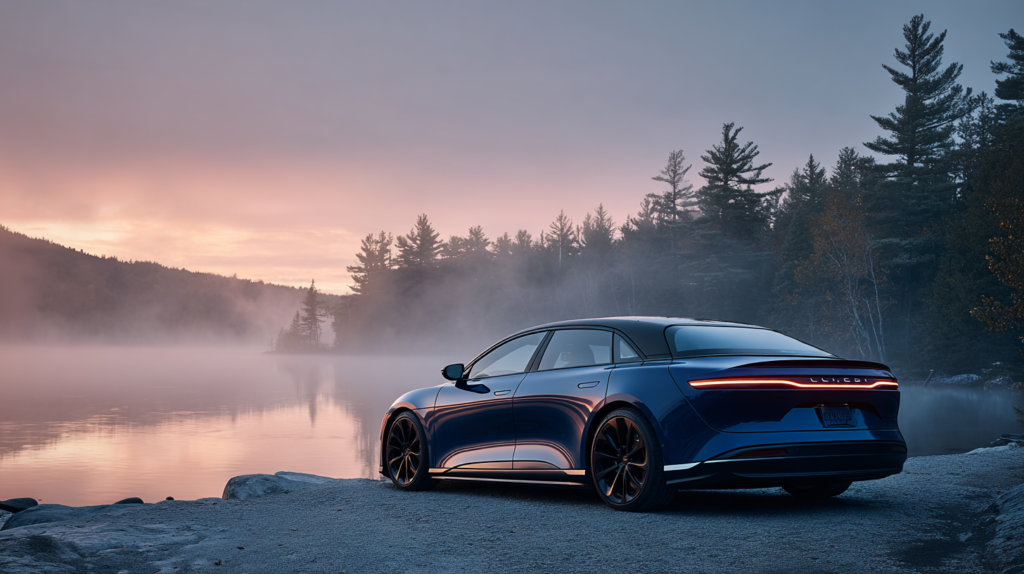
The Lucid Air Sapphire’s exterior design builds on the elegant foundation of the standard Air, adding performance oriented details that signal its capabilities. The front end features a larger grille opening and carbon fiber trim, while the side skirts are more pronounced. The rear end features the fixed carbon fiber wing, a carbon fiber diffuser, and unique badging.
The Sapphire is offered in a range of exterior colors, including the exclusive Sapphire Blue that is unique to the model. Other colors include white, black, silver, and gray.
Interior Design
The interior of the Air Sapphire reflects the car’s dual personality as both a luxury sedan and a performance machine. The seats are heavily bolstered to hold occupants during cornering, with leather and Alcantara upholstery. The front seats are power adjustable with heating, cooling, and massage functions.
The dashboard features the same 34 inch curved Glass Cockpit display found in other Air models, with a 12.3 inch central screen for infotainment functions. The Sapphire specific details include unique stitching, carbon fiber trim, and Sapphire badging on the seats and door sills.
Technology Features
The Air Sapphire is equipped with a comprehensive suite of technology features. The infotainment system includes navigation, Apple CarPlay, Android Auto, and a premium audio system. The digital instrument cluster can be configured to display performance data, including g forces, lap times, and power output.
Driver assistance features include adaptive cruise control, lane keeping assistance, blind spot monitoring, and automatic emergency braking.
Driving Experience
On Road Character
The Lucid Air Sapphire is a car that defies expectations. Despite its 1,234 horsepower and 1.89 second 0 to 60 time, it is civil and refined in normal driving. The suspension absorbs road imperfections without transmitting harshness to the cabin, and the cabin is quiet enough for conversation. The car is comfortable enough for daily driving, with a ride quality that is exceptional for a performance vehicle.
When the driver presses the accelerator, the character transforms. The acceleration is immediate and relentless, pushing occupants into their seats with force that is difficult to describe. The car reaches triple digit speeds in the time it takes to merge onto a highway, and the power is delivered with a smoothness that internal combustion engines cannot match.
On Track Behavior
When driven on a track, the Air Sapphire reveals the depth of its engineering. The brakes provide consistent stopping power lap after lap, with a pedal feel that inspires confidence. The chassis remains composed through corners, with the torque vectoring system managing power delivery to maximize grip.
The car’s weight is evident during hard cornering, but the low center of gravity and the sophisticated suspension tuning allow it to handle with agility that belies its mass. The car is balanced and predictable, with a slight tendency toward understeer at the limit that builds driver confidence.
The Sound Question
The Air Sapphire does not attempt to fake the sound of an internal combustion engine. Instead, it offers the characteristic whine of its electric motors under load, the rush of air over the bodywork, and the protest of tires at the limit. For drivers who value the sensory aspects of driving, this soundscape provides its own form of feedback.
How the Air Sapphire Stacks Up Against Rivals
Against the Porsche Taycan Turbo GT
The Porsche Taycan Turbo GT is the Air Sapphire’s most direct competitor. It is a four door electric sedan with a 1,092 horsepower, a two speed transmission, and a track focused chassis.
The Taycan Turbo GT’s advantage is its handling. Porsche’s chassis tuning is widely regarded as the benchmark in the electric performance segment, and the Taycan’s steering, suspension, and brake feel are exceptional. The car’s track performance is proven, with lap records at multiple circuits.
The Air Sapphire’s advantage is its power and its range. The Lucid produces 142 more horsepower than the Taycan, and its 427 mile range is significantly higher than the Taycan’s approximately 300 miles. The Sapphire’s acceleration is also quicker, with a 1.89 second 0 to 60 time compared to the Taycan’s approximately 2.2 seconds.
In value terms, the two cars are closely priced, with the Sapphire carrying a slight premium over the Taycan Turbo GT.
Against the Tesla Model S Plaid
The Tesla Model S Plaid is the Air Sapphire’s most obvious competitor, with a three motor powertrain producing 1,020 horsepower and a 0 to 60 time of 1.99 seconds.
The Model S Plaid’s advantage is its price. The Tesla starts at approximately $90,000, less than half the price of the Sapphire. The car also offers access to Tesla’s extensive Supercharger network, which provides reliable fast charging across the country.
The Air Sapphire’s advantage is its refinement and its performance. The Lucid’s interior is significantly more luxurious than the Tesla’s, with higher quality materials and more comfortable seats. The Sapphire’s handling and braking are also superior, with a level of track capability that the Model S Plaid cannot match.
Against the Ferrari SF90 Stradale
The Ferrari SF90 Stradale is a plug in hybrid supercar with a 4.0 liter twin turbocharged V8 and three electric motors, producing a combined 986 horsepower.
The Ferrari’s advantage is its character and its brand cachet. The SF90’s V8 engine produces a sound and a sensation that electric cars cannot replicate, and the Ferrari badge carries a prestige that few manufacturers can match.
The Air Sapphire’s advantage is its power and its practicality. The Lucid produces 248 more horsepower than the Ferrari, and its four door sedan body style offers far more passenger and cargo space. The Sapphire’s range is also significantly higher, making it more practical for long distance travel.
Against the Lamborghini Revuelto
The Lamborghini Revuelto is a plug in hybrid supercar with a 6.5 liter V12 and three electric motors, producing a combined 1,001 horsepower.
The Revuelto’s advantage is its drama. The V12 engine, the scissor doors, the aggressive styling all of these elements create an experience that is visceral and emotional. The car is designed to be a spectacle, and it delivers.
The Air Sapphire’s advantage is its efficiency and its usability. The Lucid is more refined, more comfortable, and more practical than the Revuelto. The Sapphire’s acceleration is also quicker, and its range is effectively unlimited compared to the Lamborghini’s limited electric range.
Against the Rimac Nevera
The Rimac Nevera is an all electric hypercar with four motors producing 1,914 horsepower. It is one of the most powerful and fastest production cars ever built.
The Nevera’s advantage is its sheer performance. The car’s acceleration, top speed, and handling are at the absolute pinnacle of what is possible. The Nevera is a limited edition hypercar designed for collectors and enthusiasts who want the ultimate electric performance machine.
The Air Sapphire’s advantage is its practicality and its price. The Lucid starts at approximately $250,000, less than one third the price of the Nevera. The Sapphire also offers four doors, a spacious interior, and a trunk, making it a car that can be used for daily driving as well as weekend adventures.
Value Proposition
Pricing
The Lucid Air Sapphire carries a base price of approximately $250,000. This pricing places it in the upper tier of the electric performance sedan segment, above the Porsche Taycan Turbo GT and far above the Tesla Model S Plaid.
Depreciation
Lucid is a new brand, and the long term depreciation of its vehicles is not yet established. Early indications suggest that the Air Sapphire, as a limited production halo model, may hold its value better than standard Air models. The car’s performance and exclusivity should help preserve its value over time.
Ownership Costs
Maintaining an Air Sapphire involves lower costs than internal combustion supercars. There are no oil changes, no spark plugs, and no engine air filters. The brake pads are expected to last longer than those on internal combustion cars due to regenerative braking. The tires, sized 265/35 ZR20 front and 295/30 ZR21 rear, are expensive to replace, and the carbon ceramic brakes carry significant replacement costs.
The Experience Factor
For many buyers, the Air Sapphire’s value proposition extends beyond financial considerations. The car’s performance, its technology, and its role as a flagship for the Lucid brand are factors that cannot be quantified on a spreadsheet.
Specifications Summary
| Specification | Value |
|---|---|
| Motors | 3 motor (1 front, 2 rear) |
| Horsepower | 1,234 hp |
| Torque | 1,430 lb ft |
| Battery | 118 kWh |
| Range | 427 miles |
| 0-60 mph | 1.89 seconds |
| Quarter Mile | 9.1 seconds at 154 mph |
| Top Speed | 205 mph |
| Weight | 5,200 lb |
| Base Price | $250,000 |
Conclusion
The Lucid Air Sapphire answers the question of whether electric vehicles can keep up with supercars with a definitive yes. It accelerates quicker than a Ferrari SF90 Stradale, handles with composure on track, and offers range and practicality that no internal combustion supercar can match. Its 1,234 horsepower, 1.89 second 0 to 60 time, and 427 mile range place it at the pinnacle of the electric performance segment.
Against its rivals, the Sapphire holds its own. It offers more power than the Porsche Taycan Turbo GT, more refinement than the Tesla Model S Plaid, more practicality than the Ferrari SF90 Stradale and Lamborghini Revuelto, and more value than the Rimac Nevera. It is a car that can be driven to the track, set competitive lap times, and drive home in comfort.
The Sapphire is not the most dramatic car in its class; it lacks the V12 roar of a Lamborghini or the prancing horse badge of a Ferrari. But it offers a level of performance and refinement that is difficult to find elsewhere. For buyers who value acceleration, efficiency, and usability, the Lucid Air Sapphire makes a compelling case.
In 2026, as the automotive industry continues its transition toward electrification, the Air Sapphire stands as proof that electric vehicles can not only keep up with supercars but exceed them in many ways. It is a car that challenges assumptions, pushes boundaries, and demonstrates that the future of performance is electric.

