
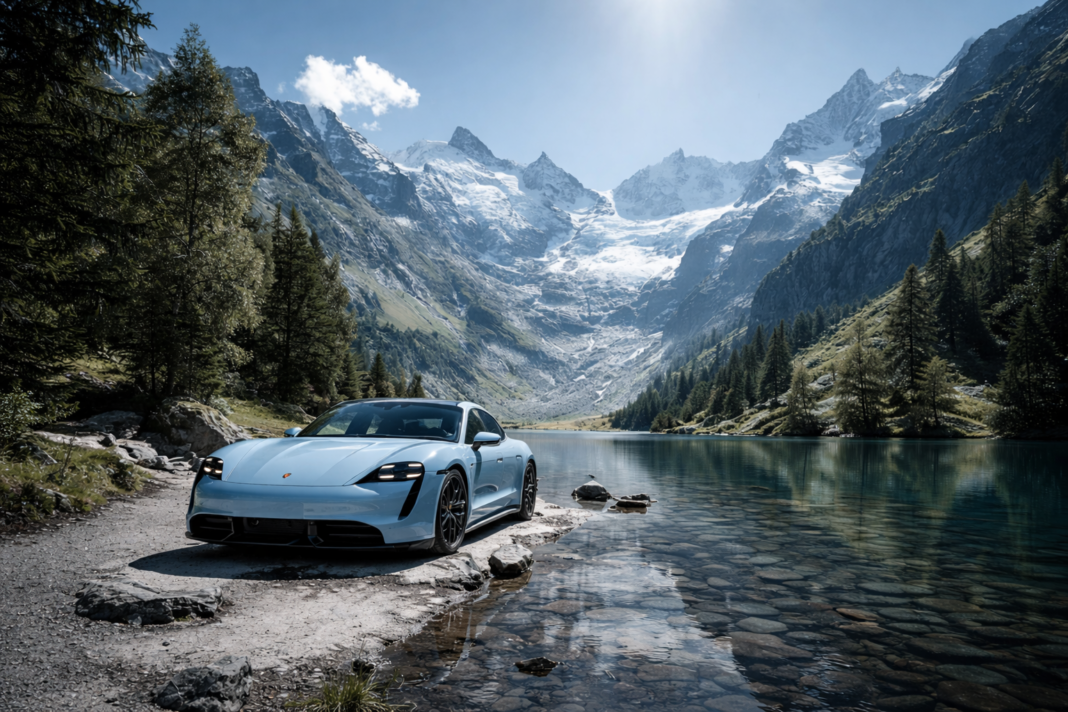
The Porsche Taycan has been a landmark vehicle for the brand since its introduction in 2019. It was Porsche’s first fully electric vehicle, a car that proved that zero emissions did not mean zero character. The Taycan combined the handling precision that Porsche is known for with the instant torque and efficiency of electric power, establishing a new benchmark for the luxury electric sedan segment.
The Taycan Turbo GT takes this formula to its logical extreme. Introduced as the most powerful and fastest accelerating production Porsche ever built, the Turbo GT represents the pinnacle of Porsche’s electric performance engineering. With 1,092 horsepower, a 0 to 60 time of 2.1 seconds, and a top speed of 180 miles per hour, it is a car that redefines what an electric vehicle can be.
This article provides a comprehensive review of the Porsche Taycan Turbo GT, examining its performance specifications, engineering, design, and what makes it the fastest Porsche EV yet.
The Taycan Evolution
The Taycan lineup has expanded significantly since the original model’s debut. From the base rear drive Taycan to the performance oriented Turbo S, each variant has offered a different balance of power, range, and capability. The Turbo GT represents the apex of this evolution, a car designed for enthusiasts who want the ultimate expression of Porsche electric performance.
The Turbo GT was developed with input from Porsche’s motorsport division, and it benefits directly from the lessons learned in Formula E and other racing programs. The car’s powertrain, chassis, and aerodynamics are all optimized for track performance, making it the most capable Taycan ever built.
Powertrain: The Most Powerful Porsche Ever
Motor Configuration
The Taycan Turbo GT is powered by a dual motor setup, with one motor at the front axle and one at the rear. The system uses Porsche’s permanent magnet synchronous motors, which are designed for high power density and efficiency.
The rear motor is the most powerful ever fitted to a production Porsche. It uses a new silicon carbide inverter that improves efficiency and allows for higher current flow. The result is a peak power output of 1,092 horsepower in launch control mode, with a maximum torque figure of 1,111 lb ft.
Boost Function
The Turbo GT features a push to pass boost function that provides an additional 184 horsepower for short periods. The system is activated through a button on the steering wheel, and it provides the extra power for approximately 10 seconds. This function is designed for track use, allowing the driver to access maximum power for overtaking or accelerating out of corners.
Battery and Charging
The Turbo GT uses a 105 kWh battery pack, the largest ever fitted to a Taycan. The battery is designed for high power delivery, with a focus on maintaining performance during sustained track use. The cell chemistry is optimized for power density rather than energy density, reflecting the car’s performance focus.
The battery can be charged at up to 320 kW, allowing a 10 to 80 percent charge in approximately 18 minutes under ideal conditions. The range is rated at approximately 290 miles on the WLTP cycle, a figure that is sufficient for track days and longer journeys.
Performance: Numbers That Define a New Class
Acceleration
The Taycan Turbo GT accelerates from 0 to 60 miles per hour in 2.1 seconds with the launch control system engaged. The 0 to 100 miles per hour sprint takes approximately 4.9 seconds. The quarter mile is completed in approximately 9.4 seconds at 145 miles per hour.
These figures make the Turbo GT the fastest accelerating production Porsche ever built, surpassing the 918 Spyder hybrid hypercar and every other model in the company’s history.
Top Speed
The top speed is 180 miles per hour, a figure that is limited by the car’s aerodynamic profile and the gearing of the transmission. For the Weissach Package version, which removes the rear seats and adds aerodynamic elements, the top speed is 190 miles per hour.
Track Performance
The Taycan Turbo GT set a lap time of 7 minutes 7.55 seconds at the Nürburgring Nordschleife, making it the fastest four door electric vehicle to lap the circuit. The time is also faster than many dedicated sports cars and supercars, demonstrating the car’s track capability.
The car’s performance at the Nürburgring is a testament to its engineering. The combination of the high power output, the advanced cooling system, and the chassis tuning allows the Turbo GT to sustain performance lap after lap, a challenge that has traditionally been difficult for electric vehicles.
Chassis and Dynamics
Suspension System
The Turbo GT features Porsche’s adaptive air suspension with Porsche Active Suspension Management. The system can adjust damping characteristics in milliseconds based on road conditions and driving mode, providing a balance of comfort for road use and control for track driving.
The suspension is tuned specifically for the Turbo GT, with stiffer springs, revised damper calibration, and a lower ride height compared to other Taycan models. The car sits approximately 10 millimeters lower than the Taycan Turbo S, lowering the center of gravity and improving aerodynamic efficiency.
Rear Axle Steering
Rear axle steering is standard on the Turbo GT, a feature that improves maneuverability at low speeds and stability at high speeds. The system can turn the rear wheels up to 2.8 degrees in the opposite direction to the front wheels at low speeds, reducing the turning circle, and in the same direction at high speeds, enhancing stability.
Braking System
The braking system uses Porsche’s Surface Coated Brake discs, which are an alternative to traditional carbon ceramic brakes. The discs are coated with tungsten carbide, providing improved braking performance, reduced wear, and less brake dust compared to standard steel discs. The system is paired with ten piston front calipers and four piston rear calipers.
The regenerative braking system, controlled by the electric motors, captures energy during deceleration and can provide up to 0.5 g of deceleration without engaging the friction brakes. The integration between regenerative and friction braking is managed by a brake by wire system that maintains consistent pedal feel regardless of the regeneration level.
Wheels and Tires
The Turbo GT rides on 21 inch wheels as standard, with 20 inch front and 21 inch rear wheels available as an option. The tires are developed specifically for the Turbo GT, with a compound and construction that provide the grip necessary for the car’s performance.
The Weissach Package adds a set of lightweight wheels that reduce unsprung weight by approximately 10 kilograms. The wheels are finished in a unique color and are paired with track focused tires.
Aerodynamics
Active Aerodynamics
The Taycan Turbo GT features an active rear spoiler that adjusts its angle based on speed and driving mode. The spoiler is designed to provide downforce without excessive drag, balancing stability and efficiency.
The front end incorporates an active cooling system that opens and closes based on thermal demands. The system improves aerodynamic efficiency when cooling is not needed, reducing drag and increasing range.
Weissach Package Aerodynamics
The Weissach Package adds a range of aerodynamic enhancements. The package includes a fixed rear wing, a more aggressive front splitter, and underbody aero elements that increase downforce by approximately 15 percent compared to the standard Turbo GT.
The fixed wing is adjustable, allowing drivers to tailor the downforce balance to suit different tracks and conditions. The wing is constructed from carbon fiber, keeping weight to a minimum while providing the necessary structural rigidity.
Design
Exterior Styling
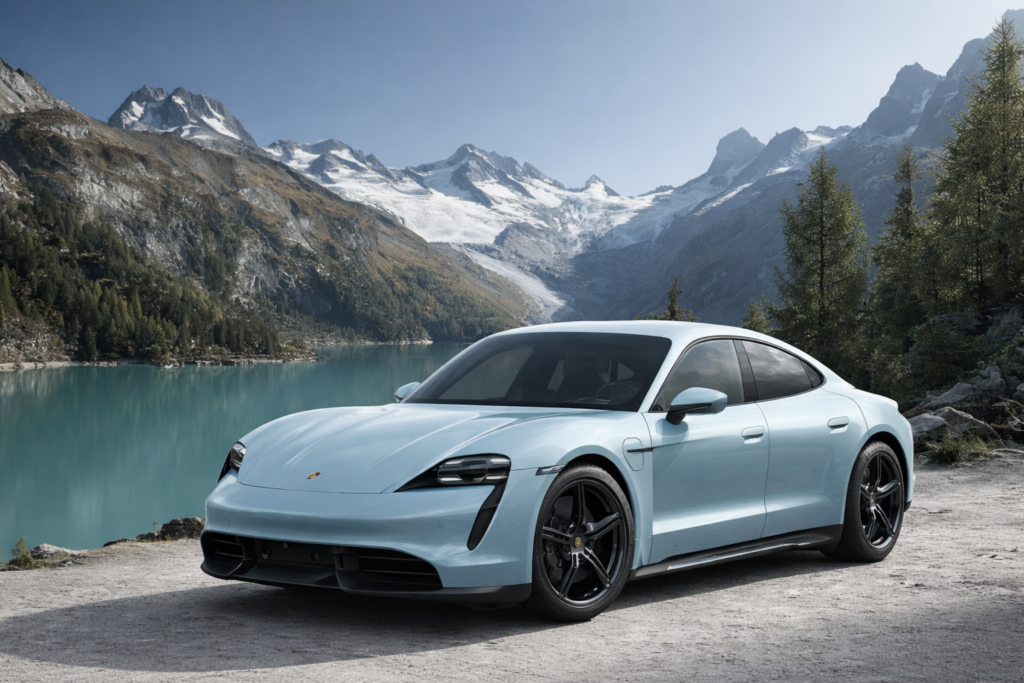
The Taycan Turbo GT builds on the elegant design of the standard Taycan, with several distinctive elements that signal its performance capabilities. The front end features a revised bumper with larger air intakes and a more aggressive splitter. The side skirts are more pronounced, and the rear diffuser is larger and more complex.
The Turbo GT is available with a range of unique colors, including the exclusive Victory Blue that was used on the car’s reveal. The Weissach Package adds carbon fiber components for the front splitter, side skirts, and rear wing.
Interior Design
The interior of the Turbo GT reflects the car’s performance focus. The seats are heavily bolstered to hold occupants during cornering, with leather and Alcantara upholstery. The seats are power adjustable with heating and ventilation.
The dashboard features a curved digital instrument cluster and a central touchscreen that handles infotainment functions. The passenger has a dedicated touchscreen that provides access to vehicle information and entertainment.
Weissach Package Interior
The Weissach Package removes the rear seats and replaces them with a lightweight storage compartment. The package also adds carbon fiber trim throughout the cabin and removes the electric seat adjustment from the front seats, reducing weight.
The result is a weight reduction of approximately 40 kilograms compared to the standard Turbo GT, contributing to improved acceleration and handling.
Driving Experience
On Road Character
The Taycan Turbo GT is surprisingly civil for a car with 1,092 horsepower. In normal driving modes, the suspension is compliant, the cabin is quiet, and the power delivery is smooth and progressive. The car can be driven in electric only mode for short distances, making it suitable for urban environments.
When the driver selects Sport Plus mode, the character transforms. The suspension stiffens, the throttle response sharpens, and the rear spoiler extends. The car accelerates with a force that pushes occupants into their seats, and the sound, while not the roar of a combustion engine, provides feedback about power delivery.
On Track Behavior
When driven on a track, the Taycan Turbo GT reveals the depth of its engineering. The brakes provide consistent stopping power lap after lap, with a pedal feel that inspires confidence. The chassis remains composed through corners, with the rear axle steering and torque vectoring system managing power delivery to maximize grip.
The car’s weight is evident during hard cornering, but the low center of gravity and the sophisticated suspension tuning allow it to handle with agility that belies its mass. The push to pass boost function provides additional power for overtaking, and the cooling system maintains performance throughout a full session.
The Sound
The Taycan Turbo GT does not attempt to fake the sound of a combustion engine. Instead, it offers the characteristic whine of its electric motors under load, the rush of air over the bodywork, and the protest of tires at the limit. For drivers who value the sensory aspects of driving, this soundscape provides its own form of feedback.
How the Taycan Turbo GT Stacks Up Against Rivals
Against the Tesla Model S Plaid
The Tesla Model S Plaid is the Taycan Turbo GT’s most obvious competitor, with a three motor powertrain producing 1,020 horsepower and a 0 to 60 time of 1.99 seconds.
The Model S Plaid’s advantage is its acceleration and its range. The Tesla is slightly quicker to 60 miles per hour, and its range of approximately 400 miles exceeds the Taycan’s. The car also offers access to Tesla’s extensive Supercharger network.
The Taycan Turbo GT’s advantage is its handling and its track capability. The Porsche’s chassis tuning, steering feel, and brake performance are superior to the Tesla’s, and the car’s ability to sustain performance on track sets it apart. The Taycan’s interior is also more luxurious, with higher quality materials and more advanced technology.
Against the Lucid Air Sapphire
The Lucid Air Sapphire is a four door electric sedan with a three motor powertrain producing 1,234 horsepower and a 0 to 60 time of 1.89 seconds.
The Air Sapphire’s advantage is its power and its range. The Lucid produces 142 more horsepower than the Taycan, and its 427 mile range is significantly higher. The interior is also more spacious, with a focus on luxury and comfort.
The Taycan Turbo GT’s advantage is its track performance and its brand heritage. The Porsche’s chassis tuning and brake performance are superior to the Lucid’s, and the car’s ability to perform on track is proven by its Nürburgring lap time. The Taycan also benefits from Porsche’s decades of motorsport experience.
Against the Rimac Nevera
The Rimac Nevera is a hypercar with a four motor powertrain producing 1,914 horsepower and a 0 to 60 time of 1.85 seconds.
The Nevera’s advantage is its sheer performance. The car’s acceleration, top speed, and handling are at the absolute pinnacle of what is possible. The Nevera is a limited edition hypercar designed for collectors and enthusiasts.
The Taycan Turbo GT’s advantage is its practicality and its price. The Porsche starts at approximately $230,000, less than one tenth the price of the Nevera. The Taycan also offers four doors, a spacious interior, and a trunk, making it a car that can be used for daily driving as well as track days.
Value Proposition
Pricing
The Porsche Taycan Turbo GT carries a base price of approximately $230,000. The Weissach Package adds approximately $30,000 to the price.
This pricing places the Turbo GT in the upper tier of the electric performance sedan market, above the Tesla Model S Plaid and approaching the Lucid Air Sapphire.
Depreciation
Porsche electric vehicles have held their value reasonably well, though not as strongly as the brand’s combustion sports cars. The Turbo GT, as the flagship of the Taycan lineup, is expected to depreciate more slowly than other Taycan models.
Ownership Costs
Maintaining a Taycan Turbo GT involves lower costs than internal combustion performance cars. There are no oil changes, no spark plugs, and no engine air filters. The brake pads are expected to last longer than those on internal combustion cars due to regenerative braking. The tires, sized for high performance, are expensive to replace.
Specifications Summary
| Specification | Value |
|---|---|
| Motors | 2 motor (1 front, 1 rear) |
| Horsepower | 1,092 hp (with launch control) |
| Torque | 1,111 lb ft |
| Battery | 105 kWh |
| Range | 290 miles (WLTP) |
| 0-60 mph | 2.1 seconds |
| Quarter Mile | 9.4 seconds at 145 mph |
| Top Speed | 180 mph (190 mph with Weissach) |
| Charging | 320 kW DC fast charging |
| Weight | Approximately 5,000 lb |
| Base Price | $230,000 |
Conclusion
The Porsche Taycan Turbo GT represents a significant achievement in the evolution of the electric performance car. It is the most powerful and fastest accelerating production Porsche ever built, with 1,092 horsepower and a 0 to 60 time of 2.1 seconds. It is a car that can lap the Nürburgring Nordschleife in 7 minutes 7.55 seconds, making it the fastest four door electric vehicle to ever complete the circuit.
The Turbo GT is not simply a faster Taycan; it is a redefinition of what an electric vehicle can be. Its powertrain, chassis, and aerodynamics are optimized for track performance, demonstrating that electric vehicles can deliver not only straight line speed but also the handling, braking, and sustained capability that enthusiasts demand.
Against its rivals, the Turbo GT holds its own. It offers better handling than the Tesla Model S Plaid, more track capability than the Lucid Air Sapphire, and more practicality than the Rimac Nevera. It is a car that can be driven to the track, set competitive lap times, and drive home in comfort.
For buyers seeking the ultimate expression of Porsche electric performance, the Taycan Turbo GT makes a compelling case. It is a car that honors the brand’s racing heritage while embracing the future of automotive technology. It is the fastest Porsche EV yet, and it stands as one of the most capable electric vehicles on the market.

