

The supercar market has long been dominated by European manufacturers. Ferrari, Lamborghini, McLaren, and Porsche have set the standard for performance, engineering, and prestige for decades. American manufacturers have occasionally challenged this dominance, but rarely with a car that could compete on all fronts.
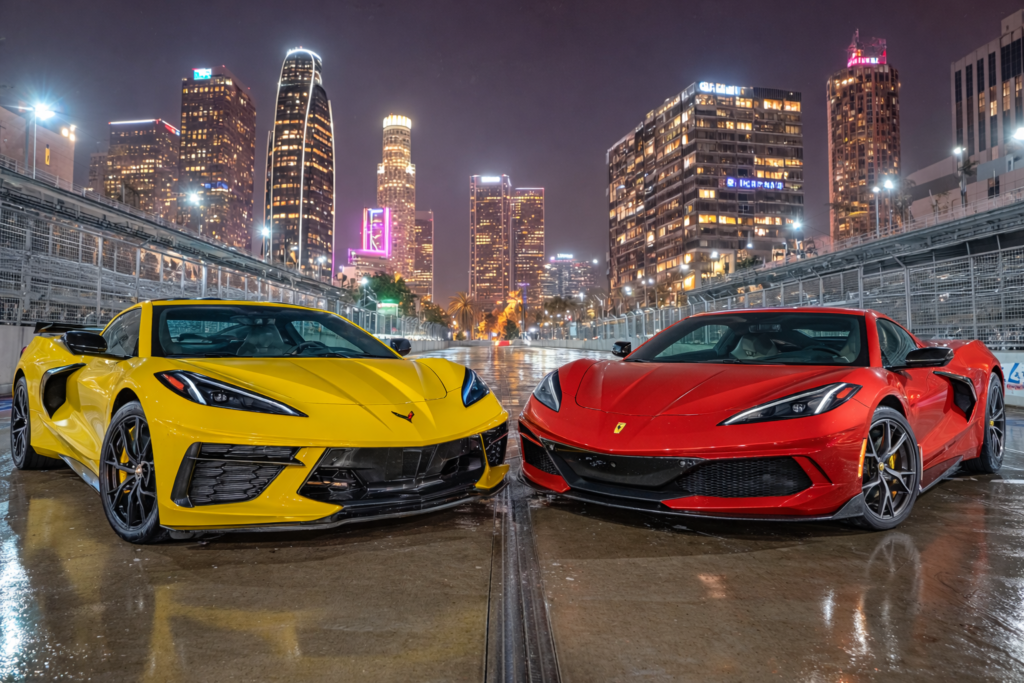
The Corvette ZR1 changes that. With 1,064 horsepower from a twin turbocharged 5.5 liter V8, 1,200 pounds of downforce, and a top speed of 233 miles per hour, it is a car that meets or exceeds the performance of European supercars costing two to three times as much. The Ferrari 296 GTB, with its 819 horsepower V6 hybrid powertrain and Ferrari’s storied heritage, represents the established order.
This comparison examines the Corvette ZR1 and Ferrari 296 GTB across the dimensions that matter to supercar buyers: performance, engineering, driving experience, design, and value.
Performance: The Numbers
Powertrain
The Corvette ZR1 is powered by a 5.5 liter twin turbocharged V8 engine producing 1,064 horsepower and 828 lb ft of torque. The engine features a flat plane crankshaft, titanium connecting rods, and a hot V turbocharger configuration that minimizes lag. Power is transmitted to the rear wheels through an eight speed dual clutch transmission.
The Ferrari 296 GTB uses a 3.0 liter twin turbocharged V6 paired with an electric motor, producing a combined 819 horsepower and 546 lb ft of torque. The V6 is a 120 degree unit with the turbochargers mounted inside the V, and the electric motor is integrated into the transmission. The car features a plug in hybrid system with a 7.45 kWh battery that provides approximately 15 miles of electric range. Power is transmitted to the rear wheels through an eight speed dual clutch transmission.
Acceleration
The ZR1 accelerates from 0 to 60 miles per hour in 2.3 seconds. The quarter mile is completed in 9.6 seconds at 150 miles per hour.
The 296 GTB accelerates from 0 to 60 miles per hour in 2.5 seconds. The quarter mile is completed in approximately 10.2 seconds at 140 miles per hour.
The ZR1 holds a clear advantage in straight line acceleration, with its additional 245 horsepower and 282 lb ft of torque providing a significant performance margin.
Top Speed
The ZR1 has a top speed of 233 miles per hour. The 296 GTB has a top speed of 205 miles per hour. The ZR1’s higher top speed reflects its greater power and aerodynamic efficiency in low drag configuration.
Track Performance
The ZR1 generates 1,200 pounds of downforce at top speed with its ZTK Performance Package, providing exceptional cornering grip. The 296 GTB generates approximately 360 kilograms of downforce, a figure that is substantial but significantly less than the Corvette’s.
Lap times at reference circuits are not directly comparable due to differences in testing conditions, but the ZR1’s power and downforce advantage suggest it would be faster on circuits with long straights and high speed corners. The 296 GTB’s lighter weight and hybrid system may give it an advantage on tighter, more technical circuits.
Engineering: Different Approaches
Engine Philosophy
The ZR1’s LT7 engine represents the traditional American approach to performance: displacement, forced induction, and brute force. Its 5.5 liter displacement is substantial, and the twin turbochargers push it to power levels that were previously the domain of hypercars. The engine’s flat plane crankshaft and titanium connecting rods demonstrate advanced engineering, but the fundamental approach is one of maximizing power output.
The 296 GTB’s F163 engine represents a different philosophy: smaller displacement, higher specific output, and hybridization. The 3.0 liter V6 produces 273 horsepower per liter, one of the highest specific outputs of any production engine. The electric motor adds instant torque and fills the gaps in the power band, creating a seamless delivery that masks the engine’s displacement disadvantage.
Weight and Distribution
The ZR1 has a curb weight of approximately 3,700 pounds. Its weight distribution is 40 percent front, 60 percent rear, a figure that is typical for mid engine supercars.
The 296 GTB has a dry weight of approximately 3,200 pounds, with a curb weight of approximately 3,500 pounds. Its weight distribution is 40.5 percent front, 59.5 percent rear.
The Ferrari is approximately 200 pounds lighter than the Corvette, a difference that contributes to its agility and responsiveness. The ZR1’s weight disadvantage is partially offset by its power advantage, but the Ferrari’s lighter weight is evident in its handling characteristics.
Aerodynamics
The ZR1’s aerodynamic package is among the most aggressive ever fitted to a production car. The ZTK package includes a large fixed rear wing, a substantial front splitter, and underbody aero elements that collectively generate 1,200 pounds of downforce at top speed. This level of downforce is typically found only in dedicated race cars.
The 296 GTB’s aerodynamic package is more subtle. The car features active aerodynamic elements, including a rear spoiler that deploys at speed, but its downforce figures are significantly lower than the ZR1’s. The Ferrari’s approach prioritizes low drag and stability over maximum downforce.
Cooling and Thermal Management
The ZR1 features 14 separate heat exchangers to manage the thermal demands of its twin turbocharged engine. The front end is almost entirely dedicated to cooling, with large grille openings and ducts that direct air to the various heat exchangers. The system is designed to maintain consistent performance during sustained track use.
The 296 GTB’s cooling system is less complex, reflecting its smaller engine and hybrid assistance. The electric motor reduces the thermal load on the V6 during hard acceleration, and the car’s lower power output generates less heat overall.
Driving Experience
On Road Character
The ZR1 is a car that demands respect. Its power is ever present, and the chassis communicates every detail of the road surface. The car is firm, with the magnetic ride control suspension transmitting impacts that a grand tourer would absorb. The cabin is focused on the driver, with minimal luxury features and a cockpit that prioritizes function over comfort.
Yet the ZR1 is surprisingly usable for a car with 1,064 horsepower. The engine produces ample torque from low speeds, making it effortless in traffic. The dual clutch transmission shifts smoothly, and the ride, while firm, is not punishing. The car can be driven to the track, perform at its limit, and drive home without issue.
The 296 GTB offers a different experience. The hybrid system allows the car to operate silently in electric mode, making it suitable for early morning departures and urban environments. When the V6 engages, the character transforms, with the engine building power smoothly and the electric motor filling the gaps. The car is more refined than the ZR1, with a more compliant ride and a quieter cabin.
On Track Behavior
When driven at the limit, the ZR1 reveals the depth of its engineering. The brakes provide consistent stopping power lap after lap, with a pedal feel that inspires confidence. The chassis remains composed through corners, with the aerodynamic downforce providing grip that mechanical systems alone could not achieve. The car’s rear wheel drive configuration requires skill to manage the power, but the chassis is balanced and predictable.
The 296 GTB offers a different track experience. The car’s lighter weight and hybrid system provide agility that the ZR1 cannot match. The electric motor’s instant torque fills the gaps during gear changes, creating a seamless power delivery. The chassis is precise and communicative, with a level of feedback that is among the best in the industry.
The Sound
The ZR1’s LT7 produces a sound that is distinct from the naturally aspirated LT6 in the Z06. The turbochargers mute some of the high frequency wail, adding a deeper, more muscular tone. The sound is mechanical and purposeful, with a character that communicates power.
The 296 GTB’s V6 produces a sound that is higher pitched and more urgent. The engine’s 8,500 rpm redline and flat plane crankshaft create a sharp, metallic wail that is distinctive and engaging. The sound is less muscular than the ZR1’s V8, but it is no less satisfying.
Design
Exterior Styling
The ZR1’s exterior design is aggressive and functional. The front end features large grille openings and a prominent splitter, while the rear is dominated by the massive fixed wing of the ZTK package. The car’s proportions are unmistakably Corvette, with the mid engine layout giving it a wedge shape that is both purposeful and dramatic.
The 296 GTB’s exterior design is more elegant. The car’s lines are clean and flowing, with subtle curves and sculpted surfaces. The design is restrained compared to the ZR1, with none of the aggressive aerodynamic elements that characterize the Corvette. The 296 GTB is a car that prioritizes beauty over aggression.
Interior Design
The ZR1’s interior is focused on the driver. The seats are heavily bolstered, the controls are within easy reach, and the digital displays are configurable to show performance data. The materials are of good quality, with leather and Alcantara throughout, but the emphasis is on function over luxury.
The 296 GTB’s interior is more luxurious. The materials are of higher quality, with fine leather, carbon fiber trim, and metal accents. The passenger has a dedicated touchscreen, and the seats are both supportive and comfortable. The Ferrari’s interior is a place to be, not just a place to drive.
Prestige and Heritage
Brand Value
Ferrari is one of the most prestigious brands in the world. The Prancing Horse badge carries a weight that few other manufacturers can match. Owning a Ferrari is a statement, an entry into an exclusive community of enthusiasts and collectors.
Chevrolet does not have the same brand cachet. The Corvette is respected, and the ZR1 is recognized as a serious performance car, but it does not carry the same prestige as a Ferrari. For buyers who value status and exclusivity, the Ferrari has a clear advantage.
Heritage
The Corvette has been in continuous production since 1953, and the ZR1 name has been associated with extreme performance since 1970. The car’s heritage is American, with a focus on power, value, and accessibility.
Ferrari’s heritage is longer and more storied. The company has been building cars since 1947, and its history is filled with legendary models, racing victories, and cultural significance. The 296 GTB’s V6 engine connects it to the Dino, a car that Enzo Ferrari himself considered a necessary step into the mid engine market.
Value Proposition
Pricing
The Corvette ZR1 carries a base price of approximately $180,000. With the ZTK Performance Package and carbon fiber wheels, the price rises to approximately $205,000.
The Ferrari 296 GTB carries a base price of approximately $350,000. With options and personalization, the price can rise to $400,000 or more.
The ZR1 is approximately half the price of the 296 GTB, a significant advantage for buyers who prioritize value.
Depreciation
Ferraris traditionally hold their value exceptionally well. The 296 GTB, as a limited production model with a hybrid powertrain, is expected to depreciate slowly, with strong demand from collectors.
Corvettes traditionally depreciate more than Ferraris, but the ZR1’s limited production and extreme performance may help it hold its value better than standard models. The C6 and C7 ZR1 have maintained strong values in the collector market.
Ownership Costs
Maintaining a Ferrari involves higher costs than maintaining a Corvette. Service intervals are more frequent, parts are more expensive, and the network of qualified technicians is more limited. The 296 GTB’s hybrid system adds additional complexity.
The ZR1 is less expensive to own and maintain. Parts are readily available, service costs are lower, and the car’s mechanical simplicity reduces the risk of expensive repairs.
The Value Equation
The ZR1 offers more power, more downforce, and faster acceleration for half the price of the 296 GTB. For buyers who prioritize performance over prestige, the ZR1 represents exceptional value.
The 296 GTB offers a different kind of value. Its hybrid technology, its refinement, and its brand cachet are qualities that the Corvette cannot match. For buyers who value these attributes, the premium is justified.
Summary Comparison
| Category | Corvette ZR1 | Ferrari 296 GTB |
|---|---|---|
| Engine | 5.5L twin turbo V8 | 3.0L twin turbo V6 hybrid |
| Horsepower | 1,064 hp | 819 hp |
| Torque | 828 lb ft | 546 lb ft |
| 0-60 mph | 2.3 seconds | 2.5 seconds |
| Top Speed | 233 mph | 205 mph |
| Downforce | 1,200 lb (ZTK) | 360 kg |
| Weight | 3,700 lb | 3,500 lb |
| Transmission | 8 speed DCT | 8 speed DCT |
| Drive | Rear wheel drive | Rear wheel drive |
| Electric Range | N/A | 15 miles |
| Base Price | $180,000 | $350,000 |
Conclusion
The Corvette ZR1 and Ferrari 296 GTB represent two different philosophies of supercar engineering. The ZR1 is about power, downforce, and value. It uses a large displacement V8, aggressive aerodynamics, and a focus on track performance to deliver numbers that rival cars costing three times as much. It is a car that prioritizes performance over refinement, capability over luxury.
The 296 GTB is about sophistication, technology, and heritage. It uses a small displacement V6 with hybrid assistance to deliver power that is both immediate and efficient. Its design is elegant, its interior is luxurious, and its brand carries a prestige that the Corvette cannot match.
For the buyer who prioritizes performance above all else, the ZR1 is the clear choice. Its 1,064 horsepower, 233 mph top speed, and 1,200 pounds of downforce are figures that the Ferrari cannot match. Its $180,000 price makes it accessible to a broader audience.
For the buyer who values refinement, technology, and brand prestige, the 296 GTB makes a compelling case. Its hybrid system, elegant design, and Ferrari heritage are qualities that the Corvette cannot replicate. For these buyers, the premium is justified.
The ZR1 and 296 GTB are not direct competitors in the traditional sense. They appeal to different buyers, prioritize different attributes, and occupy different positions in the market. But for anyone considering a supercar in 2026, both deserve serious consideration. The ZR1 offers American performance at an accessible price. The 296 GTB offers Italian sophistication at a premium. The choice depends on what the buyer values most.

