
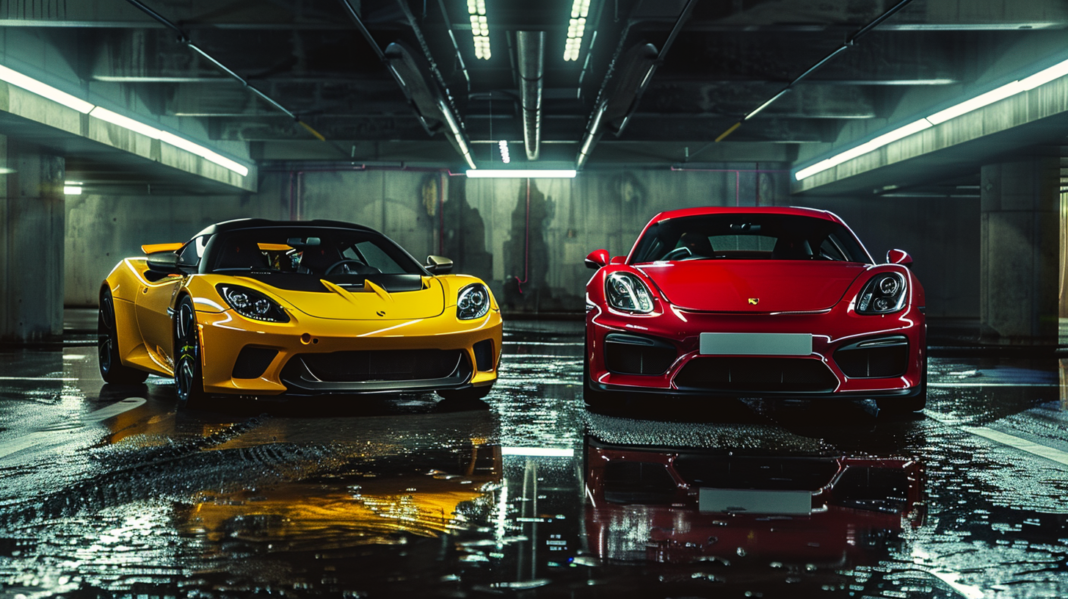
For drivers who value connection over power, feedback over acceleration, and engagement over luxury, the Lotus Evora GT and the Porsche Cayman GTS represent the pinnacle of the analog sports car experience. Both are mid-engine. Both are lightweight by modern standards. Both prioritize the driver above all else.
But they approach the formula from very different angles. The Evora GT is a hand-built, low-volume machine from a British brand that has spent decades perfecting lightweight chassis. The Cayman GTS is a mass-produced sports car from a German manufacturer that has refined its recipe over generations.
This article compares the Lotus Evora GT and the Porsche Cayman GTS across performance, handling, interior, daily usability, and value to determine which driver’s car purists should pick.
The Contenders: Two Mid-Engine Masterpieces
Lotus Evora GT
The Evora GT is the final and most extreme evolution of the Evora platform. It is powered by a supercharged 3.5 liter Toyota-sourced V6 producing 416 horsepower. The car is hand-built in Hethel, England, and production numbers are low. The Evora is designed to be a pure driver’s car, with minimal electronic intervention and maximum feedback.
Porsche Cayman GTS
The Cayman GTS is the sweet spot in Porsche’s mid-engine lineup. It is powered by a 4.0 liter naturally aspirated flat-six producing 394 horsepower. The car is mass-produced in Stuttgart, Germany, and it benefits from Porsche’s decades of engineering refinement. The Cayman is designed to be a precision instrument, with sophisticated chassis electronics and a reputation for balance.
Powertrain and Performance
Lotus Evora GT
The Evora’s supercharged V6 is a proven engine. The supercharger provides immediate throttle response and linear power delivery. The engine is mounted transversely behind the driver, and the six-speed manual transmission is a traditional unit with a mechanical feel.
- Displacement: 3.5 liters
- Configuration: Supercharged V6
- Horsepower: 416 hp at 7,000 rpm
- Torque: 317 lb-ft at 3,500 rpm
- Transmission: 6-speed manual
- Drive: Rear-wheel drive
- 0-60 mph: 3.8 seconds
- Top Speed: 188 mph
- Curb Weight: 3,100 lb
Porsche Cayman GTS
The Cayman’s flat-six is one of the best engines in the industry. The 4.0 liter naturally aspirated unit revs to 7,800 rpm and produces a sharp, mechanical wail. The engine is mounted longitudinally behind the driver, and the transmission is a six-speed manual or seven-speed dual-clutch.
- Displacement: 4.0 liters
- Configuration: Naturally aspirated flat-six
- Horsepower: 394 hp at 7,400 rpm
- Torque: 309 lb-ft at 5,000 rpm
- Transmission: 6-speed manual (7-speed PDK optional)
- Drive: Rear-wheel drive
- 0-60 mph: 4.3 seconds (manual)
- Top Speed: 182 mph (manual)
- Curb Weight: 3,200 lb
Performance Verdict
The Lotus has a slight power advantage. Its 416 horsepower is 22 more than the Porsche’s 394. The Evora is also quicker to 60 miles per hour, with a time of 3.8 seconds compared to the Cayman’s 4.3 seconds.
However, the Porsche’s engine character is superior. The naturally aspirated flat-six revs more freely and sounds more engaging than the Lotus’s supercharged V6. The Cayman’s engine is a masterpiece.
Chassis and Handling
Lotus Evora GT
The Evora’s chassis is the star of the show. The bonded aluminum structure is extremely rigid and light. The suspension is double-wishbone at all four corners, a configuration that provides exceptional control over wheel motion.
The steering is hydraulic, not electric. This is a key difference from the Porsche. The hydraulic system provides unparalleled feedback, communicating every detail of the road surface to the driver’s hands.
The Evora feels alive. It responds to inputs with immediacy, and the chassis communicates clearly. The car is balanced and predictable, with a slight tendency toward oversteer that rewards skilled drivers.
Porsche Cayman GTS
The Cayman’s chassis is also exceptional. The steel monocoque is rigid, and the suspension is MacPherson strut at the front and multi-link at the rear. The electric power steering is precise, but it lacks the feedback of the Lotus’s hydraulic system.
The Cayman is more stable and predictable than the Evora. The car feels planted and secure, inspiring confidence in drivers of all skill levels. The chassis is forgiving, but it is less communicative than the Lotus.
Handling Verdict
The Lotus Evora GT is the more engaging and rewarding car to drive. Its hydraulic steering, double-wishbone suspension, and lightweight construction create a level of feedback that the Porsche cannot match. The Cayman is more stable and predictable, but it is less alive.
Interior and Practicality
Lotus Evora GT
The Evora’s interior is functional but not luxurious. The seats are supportive and comfortable, but the materials are average. The cabin is cramped, with limited headroom and legroom. The rear seats are useless for adults and best used for storage.
The infotainment system is dated, and the controls are not intuitive. The Evora is not a car for daily driving; it is a car for driving.
Porsche Cayman GTS
The Cayman’s interior is more modern and luxurious. The seats are comfortable and supportive, with ample adjustment. The materials are high quality, and the fit and finish is excellent. The cabin is spacious for a mid-engine sports car, with good headroom and legroom.
The infotainment system is modern and intuitive, with a crisp display and responsive controls. The Cayman is a car that can be used every day.
Interior Verdict
The Porsche Cayman GTS has the more modern and comfortable interior. The Lotus Evora GT is more spartan and functional.
Daily Usability
Lotus Evora GT
The Evora is less practical for daily use. The ride is firm, the cabin is loud, and the visibility is poor. The clutch is heavy, and the shifter requires effort. The car is best reserved for weekend drives and track days.
Porsche Cayman GTS
The Cayman is more practical for daily use. The ride is compliant, the cabin is quiet, and the visibility is good. The clutch is light, and the shifter is precise. The car is comfortable enough for commuting and long road trips.
Usability Verdict
The Porsche Cayman GTS is the more practical daily driver. The Lotus Evora GT is a weekend toy.
Driving Experience
Lotus Evora GT
The Evora is a car that demands to be driven. The hydraulic steering communicates every detail of the road. The chassis responds immediately to inputs. The engine pulls strongly to the 7,000 rpm redline. The car feels alive, and it rewards smooth, precise driving.
Porsche Cayman GTS
The Cayman is a car that flatters the driver. The electric steering is precise, and the chassis is stable and predictable. The engine revs to 7,800 rpm, producing a sharp mechanical wail. The car is easy to drive quickly, but it is less engaging than the Lotus.
Value and Ownership
Pricing
The Lotus Evora GT has a base price of approximately $100,000. The Porsche Cayman GTS has a base price of approximately $90,000. The Porsche is less expensive.
Depreciation
The Porsche holds its value better than the Lotus. The Cayman is a mass-produced car with strong demand. The Evora is a low-volume car with limited appeal.
Ownership Costs
Maintaining a Porsche is less expensive than a Lotus. Parts are more readily available, and the dealer network is larger. The Lotus requires specialized service.

Which One Is Actually Better?
The answer depends on what you value most.
Choose the Lotus Evora GT if:
- You prioritize driver engagement and feedback above all else.
- You want a car that feels alive and rewards skilled drivers.
- You value rarity and exclusivity. The Evora is hand-built and low-volume.
- You are willing to accept the compromises of a raw, analog sports car.
Choose the Porsche Cayman GTS if:
- You want a car that is both engaging and livable every day.
- You value modern technology and a comfortable interior.
- You want a car that is easy to drive quickly and forgiving of mistakes.
- You want better value and lower ownership costs.
Specifications Summary
| Specification | Lotus Evora GT | Porsche Cayman GTS |
|---|---|---|
| Engine | 3.5L supercharged V6 | 4.0L naturally aspirated flat-six |
| Horsepower | 416 hp | 394 hp |
| Torque | 317 lb-ft | 309 lb-ft |
| Transmission | 6-speed manual | 6-speed manual |
| 0-60 mph | 3.8 seconds | 4.3 seconds |
| Top Speed | 188 mph | 182 mph |
| Curb Weight | 3,100 lb | 3,200 lb |
| Base Price | $100,000 | $90,000 |
| Steering | Hydraulic | Electric |
| Character | Raw, engaging, alive | Refined, stable, precise |
Conclusion
The Lotus Evora GT and the Porsche Cayman GTS are two of the most respected driver’s cars ever made. Both are mid-engine, lightweight, and focused on the driver.
The Evora GT is the purist’s choice. Its hydraulic steering, double-wishbone suspension, and hand-built construction create a level of feedback and engagement that the Porsche cannot match. It is a car that feels alive, that rewards skill, and that makes you a better driver.
The Cayman GTS is the pragmatist’s choice. It is engaging, precise, and livable every day. It has a modern interior, a comfortable ride, and a legendary engine. It is a car that you can drive to work, to the track, and on road trips.
Which one is actually better? The Evora is the better driver’s car. The Cayman is the better overall car.
For purists who value feedback above all else, the Lotus Evora GT is the pick. For everyone else, the Porsche Cayman GTS is the smarter choice.
Both are exceptional. Both will be remembered as legends. And both prove that the analog sports car is far from dead.

