
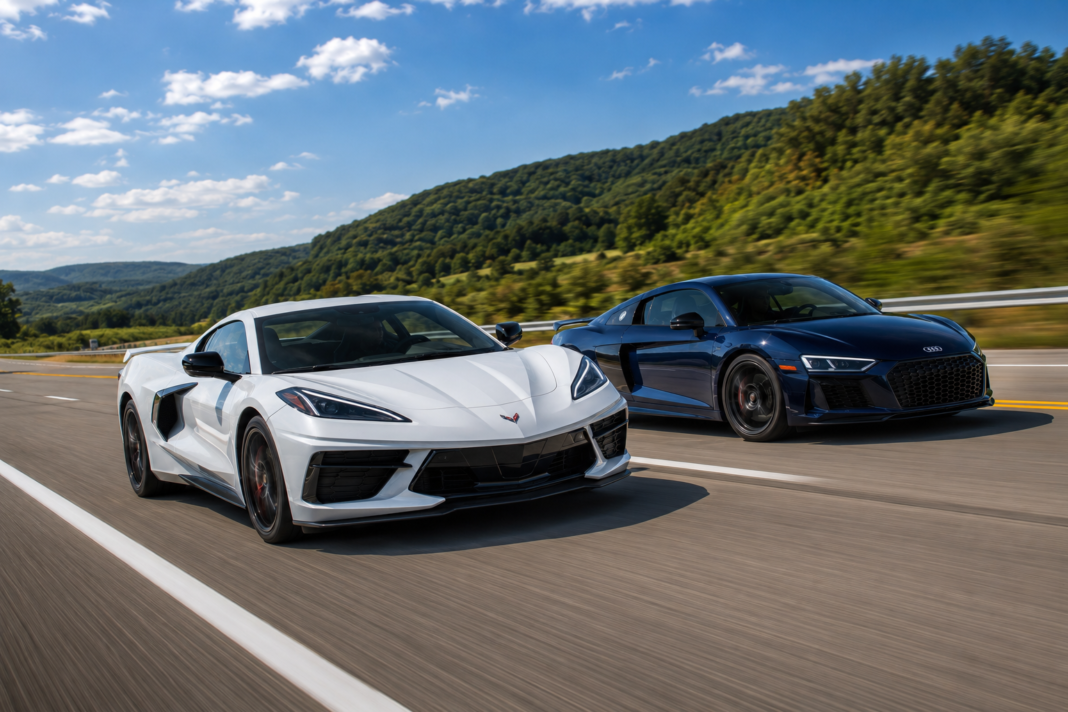
The Chevrolet Corvette C8 Stingray and the Audi R8 V10 represent two very different approaches to the mid-engine supercar formula. The Corvette is the disruptor, bringing a mid-engine layout to an affordable price point for the first time in the model’s history. The Audi R8 is the established exotic, with a naturally aspirated V10 engine, a quattro all-wheel drive system, and the prestige of the four rings.
The price difference is staggering. A new Corvette C8 Stingray starts at approximately $80,000 for a base coupe, with well-equipped models reaching around $90,000. The Audi R8 V10 starts at approximately $180,000, more than double the price of the Corvette. The question is whether the price gap is justified, or if the Corvette is simply the smarter buy.
This article compares the Chevrolet Corvette C8 Stingray and the Audi R8 V10 across performance, handling, design, interior quality, daily usability, and value to determine whether the extra $80,000 to $100,000 for the Audi is money well spent.
The Contenders: Two Mid-Engine Layouts
Chevrolet Corvette C8 Stingray
The Corvette C8 is the first production Corvette with a mid-engine layout. The 6.2 liter naturally aspirated V8 produces 490 horsepower and 465 lb-ft of torque. The engine is mounted behind the driver, and power is sent to the rear wheels through an eight-speed dual-clutch transmission. The Corvette is designed to be a performance value, offering supercar capability at a sports car price.
Audi R8 V10
The Audi R8 V10 is one of the last naturally aspirated V10s in production. The 5.2 liter V10 produces 562 horsepower and 406 lb-ft of torque. The engine is mounted longitudinally behind the driver, and power is sent to all four wheels through a seven-speed dual-clutch transmission. The R8 is designed to be an everyday exotic, combining supercar performance with daily usability.
Powertrain and Performance
Chevrolet Corvette C8 Stingray
The LT2 V8 is a pushrod engine, a design that emphasizes low-end torque and compact packaging. It produces 490 horsepower at 6,450 rpm and 465 lb-ft of torque at 5,150 rpm. The eight-speed dual-clutch transmission provides rapid shifts and is paired with a standard limited-slip differential. The Corvette’s performance numbers are impressive for its price. Zero to 60 miles per hour takes approximately 3.0 seconds. The quarter mile is completed in approximately 11.2 seconds. Top speed is 194 miles per hour.
Audi R8 V10
The R8’s V10 is a high-revving engine. It produces 562 horsepower at 8,000 rpm and 406 lb-ft of torque at 6,500 rpm. The seven-speed dual-clutch transmission is one of the best in the industry, with lightning-fast shifts. The R8’s acceleration numbers are strong. Zero to 60 miles per hour takes approximately 3.2 seconds. Top speed is 205 miles per hour.
Performance Verdict
The Audi R8 V10 has more power. Its 562 horsepower is 72 more than the Corvette’s 490. However, the Corvette is actually quicker to 60 miles per hour, with a time of 3.0 seconds compared to the R8’s 3.2 seconds. The Corvette’s higher torque and excellent launch control give it a straight-line advantage. At higher speeds, the R8’s power advantage becomes more evident. The Audi pulls harder above 100 miles per hour and has a higher top speed.
Chassis and Handling
Chevrolet Corvette C8 Stingray
The Corvette’s mid-engine layout is a game changer. The weight distribution is nearly 50:50, and the car rotates eagerly on corner entry. The suspension uses double wishbones at all four corners. The steering is electric but provides good feedback. The Corvette’s chassis is stiff and responsive. The car feels smaller than it is, and it rewards smooth inputs. On a track, the Corvette is capable of lap times that exceed many cars costing twice as much.
Audi R8 V10
The R8’s chassis is also excellent. The all-wheel drive system provides exceptional traction, making the car easy to drive quickly even in poor conditions. The suspension is adaptive, with settings that range from comfortable to firm. The R8’s steering is precise but less communicative than the Corvette’s. The car feels planted and secure, but less playful. The all-wheel drive system eliminates any drama, making the R8 fast but clinical.
Handling Verdict
The Corvette C8 is the more engaging car to drive. Its rear-wheel drive layout and lower weight make it feel more alive and responsive. The Audi R8 is more stable and predictable, providing confidence in all conditions. On a dry track, the Corvette is the more rewarding car. In wet or slippery conditions, the R8’s all-wheel drive system is a clear advantage.
Design and Styling
Chevrolet Corvette C8 Stingray
The Corvette’s design is dramatic and aggressive. The mid-engine proportions are classic supercar, with a long wheelbase, short overhangs, and a cabin pushed forward. The front end features sharp angles and large air intakes. The side profile shows the massive side air intakes that feed the engine. The rear end is dominated by quad exhaust outlets and a prominent diffuser. The Corvette is available as a coupe with a removable hardtop or as a convertible.
Audi R8 V10
The R8’s design is more restrained. The front end features Audi’s signature single-frame grille and sharp LED headlights. The side profile shows the distinctive side blade, a design element that has been part of the R8 since its introduction. The rear end features a full-width diffuser and quad exhaust outlets. The R8’s design has aged well, but it is less dramatic than the Corvette’s.
Design Verdict
The Corvette C8 is the more dramatic and eye-catching design. The Audi R8 is more understated and elegant.
Interior and Technology
Chevrolet Corvette C8 Stingray
The Corvette’s interior is a significant improvement over previous generations. The dashboard is driver-focused, with a digital instrument cluster and a central touchscreen. The seats are supportive, with power adjustment on many trims. The materials are good for the price, but they do not match the Audi’s quality. Hard plastics are present in lower areas. The cabin is functional and modern, but not luxurious. The Corvette seats two passengers. The trunk space is split between a front trunk and a rear trunk, providing enough room for a weekend trip.
Audi R8 V10
The R8’s interior is more luxurious. The materials are exceptional, with leather, Alcantara, and metal trim throughout. The seats are comfortable and supportive. The virtual cockpit displays all essential information directly in front of the driver. The R8 seats two passengers. The front trunk is smaller than the Corvette’s combined cargo space.
Interior Verdict
The Audi R8 V10 has the more luxurious and refined interior. The Corvette C8 is more functional but less premium.
Daily Usability
Chevrolet Corvette C8 Stingray
The Corvette is surprisingly usable for a mid-engine supercar. The ride is compliant, with the optional magnetic ride control system absorbing road imperfections effectively. The cabin is relatively quiet at highway speeds. The dual trunks provide enough space for a weekend trip. The fuel economy is acceptable for a performance car.
Audi R8 V10
The R8 is also usable daily. The ride is more compliant than many supercars, and the cabin is quiet. The all-wheel drive system provides confidence in rain and snow. However, the smaller trunk limits cargo space.
Usability Verdict
Both cars are surprisingly usable. The Corvette has more cargo space and better fuel economy. The R8 has better all-weather traction.
Driving Experience
Chevrolet Corvette C8 Stingray
The Corvette is a car that demands to be driven. The V8 produces a deep, guttural roar that builds to a sharp wail at high rpm. The throttle response is immediate, and the car launches hard. The chassis communicates clearly, and the car rotates eagerly on corner entry. The Corvette is not a car for passive drivers. It requires engagement, and it rewards skilled inputs.
Audi R8 V10
The R8 is more relaxed. The V10’s high-pitched wail is intoxicating, but the car is easier to drive. The all-wheel drive system provides traction that inspires confidence, and the steering is less demanding. The R8 is a car that can be driven gently and also driven hard. It is more versatile, but it is less engaging.
Value and Ownership
Pricing
The Chevrolet Corvette C8 Stingray has a base price of approximately $80,000. A well-equipped model is approximately $90,000. The Audi R8 V10 has a base price of approximately $180,000. The Audi is more than double the price of the Corvette.
Depreciation
Both cars depreciate, but the Corvette’s lower starting price puts more distance between their used values. The true cost analysis shows that the more expensive car is not necessarily “worth it” financially, regardless of brand.
Ownership Costs
The Corvette is less expensive to maintain. Parts are more readily available, and Chevrolet dealers are more numerous. The Audi’s V10 requires specialized service, and parts are more expensive.
Is the Price Gap Justified?
The Audi R8 V10 is a beautiful, refined, and highly capable machine. It has a legendary engine, all-wheel drive traction, and the prestige of the four rings. But it costs more than twice as much as the Corvette C8 Stingray.
The Corvette delivers comparable performance for half the price. It is quicker to 60 miles per hour, it is more engaging to drive, and it has more cargo space. The interior is not as luxurious, and the engine lacks the character of the V10. But the performance per dollar is unmatched.
For most buyers, the Corvette is the smarter buy. The extra $80,000 to $100,000 for the Audi is difficult to justify based on performance alone. The Audi is a car for buyers who value the brand, the engine character, and the all-weather capability.

Which One Is Right for You?
Choose the Chevrolet Corvette C8 Stingray if:
- You want the best performance for your dollar. The Corvette delivers supercar performance for a sports car price.
- You value handling and driver engagement. The Corvette is more rewarding on a track.
- You need more cargo space. The Corvette’s dual trunks are surprisingly practical.
- You are budget-conscious. The Corvette is half the price of the Audi.
- You prefer a more dramatic and aggressive design.
Choose the Audi R8 V10 if:
- You want the prestige and refinement of a German exotic.
- You need all-weather capability. The R8’s all-wheel drive system is a clear advantage.
- You love the sound and character of a naturally aspirated V10.
- You value a luxurious interior with high-quality materials.
- You are willing to pay the premium for the brand and the experience.
Specifications Summary
| Specification | Chevrolet Corvette C8 Stingray | Audi R8 V10 |
|---|---|---|
| Engine | 6.2L naturally aspirated V8 | 5.2L naturally aspirated V10 |
| Horsepower | 490 hp | 562 hp |
| Torque | 465 lb-ft | 406 lb-ft |
| Transmission | 8-speed dual-clutch | 7-speed dual-clutch |
| Drive | Rear-wheel drive | All-wheel drive |
| 0-60 mph | 3.0 seconds | 3.2 seconds |
| Top Speed | 194 mph | 205 mph |
| Seating | 2 | 2 |
| Base Price | $80,000 | $180,000 |
Conclusion
The Chevrolet Corvette C8 Stingray and the Audi R8 V10 are both exceptional mid-engine supercars. The Corvette is a performance value that redefines what is possible at an $80,000 price point. It is quicker to 60 miles per hour than the Audi, it is more engaging to drive, and it offers surprising practicality.
The Audi R8 V10 is a masterpiece of engineering. Its naturally aspirated V10 is one of the greatest engines ever built. Its interior is luxurious, its all-wheel drive system provides confidence in all conditions, and its design is timeless.
Is the price gap justified? For performance-focused buyers, no. The Corvette delivers nearly identical performance for half the price. For buyers who value brand prestige, engine character, and all-weather capability, the Audi is the choice.
The Corvette is the smarter buy. The Audi is the emotional buy.
Both will put a smile on your face. Both are legends. The choice is yours.

