
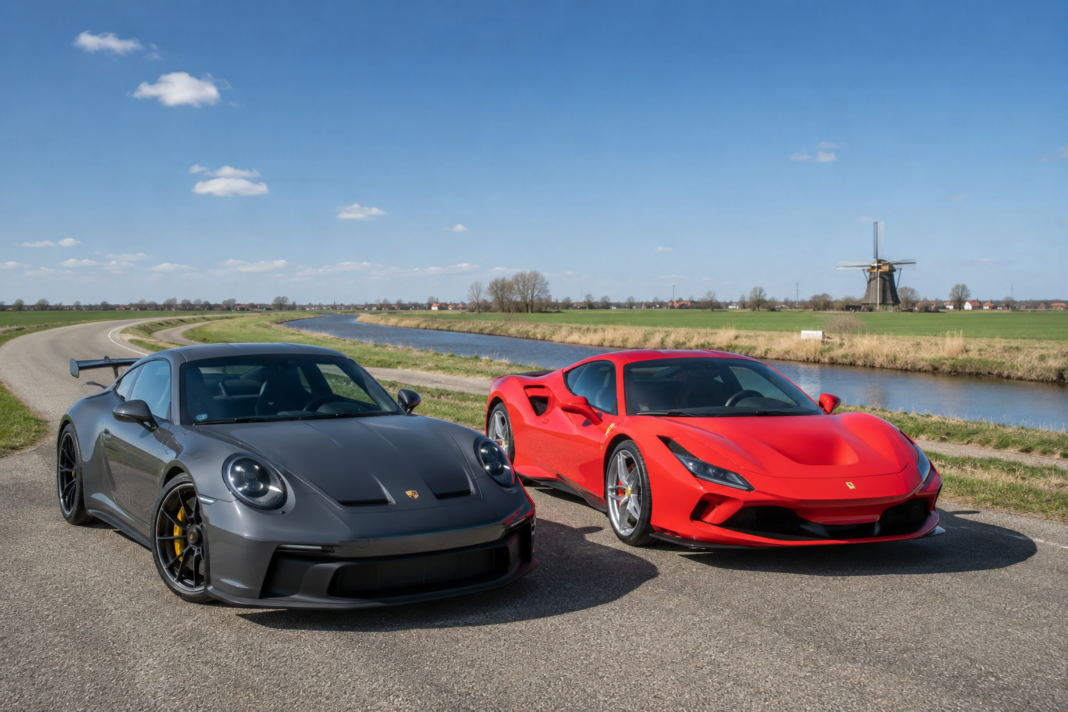
The Porsche 911 GT3 and the Ferrari F8 Tributo represent two very different engineering philosophies in the pursuit of performance. The GT3 uses a 4.0 liter naturally aspirated flat-six that revs to 9,000 rpm. The F8 Tributo uses a 3.9 liter twin-turbo V8 that delivers massive torque from low in the rev range. The GT3 prioritizes driver engagement and sensory feedback. The F8 Tributo prioritizes raw power and lap times.
Both are exceptional machines. Both have passionate fanbases. This article compares the Porsche 911 GT3 and the Ferrari F8 Tributo across performance, handling, driving experience, design, and value to determine which delivers the purer driving experience and which one wins on lap times.
The Contenders: Two Different Approaches
Porsche 911 GT3
The 911 GT3 is the purist’s 911. It uses a 4.0 liter naturally aspirated flat-six engine producing 502 horsepower. The engine revs to 9,000 rpm, and power is sent to the rear wheels through either a six-speed manual or a seven-speed dual-clutch transmission. The GT3 is designed for driver engagement, with hydraulic steering feedback and a chassis that communicates clearly.
Ferrari F8 Tributo
The F8 Tributo is Ferrari’s final mid-engine V8 supercar before the brand moved toward hybrid powertrains. It uses a 3.9 liter twin-turbo V8 producing 710 horsepower. Power is sent to the rear wheels through a seven-speed dual-clutch transmission. The F8 is designed for blistering speed, with advanced aerodynamics and electronics that make it brutally effective.
Powertrain and Performance
Porsche 911 GT3
The GT3’s 4.0 liter flat-six is a masterpiece of naturally aspirated engineering. The engine produces 502 horsepower at 8,400 rpm and 346 lb-ft of torque at 6,100 rpm. The power builds linearly to the 9,000 rpm redline, rewarding drivers who keep the revs high. The six-speed manual transmission is available, offering a traditional, engaging shift experience.
The GT3 accelerates from 0 to 60 miles per hour in 3.4 seconds with the manual transmission and 3.2 seconds with the dual-clutch. Top speed is 197 miles per hour. The quarter mile is completed in approximately 11.2 seconds.
Ferrari F8 Tributo
The F8’s 3.9 liter twin-turbo V8 produces 710 horsepower at 8,000 rpm and 568 lb-ft of torque at 3,250 rpm. The power comes on strong from low rpm, with the twin turbos providing massive mid-range punch. The seven-speed dual-clutch transmission shifts rapidly, keeping the engine in its power band.
The F8 accelerates from 0 to 60 miles per hour in 2.8 seconds. Top speed is 211 miles per hour. The quarter mile is completed in approximately 10.1 seconds.
Performance Verdict
The Ferrari F8 Tributo is significantly quicker in a straight line. Its 710 horsepower is 208 more than the GT3’s 502. The F8’s 0 to 60 time of 2.8 seconds is a full 0.6 seconds quicker than the GT3 manual and 0.4 seconds quicker than the PDK. The quarter mile difference is even more dramatic.
On lap times, the F8 also has an advantage. Its power, advanced aerodynamics, and electronic aids make it faster around most circuits. The GT3 is not a slow car by any measure, but it cannot match the Ferrari’s raw performance numbers.
Chassis and Handling
Porsche 911 GT3
The GT3’s chassis is legendary. The double-wishbone front suspension, a first for a production 911, provides exceptional grip and turn-in response. The rear-axle steering improves agility. The hydraulic steering offers direct communication and excellent feedback.
The GT3 is balanced and predictable. The rear-engine layout gives it unique handling characteristics. The car rotates on corner entry, and the driver can adjust the cornering attitude with the throttle. The GT3 rewards skilled drivers and invites them to explore its limits.
Ferrari F8 Tributo
The F8’s chassis is also exceptional, but it is different in character. The mid-engine layout provides neutral handling. The active aerodynamics, including the S-duct and deployable rear wing, generate significant downforce. The Side Slip Control system manages torque delivery, making the car easier to drive quickly.
The F8 is more clinical than the GT3. It is fast and precise, but it is less communicative. The electronic aids do much of the work, and the driver feels less connected to the road.
Handling Verdict
The Porsche 911 GT3 is the more engaging and rewarding car to drive at the limit. Its hydraulic steering, rear-engine dynamics, and naturally aspirated engine create a level of feedback that the Ferrari cannot match. The F8 is faster and more stable, but it is less alive.
Driving Experience
Porsche 911 GT3
The GT3 is a car that demands to be driven. The engine encourages high revs, rewarding the driver with a sharp, metallic wail as the tachometer climbs toward 9,000 rpm. The manual transmission requires precise inputs. The steering communicates every detail of the road surface.
The GT3 is not a car for effortless speed. It requires skill and attention. But that is the point. The GT3 is a driver’s car, designed for those who value the connection between driver and machine.
Ferrari F8 Tributo
The F8 is a car that delivers effortless speed. The engine provides massive torque from low rpm, making the car feel fast without needing to work it. The dual-clutch transmission shifts seamlessly. The electronic aids keep the car planted and stable.
The F8 is fast and capable, but it is less involving. It is a car that flatters the driver, making it easy to go quickly without requiring the same level of skill as the GT3.
The Sound
The GT3’s flat-six produces a high-pitched wail that builds to a crescendo at 9,000 rpm. The sound is mechanical, sharp, and intoxicating. It is one of the best-sounding engines in production.
The F8’s twin-turbo V8 produces a deep, muscular roar. The sound is aggressive and powerful, but it lacks the high-revving purity of the GT3. The turbochargers muffle some of the engine’s character.
Interior and Technology
Porsche 911 GT3
The GT3’s interior is driver-focused and functional. The seats are supportive, with excellent lateral hold. The materials are high quality, but the emphasis is on function over luxury. The instrument cluster features a central tachometer, a nod to the 911’s heritage. The infotainment system is modern and intuitive.
Ferrari F8 Tributo
The F8’s interior is more luxurious. The materials are exceptional, with leather, Alcantara, and carbon fiber throughout. The seats are comfortable and supportive. The instrument cluster is digital, with a central tachometer. The infotainment system is functional but can be less intuitive than the Porsche’s.
Interior Verdict
The Ferrari F8 Tributo has the more luxurious interior. The Porsche 911 GT3 is more functional and driver-focused.
Value and Ownership
Pricing
The Porsche 911 GT3 has a base price of approximately $170,000. The Ferrari F8 Tributo has a base price of approximately $280,000. The Ferrari is significantly more expensive.
Depreciation
The GT3 holds its value exceptionally well. The F8 also holds its value, but the higher starting price means greater absolute depreciation.
Ownership Costs
The Porsche is less expensive to maintain. The Ferrari’s specialized service and parts costs are higher.
Which Delivers the Purer Driving Experience?
The Porsche 911 GT3 delivers the purer driving experience. Its naturally aspirated engine, hydraulic steering, and rear-engine dynamics create a level of feedback and engagement that the Ferrari cannot match. The GT3 is a car that rewards the driver, that requires skill, and that communicates clearly.
The Ferrari F8 Tributo is faster, more powerful, and more technologically advanced. But it is less involving, less communicative, and less alive.
For drivers who value the connection between driver and machine, the GT3 is the choice.
Which One Wins on Lap Times?
The Ferrari F8 Tributo wins on lap times. Its 710 horsepower, advanced aerodynamics, and electronic aids make it faster around most circuits. The GT3 is quick, but it cannot match the Ferrari’s raw performance.
The F8 is a car designed for speed. The GT3 is a car designed for engagement.
Which One Is Right for You?
Choose the Porsche 911 GT3 if:
- You value driver engagement and feedback above all else.
- You want a high-revving naturally aspirated engine.
- You prefer a manual transmission.
- You enjoy the challenge of managing a rear-engine car.
- You want a car that holds its value well.
Choose the Ferrari F8 Tributo if:
- You want the fastest lap times.
- You value raw power and acceleration.
- You prefer the prestige of the Ferrari badge.
- You want a car with a luxurious interior.
- You are willing to pay the premium for Italian exotic performance.
Specifications Summary
| Specification | Porsche 911 GT3 | Ferrari F8 Tributo |
|---|---|---|
| Engine | 4.0L naturally aspirated flat-six | 3.9L twin-turbo V8 |
| Horsepower | 502 hp | 710 hp |
| Torque | 346 lb-ft | 568 lb-ft |
| Redline | 9,000 rpm | 8,000 rpm |
| Transmission | 6-speed manual / 7-speed PDK | 7-speed dual-clutch |
| Drive | Rear-wheel drive | Rear-wheel drive |
| 0-60 mph | 3.4 / 3.2 seconds | 2.8 seconds |
| Top Speed | 197 mph | 211 mph |
| Quarter Mile | 11.2 seconds | 10.1 seconds |
| Base Price | $170,000 | $280,000 |
| Character | Engaging, pure, communicative | Fast, capable, clinical |
Conclusion
The Porsche 911 GT3 and the Ferrari F8 Tributo are two of the greatest performance cars ever built. They represent two very different philosophies. The GT3 is about the journey, the feel, the connection. The F8 is about the destination, the speed, the numbers.
The GT3 delivers the purer driving experience. Its high-revving flat-six, hydraulic steering, and rear-engine dynamics create a level of feedback that is unmatched. It is a car for drivers who want to feel every input, who enjoy the challenge of managing a car at the limit, who value the process as much as the result.
The F8 wins on lap times. It is faster, more powerful, and more technologically advanced. It is a car for drivers who want the fastest time, who value performance above all else.
Neither is better. They are different. The GT3 is for purists. The F8 is for speed seekers.
Both will put a smile on your face. Both are legends. The choice is yours.

