
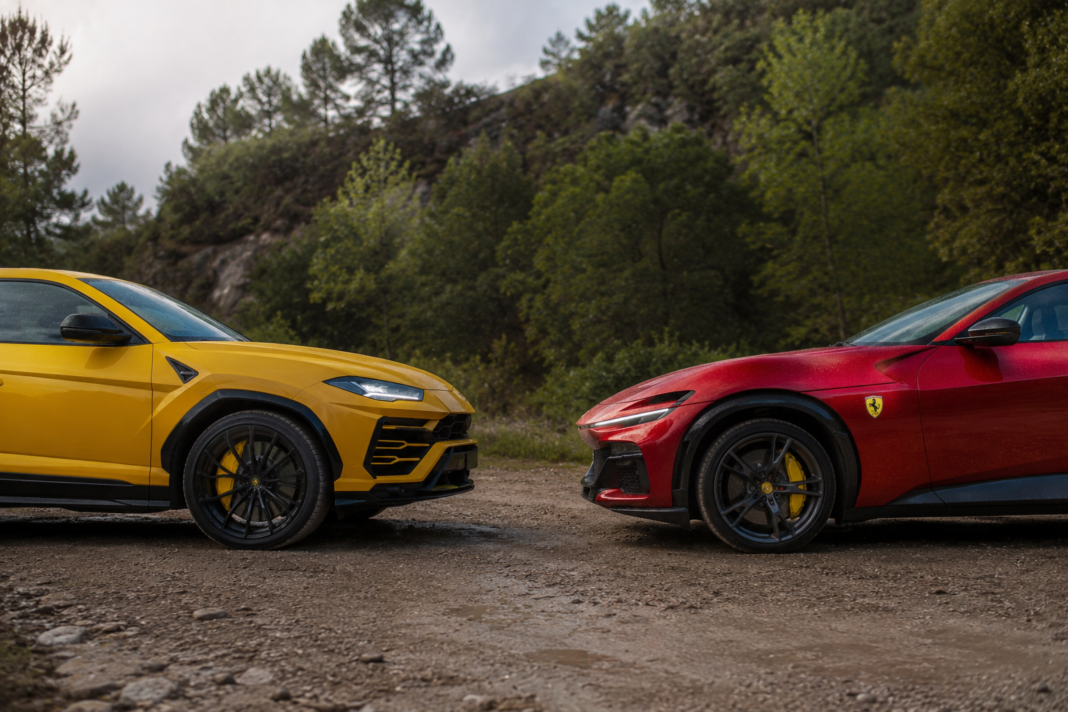
The Lamborghini Urus and the Ferrari Purosangue represent two very different answers to the question of whether a supercar manufacturer should build an SUV. The Urus was Lamborghini’s first production SUV since the LM002 of the 1980s. It was a commercial success, doubling the brand’s sales and introducing Lamborghini to a new audience. The Purosangue was Ferrari’s first production four-door, four-seat vehicle. It was a controversial departure for a brand that had long resisted the SUV trend.
Both are high-performance, luxurious, and expensive. But they take very different approaches to the formula. The Urus is a brute, using a twin-turbo V8 and aggressive styling. The Purosangue is an elegant machine, using a naturally aspirated V12 and a more restrained design.
This article compares the Lamborghini Urus and the Ferrari Purosangue across performance, design, interior, driving experience, and value to determine which super-SUV comes out on top.
The Contenders: Two Super-SUV Philosophies
Lamborghini Urus
The Urus is Lamborghini’s best-selling model. It is powered by a 4.0 liter twin-turbo V8 producing 657 horsepower. The engine is shared with the Porsche Cayenne Turbo GT, but Lamborghini has tuned it for more power and a more aggressive character. The Urus features all-wheel drive, an eight-speed automatic transmission, and a torque vectoring system. The design is sharp, angular, and unmistakably Lamborghini.
Ferrari Purosangue
The Purosangue is Ferrari’s first four-door vehicle. It is powered by a 6.5 liter naturally aspirated V12 producing 715 horsepower. The engine is mounted in the front, but behind the front axle line, and power is sent to all four wheels through an eight-speed dual-clutch transmission. Ferrari calls the Purosangue an “FUV” (Ferrari Utility Vehicle) rather than an SUV. The design is elegant and flowing, with a fastback roofline and rear-hinged rear doors.
Powertrain and Performance
Lamborghini Urus
The Urus’s 4.0 liter twin-turbo V8 is a proven engine. It produces 657 horsepower at 6,000 rpm and 627 lb-ft of torque from 2,250 to 4,500 rpm. The eight-speed automatic transmission is quick and responsive. The all-wheel drive system, combined with torque vectoring and rear-wheel steering, makes the Urus exceptionally capable for its size.
- 0 to 60 mph: 3.2 seconds
- Quarter mile: 11.2 seconds
- Top Speed: 190 mph
- Weight: Approximately 4,800 lb
Ferrari Purosangue
The Purosangue’s 6.5 liter naturally aspirated V12 is a masterpiece. It produces 715 horsepower at 7,750 rpm and 528 lb-ft of torque at 6,250 rpm. The eight-speed dual-clutch transmission is mounted at the rear, contributing to near perfect weight distribution. The all-wheel drive system is a development of the system used in the FF and GTC4Lusso.
- 0 to 60 mph: 3.3 seconds
- Top Speed: 193 mph
- Weight: Approximately 4,600 lb
Performance Verdict
The Ferrari has more power. Its 715 horsepower is 58 more than the Urus’s 657. The Urus is slightly quicker to 60 miles per hour, with a time of 3.2 seconds compared to the Purosangue’s 3.3 seconds. The Urus also has a higher top speed, at 190 mph versus the Ferrari’s 193 mph? Actually, the Ferrari has the edge here. The Purosangue’s 193 mph top speed is slightly higher than the Urus’s 190 mph.
Both are exceptionally fast for SUVs. The Urus feels more aggressive, with a sharper power delivery. The Purosangue’s naturally aspirated V12 is smoother and more linear, building power as the revs climb.
Chassis and Handling
Lamborghini Urus
The Urus is built on the Volkswagen Group’s MLB Evo platform, shared with the Porsche Cayenne and Bentley Bentayga. The suspension uses air springs with adaptive dampers, and the car features rear-wheel steering. The Urus has multiple drive modes, including Strada, Sport, Corsa, and Sabbia (sand), Terra (off-road), and Neve (snow).
The Urus handles remarkably well for its size and weight. The all-wheel drive system provides exceptional traction, and the rear-wheel steering improves agility. The steering is precise, but it lacks the feedback of the Ferrari.
Ferrari Purosangue
The Purosangue uses a modified version of the platform that underpins the Roma and 296 GTB. The suspension uses double wishbones at all four corners, with active dampers. Ferrari’s Active Suspension Technology uses electric motors to control wheel motion, actively counteracting body roll during cornering.
The Purosangue handles like a sports car. The active suspension keeps the car flat through corners, and the rear-wheel drive bias (the front wheels receive power only when needed) gives it a playful character. The steering is precise and communicative, providing excellent feedback.
Handling Verdict
The Ferrari Purosangue is the better handling car. Its active suspension, lower center of gravity, and rear-wheel drive bias make it feel more like a sports car than an SUV. The Urus is capable and agile, but it does not match the Ferrari’s composure and feedback.
Design and Styling
Lamborghini Urus
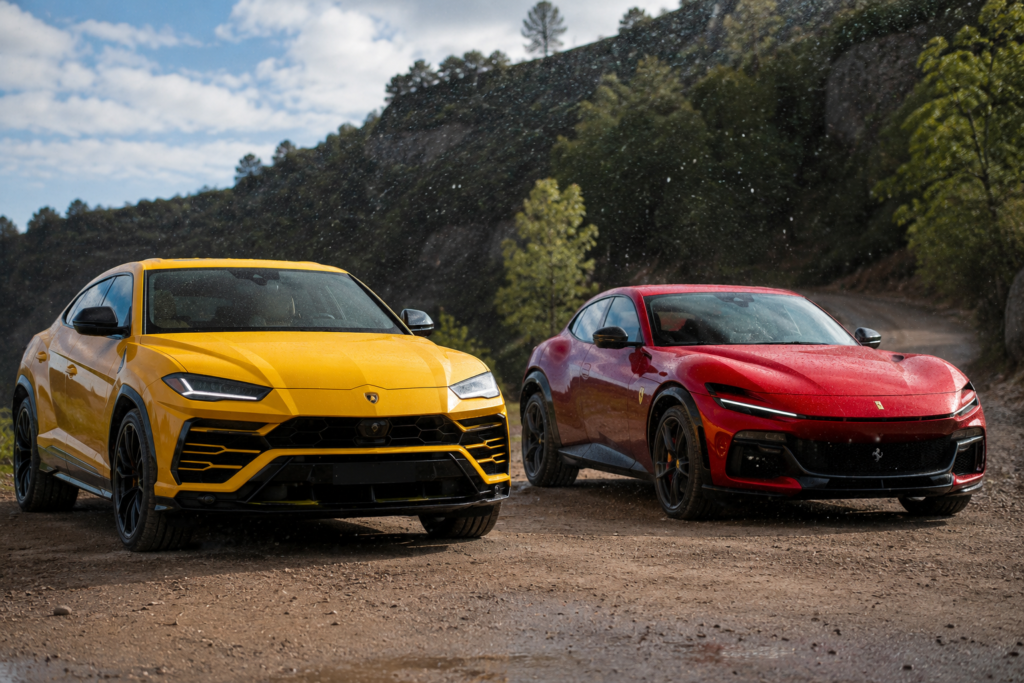
The Urus’s design is sharp, angular, and aggressive. The front end features the signature Lamborghini Y-shaped daytime running lights and a massive grille. The side profile shows the sharp creases and muscular haunches. The rear end is dominated by the Y-shaped taillights and a prominent diffuser.
The Urus is available in a range of bright colors, including Arancio Borealis (orange) and Verde Mantis (green). The design is loud, aggressive, and unmistakably Lamborghini.
Ferrari Purosangue
The Purosangue’s design is more elegant and flowing. The front end features a prominent grille and slim headlights. The side profile shows the fastback roofline and the rear-hinged rear doors. The rear end features a full-width light bar and a subtle diffuser.
The Purosangue is available in a range of sophisticated colors, including Rosso Corsa (red) and Blu Tour de France (blue). The design is elegant and understated compared to the Urus.
Design Verdict
The Lamborghini Urus is the more dramatic and aggressive design. The Ferrari Purosangue is more elegant and sophisticated. Which is better is a matter of personal taste.
Interior and Luxury
Lamborghini Urus
The Urus’s interior is sporty and modern. The seats are supportive, with hexagonal stitching that echoes the Lamborghini design language. The dashboard features a digital instrument cluster and a central touchscreen that controls infotainment and climate functions. A second touchscreen below controls additional vehicle functions.
The materials are high quality, with leather, Alcantara, and carbon fiber throughout. The cabin is spacious, with comfortable seating for four adults. The cargo area offers approximately 21 cubic feet of space with the rear seats up.
Ferrari Purosangue
The Purosangue’s interior is luxurious and elegant. The seats are comfortable and supportive, with leather and Alcantara upholstery. The dashboard features a digital instrument cluster and a central touchscreen. The passenger has a dedicated touchscreen. The rear seats are equally well appointed, with power adjustment and heating.
The materials are exceptional, with fine leather, real metal, and carbon fiber trim. The cabin is spacious, with comfortable seating for four adults. The cargo area offers approximately 15 cubic feet of space with the rear seats up.
Interior Verdict
The Ferrari Purosangue has the more luxurious and refined interior. The Lamborghini Urus is more sporty and aggressive.
Driving Experience
Lamborghini Urus
The Urus is a car that demands to be driven aggressively. The V8 roars, the suspension firms up in Corsa mode, and the car hurls itself down the road. The Urus is thrilling, but it is also tiring. It is not a car for relaxed cruising.
Ferrari Purosangue
The Purosangue is more versatile. It can be driven gently, with the V12 providing smooth, effortless power. In Comfort mode, the ride is compliant and the cabin is quiet. In Race mode, the car transforms, with sharper responses and a more aggressive exhaust note.
The Purosangue is a car that can be driven every day. The Urus is a car for weekends.
Value and Ownership
Pricing
The Lamborghini Urus has a base price of approximately $230,000. The Ferrari Purosangue has a base price of approximately $400,000. The Ferrari is significantly more expensive.
Depreciation
The Urus has depreciated less than many expected, thanks to strong demand. The Purosangue’s limited production and higher price point may help it hold its value.
Ownership Costs
Both cars are expensive to maintain. The Ferrari’s V12 requires specialized service, and parts are more costly.
Which Brand Made the Right Call?
Both brands made the right call for their respective customers.
Lamborghini needed the Urus to survive. The brand’s sales doubled after the Urus was introduced, and it funded the development of the Revuelto and other future models. The Urus brought new customers to the brand, many of whom went on to purchase a Huracán or Aventador.
Ferrari did not need the Purosangue to survive. The brand was already profitable, and it had a waiting list for its existing models. But Ferrari recognized that its customers wanted a vehicle that could carry four people in comfort and still deliver the Ferrari driving experience. The Purosangue is a low-volume, high-margin vehicle that satisfies existing customers rather than chasing new ones.
Which One Is Right for You?
Choose the Lamborghini Urus if:
- You want a more aggressive, dramatic design.
- You prefer a twin-turbo V8 with a sharper power delivery.
- You need more cargo space.
- You want a lower entry price.
- You value the Lamborghini brand’s extroverted character.
Choose the Ferrari Purosangue if:
- You want a more elegant, sophisticated design.
- You value the naturally aspirated V12 engine.
- You want the best handling SUV on the market.
- You prefer a more luxurious interior.
- You are willing to pay the premium for the Ferrari badge and V12.
Specifications Summary
| Specification | Lamborghini Urus | Ferrari Purosangue |
|---|---|---|
| Engine | 4.0L twin-turbo V8 | 6.5L naturally aspirated V12 |
| Horsepower | 657 hp | 715 hp |
| Torque | 627 lb-ft | 528 lb-ft |
| Transmission | 8-speed automatic | 8-speed dual-clutch |
| Drive | All-wheel drive | All-wheel drive |
| 0-60 mph | 3.2 seconds | 3.3 seconds |
| Top Speed | 190 mph | 193 mph |
| Seating | 4-5 | 4 |
| Cargo Space | 21 cu ft | 15 cu ft |
| Base Price | $230,000 | $400,000 |
| Character | Aggressive, loud, thrilling | Elegant, refined, engaging |
Conclusion
The Lamborghini Urus and the Ferrari Purosangue are two of the most extraordinary SUVs ever built. They represent two different answers to the question of what a super-SUV should be.
The Urus is a brute. It is loud, aggressive, and thrilling. It is a Lamborghini in every way, with the sharp styling, powerful V8, and extroverted character that define the brand. It is the car that saved Lamborghini, and it deserves its success.
The Purosangue is an elegant machine. It is refined, luxurious, and engaging. It is a Ferrari first and an SUV second. Its V12 is one of the greatest engines ever built, and its handling defies the laws of physics. It is not a car that Ferrari needed to build, but it is a car that Ferrari customers wanted.
Who wins the super-SUV heavyweight fight? There is no clear winner. The Urus is the better value, with a lower price and more cargo space. The Purosangue is the better driver’s car, with a superior engine and handling.
The choice depends on what you value. If you want aggression and drama, choose the Urus. If you want elegance and refinement, choose the Purosangue.
Both are legends. Both will put a smile on your face. The choice is yours.

