

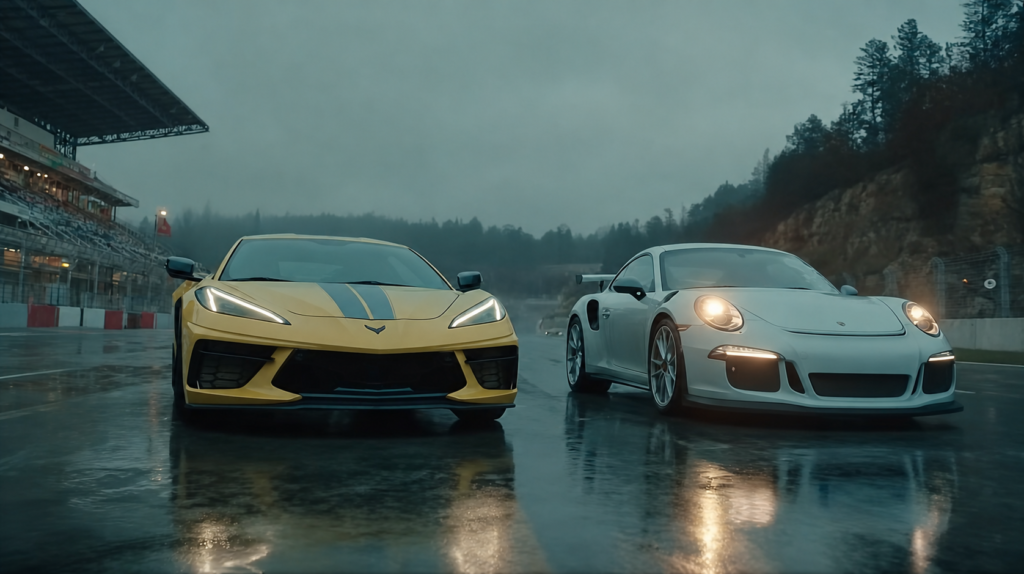
The debate between the Chevrolet Corvette and the Porsche 911 has persisted for decades. But the arrival of the mid-engine C8 Corvette Z06 has fundamentally changed the terms of the discussion. For the first time, the Corvette can claim not just superior power and value, but also technological sophistication that rivals the best from Stuttgart. The Porsche 911 GT3, now in its 992.2 generation, remains the benchmark for naturally aspirated driver’s cars. It offers a high-revving flat-six, a manual transmission, and chassis tuning that is widely regarded as peerless.
Choosing between these two machines is not a matter of simple metrics. It is a decision rooted in philosophy, driving priorities, and the ownership experience. This article compares the Corvette Z06 and the Porsche 911 GT3 across performance, track capability, design, practicality, and value to help determine which is the better driver’s car.
The Contenders: Two Philosophies of Speed
Chevrolet Corvette Z06
The Corvette Z06 represents America’s answer to European exoticars. It uses a 5.5 liter naturally aspirated V8 with a flat-plane crank, an engine configuration traditionally associated with Ferrari. The layout is mid-engine, a radical departure for a nameplate that was front-engine for seven generations. The Z06 is designed to deliver supercar performance at a fraction of the price of its rivals.
Porsche 911 GT3
The 911 GT3 is the purist’s choice. It retains the rear-engine layout that has defined the 911 for over six decades. Its 4.0 liter naturally aspirated flat-six revs to 9,000 rpm and is available with a six-speed manual transmission. The GT3 is less about raw power and more about balance, feedback, and the connection between driver and machine.
Powertrain and Performance
The Corvette Z06: The Flat-Plane Crank V8
The Z06’s LT6 engine is a masterpiece of engineering. It is one of the most powerful naturally aspirated V8s ever fitted to a production car. The flat-plane crank allows it to rev quickly and produce a high-pitched wail reminiscent of a Ferrari V8 rather than the deep rumble of a traditional American V8.
- Displacement: 5.5 liters
- Configuration: Naturally aspirated V8 with flat-plane crank
- Horsepower: 670 hp at 8,400 rpm
- Torque: 460 lb-ft at 6,300 rpm
- Transmission: 8-speed dual-clutch (no manual option)
- 0-60 mph: 2.6 seconds
- Quarter mile: 10.6 seconds at 131 mph
The Porsche 911 GT3: The 9,000 rpm Flat-Six
The GT3’s 4.0 liter engine is the defining feature of the car. Its power output is relatively modest, but its willingness to rev and its immediate throttle response make it incredibly rewarding to drive hard. It produces a sharp, mechanical howl at high rpm that is distinctly Porsche.
- Displacement: 4.0 liters
- Configuration: Naturally aspirated flat-six with 9,000 rpm redline
- Horsepower: 502 to 518 hp depending on market
- Torque: 331 to 346 lb-ft
- Transmission: 7-speed dual-clutch or 6-speed manual
- 0-60 mph: 3.4 seconds with dual-clutch, 3.9 seconds with manual
- Top speed: 193 to 197 mph
Performance Verdict
The Corvette is significantly faster in a straight line. Its 670 horsepower and mid-engine traction allow it to launch harder and pull away from the Porsche on any straight section of road. However, the GT3 is not about straight-line speed. The manual transmission and the 9,000 rpm redline create an interactive experience that many drivers find more rewarding than simply going faster.
Chassis and Handling
The Corvette Z06: Mid-Engine Traction
The C8 platform is the first mid-engine Corvette. This layout provides a lower center of gravity and a more balanced weight distribution than the front-engine C7. The Z06 adds wider tires, a stiffer suspension, and an optional performance package that includes massive aerodynamic components and sticky cup tires. The car is incredibly capable, with immense grip and traction that allows drivers to apply power very early when exiting corners.
The Porsche 911 GT3: Rear-Engine Precision
The GT3’s rear-engine layout creates a unique handling signature. The weight over the rear axle provides phenomenal traction on corner exit. The steering is widely considered among the best in the industry, with an unparalleled level of feel and communication. The car rotates willingly on corner entry and remains stable and predictable at the limit.
Handling Verdict
On a track day, the Z06 will likely post a faster lap time, provided the driver can manage the car’s power and weight. However, the GT3 is generally considered the more rewarding car to drive at the limit. Its lower limits are more accessible, and its chassis communicates more clearly. Porsche’s rear-axle steering and advanced torque vectoring make the car feel smaller and more agile than its dimensions suggest.
Track Capability
The standard GT3 is exceptionally fast on a circuit, typically lapping in the low seven-minute range at the Nürburgring. The more extreme GT3 RS is even quicker. The Corvette Z06 with its performance package is also exceptionally quick, but its larger, heavier character can make it feel more intimidating on a tight circuit.
The Porsche is designed from the ground up for sustained track use. It has a sophisticated cooling system and brakes that resist fade lap after lap. The Corvette has proven its track capability, but its complex flat-plane-crank V8 generates significant heat that must be managed.
Design and Styling
The Corvette Z06: Exotic Aggression
The C8 Z06 looks like a supercar. Its wide stance, massive rear haunches, and sharp angles give it a presence that is genuinely exotic. With the performance package’s large rear wing and front dive planes, the car looks ready for a race track. It attracts attention wherever it goes.
- Proportions: It is wide and low, with a dramatic silhouette that borrows cues from European supercars.
- Aerodynamics: The performance package includes a massive adjustable rear wing and substantial front dive planes, generating significant downforce.
The Porsche 911 GT3: Purposeful Elegance
The 911 GT3 is more understated than the Corvette. The Touring package removes the large rear wing entirely, creating a car that looks like a standard 911 Carrera to the untrained eye. The winged version is more aggressive, but it still maintains the classic 911 silhouette. The design is functional and elegant rather than flashy.
- Timeless Proportions: The 911 shape is universally recognized and has aged gracefully over decades.
- Aerodynamics: The front spoiler and rear wing are functional but integrated more subtly than on the Corvette.
- Touring Package: An option that deletes the rear wing for a more classic, understated look.
Interior and Practicality
The Corvette Z06: Driver-Focused Tech
The Corvette’s interior is a significant leap forward from previous generations. It features a squared-off steering wheel, a bank of physical buttons for climate control, and a high-resolution digital gauge cluster. The seats are supportive for spirited driving. The cabin is designed to cocoon the driver.
The Porsche 911 GT3: Ergonomic Precision
The 911 GT3’s interior is less dramatic than the Corvette’s, but it is ergonomically superior. Everything falls naturally to hand. The driving position is excellent. The materials are of high quality, though the cabin can feel utilitarian compared to the Corvette’s more stylized layout.
Practicality and Daily Use
Neither car is particularly practical, but the Porsche is easier to live with daily. The front trunk is a useful size, and the rear seats offer additional storage space. The Corvette has a front trunk and a rear trunk, but the rear trunk is small and can get hot from the engine. The Corvette’s cabin is also quite tight on space.
Ownership Experience and Value
Acquisition Cost and Availability
The Corvette Z06 has a starting MSRP of approximately $115,000 to $120,000. However, due to high demand and dealer markups, actual transaction prices have often been significantly higher. The used market has moderated, but finding one at MSRP remains challenging.
The Porsche 911 GT3 starts at approximately $180,000. Allocations are difficult to secure, and dealers often require a history of Porsche purchases to order one. The GT3 holds its value exceptionally well, often selling for more than its original MSRP on the used market.
Reliability and Maintenance
The Corvette’s high-strung LT6 engine is a complex new design. While many owners have no issues, there have been reports of engine problems requiring warranty replacement. Standard maintenance on a Porsche is expensive, but the cars are generally considered very reliable if serviced correctly. The Corvette also requires specialized servicing at a Chevrolet dealership.
Which One is Right for You?
Choose the Chevrolet Corvette Z06 if:
- You want the most power and performance for your dollar. The Z06 offers hypercar-level acceleration for a fraction of the price of European rivals.
- You love the sound of a high-revving V8. The flat-plane crank V8 is one of the best-sounding engines in production today.
- You are comfortable with a car that demands more from the driver and has a higher risk of mechanical issues.
- You prefer the dramatic looks of a mid-engine supercar.
Choose the Porsche 911 GT3 if:
- You are a purist who values the driving experience above all else. The 9,000 rpm flat-six and the manual transmission are defining features for enthusiasts.
- You plan to track your car frequently. The GT3 is more durable and easier to drive at the limit for extended sessions.
- You care about resale value. The GT3 is a more stable investment that is unlikely to depreciate heavily.
- You prefer a car that is easier to live with on a daily basis.
Specifications Summary
| Specification | Chevrolet Corvette Z06 | Porsche 911 GT3 (992.2) |
|---|---|---|
| Engine | 5.5L V8 (flat-plane crank) | 4.0L flat-six |
| Aspiration | Naturally aspirated | Naturally aspirated |
| Horsepower | 670 hp | 502 to 518 hp |
| Torque | 460 lb-ft | 331 to 346 lb-ft |
| Transmission | 8-speed dual-clutch | 6-speed manual / 7-speed dual-clutch |
| Drive | Rear-wheel drive | Rear-wheel drive |
| 0-60 mph | 2.6 seconds | 3.4 seconds (dual-clutch) |
| Curb weight | Approximately 3,600 lb | Approximately 3,200 lb |
| Base price (USD) | $115,000 to $120,000 | $180,000 |
Conclusion
The Corvette Z06 and the Porsche 911 GT3 represent two different philosophies of what a modern sports car should be. The Corvette is about democratizing extreme performance. It offers Ferrari-rivaling technology and sound for a fraction of the price. It is a car that screams for attention and delivers brutal, thrilling speed.
The Porsche 911 GT3 is about the purity of the analog driving experience. It is about the balance, the feedback, and the interaction between the driver, the engine, and the road. It is a car that feels alive at any speed, even when you are not breaking any laws.
The Corvette is the better value. The Porsche is the better driver’s car. For the enthusiast who wants to feel a connection to the machine, the 9,000 rpm flat-six and the precise six-speed gearbox of the Porsche 911 GT3 are difficult to surpass. For the enthusiast who wants the relentless thrust and exotic howl of a world-class V8, the Corvette Z06 is the only logical choice.

