

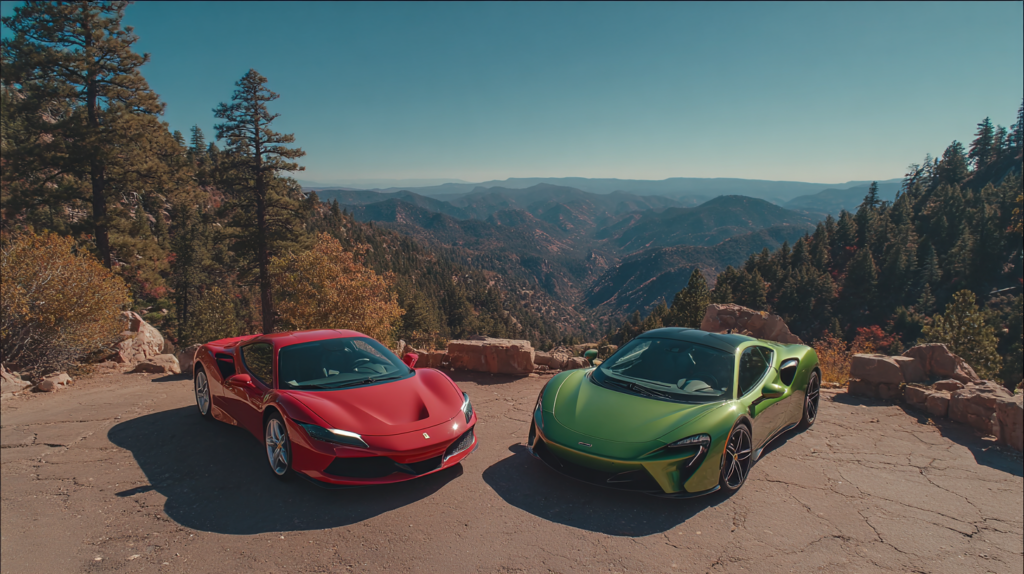
The Ferrari 296 GTB and the McLaren Artura represent a new generation of hybrid supercars. Both use a V6 engine paired with an electric motor. Both prioritize lightweight construction and handling precision over sheer horsepower. Both are designed to be as usable on city streets as they are thrilling on a race track.
Yet the two cars take very different approaches to the hybrid formula. The Ferrari emphasizes the emotional connection between driver and machine. Its V6 revs to 8,500 rpm and is mounted behind the driver in a mid-engine layout. The McLaren focuses on efficiency and weight reduction. Its V6 is smaller, its battery is larger, and its electric-only range is longer.
This article compares the Ferrari 296 GTB and the McLaren Artura across performance, handling, design, technology, and daily usability to help determine which hybrid supercar is the better choice.
The Hybrid Formula: Two Approaches
Ferrari 296 GTB: Emotion First
The 296 GTB is Ferrari’s first production V6 mid-engine supercar since the Dino of the 1960s and 1970s. The name refers to the engine displacement (2.9 liters) and the number of cylinders. The car features a 120-degree V6 mounted longitudinally behind the driver. The wide angle allows the turbochargers to be mounted inside the V, reducing lag and improving throttle response.
The electric motor is integrated into the transmission. It provides instant torque at low engine speeds and fills the gaps during gear shifts. The battery is small, with a capacity of 7.45 kWh. The electric range is approximately 15 miles, sufficient for short urban trips but not a primary feature.
McLaren Artura: Efficiency and Lightness
The Artura is McLaren’s first series-production hybrid supercar. It uses a 3.0 liter V6 with a 120-degree angle, similar to the Ferrari. But the McLaren’s engine is designed for a broader torque curve and greater fuel efficiency. The electric motor is also integrated into the transmission, but the battery is larger, with a capacity of 7.4 kWh.
The Artura’s electric range is approximately 19 miles, slightly better than the Ferrari. McLaren also emphasizes weight reduction, with a carbon fiber monocoque that keeps the dry weight to just 1,395 kilograms.
Powertrain and Performance
Ferrari 296 GTB
The 296 GTB’s powertrain is designed for maximum driver engagement. The V6 produces 654 horsepower on its own, with the electric motor adding an additional 165 horsepower. The total output is 819 horsepower and 546 lb-ft of torque.
- Engine: 3.0L twin-turbo V6 (120-degree)
- Electric Motor: Integrated into transmission
- Total Power: 819 hp
- Total Torque: 546 lb-ft
- Transmission: 8-speed dual-clutch
- Drive: Rear-wheel drive
- 0-60 mph: 2.9 seconds
- Top Speed: 205 mph
- Dry Weight: 1,470 kg
McLaren Artura
The Artura’s powertrain is tuned for a balance of performance and efficiency. The V6 produces 577 horsepower, with the electric motor adding 94 horsepower. The total output is 671 horsepower and 531 lb-ft of torque.
- Engine: 3.0L twin-turbo V6 (120-degree)
- Electric Motor: Integrated into transmission
- Total Power: 671 hp
- Total Torque: 531 lb-ft
- Transmission: 8-speed dual-clutch
- Drive: Rear-wheel drive
- 0-60 mph: 3.0 seconds
- Top Speed: 205 mph
- Dry Weight: 1,395 kg
Performance Verdict
The Ferrari is significantly more powerful. Its 819 horsepower gives it a 148 horsepower advantage over the McLaren. The 296 GTB is also slightly quicker to 60 miles per hour, with a time of 2.9 seconds compared to the Artura’s 3.0 seconds.
However, the McLaren is lighter. Its dry weight of 1,395 kilograms is 75 kilograms less than the Ferrari. The power-to-weight ratio of the Ferrari is approximately 1.75 hp per kilogram, while the Artura’s is approximately 1.67 hp per kilogram. The Ferrari has a clear advantage, but the McLaren’s lighter weight and broader torque curve make it feel more responsive in everyday driving.
Chassis and Handling
Ferrari 296 GTB: The Evolution of the Mid-Engine Formula
The 296 GTB uses a mid-engine layout that has been refined over decades of Ferrari supercar development. The engine is mounted low in the chassis, contributing to a low center of gravity. The suspension uses double wishbones at all four corners, with active dampers that adjust based on driving conditions.
The car features Ferrari’s Side Slip Control system, which uses the electric motor to manage torque delivery and stability. The system allows the driver to control oversteer with confidence, making the car feel playful but predictable.
McLaren Artura: The Lightweight Specialist
McLaren’s expertise in carbon fiber construction is evident in the Artura. The car’s monocoque weighs only 82 kilograms, contributing to the low overall weight. The suspension uses double wishbones at all four corners, with pushrod-activated dampers.
The Artura features McLaren’s Proactive Chassis Control system, which uses the electric motor to manage body roll without the need for anti-roll bars. The system keeps the car flat through corners while maintaining ride comfort.
Handling Verdict
Both cars are exceptional. The Ferrari has a slightly more rear-biased weight distribution, giving it a playful, adjustable character. The car can be rotated on corner entry and set up for a corner with the throttle. The McLaren is more neutral and precise. Its lower weight and rigid chassis make it feel more agile, but it is less willing to oversteer.
The Ferrari is the more exciting car to drive at the limit. The McLaren is the more forgiving car, making it easier to drive quickly with less effort.
Design and Styling
Ferrari 296 GTB: Elegant and Aggressive
The 296 GTB’s design is a blend of classic Ferrari styling and modern aerodynamics. The front end features a prominent grille and slim headlights that are integrated into the bodywork. The side profile shows the mid-engine proportions, with a long wheelbase and short overhangs.
The rear end is dominated by a prominent diffuser and quad exhaust outlets. The taillights are slim and integrated into the bodywork. The car is available as a coupe or as a retractable hardtop convertible called the 296 GTS.
McLaren Artura: Purposeful and Technical
The Artura’s design is more technical, with sharp lines and dramatic air intakes. The front end features a low nose and large intakes that feed cooling air to the engine and brakes. The side profile shows the dihedral doors, a McLaren signature, and the massive side intakes.
The rear end is characterized by a prominent diffuser and high-mounted exhaust outlets. The taillights are slim and integrated into the bodywork.
Design Verdict
The Ferrari is the more beautiful car. Its curves and proportions are classic and elegant. The McLaren is the more aggressive car, with a technical, race-inspired appearance. The choice between them is a matter of personal taste.
Interior and Technology
Ferrari 296 GTB: Driver Focused
The interior of the 296 GTB is designed around the driver. The digital instrument cluster is positioned directly in front of the driver, and the passenger has a dedicated touchscreen. The steering wheel is flat-bottom, with integrated controls for the car’s systems.
The seats are comfortable and supportive, with ample adjustment. The cabin is well-insulated, making the car quiet at highway speeds.
McLaren Artura: Minimalist and Modern
The Artura’s interior is minimalist, with a small digital instrument cluster and a central touchscreen. The steering wheel has few controls, with most functions managed through the touchscreen.
The seats are supportive but firm. The cabin is less spacious than the Ferrari’s, with less storage space.
Technology Verdict
The Ferrari has a more advanced and user-friendly infotainment system. The Touchpad interface is intuitive, and the passenger display is a useful feature. The McLaren’s system is simpler but less capable.
Daily Usability and Practicality
Electric Range
The Ferrari has an electric range of approximately 15 miles. This is sufficient for short trips, but the car will rely on the V6 for most driving. The McLaren has a range of approximately 19 miles, slightly better but still limited.
Cargo Space
The Ferrari has a front trunk with space for a weekend bag. There is additional storage behind the seats. The McLaren has a small front trunk and limited interior storage.
Ride Comfort
Both cars are surprisingly comfortable for supercars. The Ferrari’s suspension is slightly more compliant, making it better suited to rough roads. The McLaren’s ride is firmer, but it is still acceptable for daily driving.
Usability Verdict
The Ferrari is the more practical daily driver. Its ride is more comfortable, its interior is more spacious, and its infotainment system is better. The McLaren is lighter and more agile, but it is less forgiving on rough roads.
Value and Ownership
Pricing
The Ferrari 296 GTB has a base price of approximately $350,000. The McLaren Artura has a base price of approximately $240,000. The Ferrari is significantly more expensive, reflecting its higher power output and brand prestige.
Depreciation
Both cars are expected to hold their value well, but the Ferrari’s limited production numbers and brand cachet give it an advantage. The 296 GTB is likely to depreciate less than the Artura over the long term.
Ownership Costs
Maintaining a Ferrari is more expensive than a McLaren. Service intervals are shorter, parts are more expensive, and the dealer network is smaller. The Artura’s simpler powertrain and lower complexity should result in lower ownership costs.
Which One is Right for You?
Choose the Ferrari 296 GTB if:
- You want the most powerful and exciting hybrid supercar. The Ferrari’s 819 horsepower provides a thrill that the McLaren cannot match.
- You value brand prestige and exclusivity. The Ferrari badge carries a weight that McLaren cannot equal.
- You plan to drive the car on public roads more than on track. The Ferrari is more comfortable and more usable.
- You can afford the higher purchase price and ownership costs.
Choose the McLaren Artura if:
- You prioritize handling precision and driving engagement. The Artura is lighter and more agile, making it more rewarding on a track.
- You value efficiency and modern technology. The Artura’s longer electric range and lower weight are advantages.
- You want a car that is easier to live with on a daily basis. The Artura’s simpler systems and lower running costs make it a better value.
- You are price-sensitive. The Artura is significantly less expensive than the Ferrari.
Specifications Summary
| Specification | Ferrari 296 GTB | McLaren Artura |
|---|---|---|
| Engine | 3.0L twin-turbo V6 | 3.0L twin-turbo V6 |
| Electric Motor | 165 hp | 94 hp |
| Total Power | 819 hp | 671 hp |
| Total Torque | 546 lb-ft | 531 lb-ft |
| Transmission | 8-speed DCT | 8-speed DCT |
| Drive | Rear-wheel drive | Rear-wheel drive |
| 0-60 mph | 2.9 seconds | 3.0 seconds |
| Top Speed | 205 mph | 205 mph |
| Electric Range | 15 miles | 19 miles |
| Dry Weight | 1,470 kg | 1,395 kg |
| Base Price | $350,000 | $240,000 |
Conclusion
The Ferrari 296 GTB and the McLaren Artura are two of the finest hybrid supercars ever built. They represent the future of performance: electrification without compromise. Both combine a V6 engine with an electric motor to deliver thrilling performance and surprising efficiency.
The Ferrari is the more powerful and more exciting car. Its 819 horsepower and 8,500 rpm redline are intoxicating. The car is also more comfortable, more usable, and more prestigious. But it is also significantly more expensive.
The McLaren is the lighter and more agile car. Its 1,395 kilogram curb weight and Proactive Chassis Control make it one of the best handling cars on the market. It is also more efficient, with a longer electric range and lower running costs. And it is significantly less expensive.
Which is the better supercar? The answer depends on what you value most. If you want the most powerful and prestigious hybrid supercar, the Ferrari 296 GTB is the clear choice. If you want a lighter, more agile car that is easier to live with and costs less, the McLaren Artura is the better option.
Both are exceptional. Both represent the best of what hybrid technology can offer. And both prove that the supercar is far from dead. It is simply evolving.

