
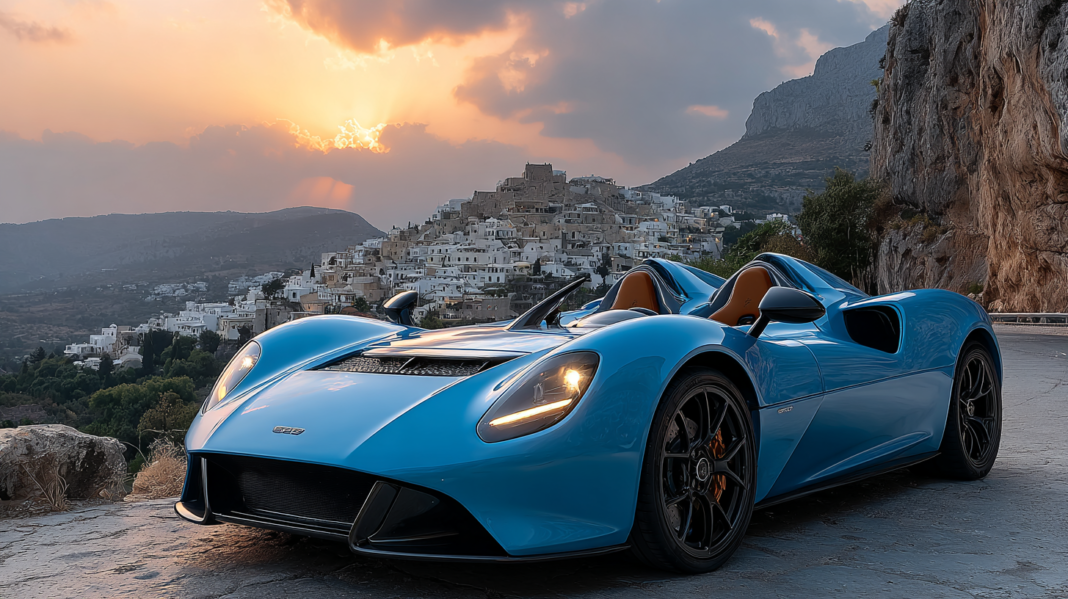
The name Gordon Murray carries a specific weight in automotive circles. As the designer of the McLaren F1, widely regarded as one of the greatest driver’s cars ever built, Murray established a philosophy that prioritizes lightweight construction, analog engagement, and timeless design over chasing horsepower figures and electronic complexity. His post-McLaren career has been defined by a return to these principles through his own company, Gordon Murray Automotive.
The T.33 Spider, revealed in 2023 and now approaching customer deliveries in 2026, represents the open-top expression of Murray’s vision for an “everyday supercar.” It follows the T.33 coupe, which was first shown in 2022, and shares its core engineering with that model while adding the sensory experience of roof-open driving. Developed in parallel with the coupe from the earliest sketches, the Spider was designed to maintain the structural integrity and driving dynamics of the closed car without the weight penalties that typically accompany convertible conversions.
This article provides a detailed examination of the Gordon Murray T.33 Spider, its performance specifications, design philosophy, and what makes this car stand out in the current automotive landscape.
The Gordon Murray Philosophy
Gordon Murray Automotive operates differently from conventional car manufacturers. Based in Windlesham, England, the company produces vehicles in strictly limited numbers, with each car assembled by hand at its new global headquarters. The T.33 Spider represents the fourth model in the company’s portfolio, joining the T.50, T.50s, and T.33 coupe.
The company’s approach is guided by seven core principles: Driving Perfection, Lightweight, Engineering Art, Premium Brand, A Return to Beauty, Exclusivity, and a personalized Customer Journey. These principles inform every decision, from material selection to suspension tuning, and they explain why the T.33 Spider exists in an automotive world increasingly dominated by electrification and automation.
Murray has described the T.33 as a car for those who appreciate the purity of the driving experience. It is not designed to win spec sheet comparisons or to claim the highest top speed. It is designed to reward the driver with feedback, precision, and engagement every time they get behind the wheel.
Development Timeline and Production Status
The journey from concept to customer for the T.33 Spider has been longer than originally anticipated. The T.33 coupe was first revealed in early 2022, with first deliveries initially planned for 2024. However, delays in the production of the limited-run T.50, of which only 100 examples were built, pushed back the timeline for the T.33 program.
Production of the T.50 was completed in July 2025, allowing Gordon Murray Automotive to shift its focus fully to the T.33. A fresh investment of 90 million pounds secured at the end of 2025 has accelerated preparations for production and the development of additional variants. The T.33 has now completed its final development phase, including winter testing in Sweden where three prototypes were spotted on public roads for the first time.
These cold weather tests, conducted near the Arctic Circle, represent the last step before the planned production start in late 2026. The prototypes, designated AP1, AP2, and AP3, were seen running in formation on snow and ice, collecting data on chassis, steering, and electronic systems under extreme conditions. The T.33 has also received full homologation for the United States market, a critical step for a low volume manufacturer seeking global reach.
All 100 examples of the T.33 coupe were sold within a week of its unveiling in 2022, at a price of approximately 1.37 million pounds. The Spider variant, also limited to 100 units, followed the same trajectory, with allocations claimed quickly by collectors and enthusiasts who understood what Murray was creating.
Powertrain Specifications
Engine Design and Development
The heart of the T.33 Spider is a 3.9 liter naturally aspirated V12 engine developed in partnership with Cosworth, the British engineering firm with decades of Formula One and motorsport experience. Designated the Cosworth GMA.2, this engine is a derivative of the unit used in the T.50 but has been specifically tuned for the T.33’s character.
The engine produces 617 horsepower at 10,250 rpm in some specifications, with other sources citing 606 to 609 horsepower depending on the market and testing cycle. Torque is rated at 333 lb ft or 451 Newton meters. While these figures may appear modest compared to turbocharged competitors producing 800 or 1,000 horsepower, they must be understood in context. The engine’s responsiveness and the car’s low weight combine to deliver performance that feels immediate and accessible rather than overwhelming.
High Revving Character
The V12 spins to 11,100 rpm, a figure that places it among the highest revving production engines ever built. This willingness to rev is central to the driving experience. Unlike turbocharged engines that produce peak torque early and then fade, the T.33 Spider’s naturally aspirated V12 builds power progressively as the rpm climbs, rewarding the driver who works through the gears and keeps the engine on the boil.
Ninety percent of peak torque is available from 4,500 rpm to 10,500 rpm, providing a broad power band that suits both road and track driving. The specific output of 158 horsepower per liter demonstrates the efficiency of the design, which uses gear driven double overhead camshafts, four valves per cylinder, and a ram induction air intake with four throttle bodies.
Transmission
Power is sent to the rear wheels through a six speed manual transmission developed specifically for Gordon Murray Automotive by Xtrac, a respected British motorsport specialist. The transmission uses an H pattern shift gate, providing the mechanical engagement that enthusiasts value. It weighs only 82 kilograms, a remarkably low figure that contributes to the car’s overall weight target.
The clutch is a 184 millimeter diameter low inertia unit, designed for quick engagement and precise modulation. A limited slip differential of Salisbury type manages power delivery to the rear wheels, providing traction during hard acceleration while allowing the driver to adjust cornering attitude through throttle application.
Weight and Power to Weight
The T.33 Spider has a target dry weight of 1,108 kilograms, or approximately 2,443 pounds. This is just 18 kilograms more than the coupe, a remarkable achievement for an open top vehicle. To put this figure in context, it is comparable to the weight of a Mazda MX-5 Miata, a car with less than one third the power.
The power to weight ratio exceeds 550 horsepower per ton, ensuring that the T.33 Spider can compete with much more powerful machines while maintaining the agility that only low mass can provide.
Chassis and Structure
iStream Ultralight Construction
The T.33 Spider is built around Gordon Murray Technologies’ iStream Ultralight carbon monocoque system. This construction method combines carbon fiber composite panels bonded to an extruded aluminum tube structure, which is triangulated at precision die cast aluminum nodes. The result is a body structure that provides exceptional torsional rigidity and occupant protection while minimizing weight.
Crucially, the T.33 program was Spider led from the beginning. This means that all torsional rigidity targets were set for the open top version, ensuring that no structural compromises were required when converting from coupe to Spider. The traditional approach of designing a coupe first and then adding reinforcements to create a convertible typically results in weight increases of 100 kilograms or more. By designing the Spider first, Murray’s team avoided this penalty entirely.
Suspension
The T.33 Spider uses double wishbone suspension at all four corners, with components manufactured from lightweight aluminum. The high pressure monotube dampers are of coilover design and are also made from aluminum. Unlike many modern performance cars, the T.33 does not offer adaptive damping. Murray’s vehicle dynamics team has meticulously calibrated fixed rate bump and rebound settings to deliver what they consider the ideal balance of ride comfort and handling precision.
Following motorsport practice, the powertrain is semi structural, with the rear suspension mounted directly to the transmission casing. This approach reduces weight and improves stiffness, but requires careful isolation to prevent noise, vibration, and harshness from reaching the cabin. Gordon Murray Automotive’s Inclined Axis Shear Mounting system uses flexible mountings to provide exactly the right amount of isolation for refinement while maintaining the precise handling that the chassis delivers.
Steering
The T.33 Spider features electrohydraulic power steering, a system that combines the feel and feedback of traditional hydraulic assistance with the energy efficiency of electric operation. An on demand electric pump provides power assistance only when needed, removing the parasitic losses of an engine driven pump while preserving the steering feel that enthusiasts value.
The steering rack is mounted directly to the chassis, and the column is adjustable for both rake and reach, allowing drivers of different sizes to find their ideal position.
Brakes
Stopping power is provided by a carbon ceramic matrix braking system developed specifically for the T.33. Front brakes use 370 millimeter by 34 millimeter discs clamped by six piston monobloc calipers. Rear brakes use 340 millimeter by 34 millimeter discs with four piston monobloc calipers. This system delivers high thermal resistance, low unsprung mass, and reduced wear, ensuring fade free deceleration under all driving conditions.
The handbrake is a manual twin cable light alloy caliper, a traditional mechanical system that avoids the weight and complexity of electronic parking brakes.
Wheels and Tires
The T.33 Spider rides on forged aluminum wheels, sized 19 inches at the front and 20 inches at the rear. Each wheel weighs less than 7 kilograms, contributing to low unsprung mass and responsive suspension behavior.
Tires are Michelin Pilot Sport 4 S, sized 235/35 ZR19 front and 295/30 ZR20 rear. Notably, these tires are smaller and narrower than those typically fitted to supercars with comparable power outputs. This is a deliberate choice, enabled by the car’s low weight. Narrower tires reduce rolling resistance, improve ride comfort, and enhance steering feel while still providing ample grip for the T.33’s performance capabilities.
Aerodynamics
Passive Aerodynamic Concept
The T.33 Spider takes a different aerodynamic approach than its T.50 stablemate. The T.50 used an active fan system, inspired by the Brabham Formula One cars that Murray designed in the 1970s, to manage underbody airflow. The T.33 dispenses with this complexity in favor of a passive ground effect system.
A front inlet directs low pressure air under the floor, where it is channeled to a rear diffuser featuring Passive Boundary Layer Control. This system, first introduced on the T.33 coupe and further refined for the Spider, manages the boundary layer of air flowing beneath the car to maximize the efficiency of the diffuser.
Active Rear Spoiler
The only active aerodynamic element on the T.33 Spider is a deployable rear spoiler. This small flap can be raised or lowered as needed, providing additional downforce or drag reduction depending on driving conditions. In high downforce mode and brake boost mode, the spoiler optimizes aerodynamic balance for cornering and braking.
At 150 miles per hour, the aerodynamic package generates 150 kilograms of downforce. At the car’s 208 miles per hour top speed, downforce increases to 312 kilograms. This level of aerodynamic grip enhances stability without compromising the car’s clean, uncluttered appearance.
Spider Specific Aerodynamics
The fixed rear section of the roof, which provides rollover protection, has been carefully shaped to minimize drag and buffeting when the roof panels are removed. This faired in design is more streamlined than the traditional twin humps behind the seats found on many speedster style convertibles. It maintains the T.33’s aerodynamic efficiency in open top configuration while contributing to the car’s distinctive visual identity.
Exterior Design
Timeless Styling Philosophy
Gordon Murray has been explicit about his design intent for the T.33 Spider. He wanted to create a car with timeless proportions, drawing inspiration from the sports cars of the 1960s that he admired in his youth. The result is a shape defined by clean surfaces, flowing curves, and an absence of aggressive aerodynamic appendages.
Every surface from the A pillar backward is unique to the Spider, yet it clearly shares its design language with the coupe. Murray has stated that he sketched both versions simultaneously to ensure that the proportions would work for the open top car, and that challenge of maintaining the purity and balance of the design while accommodating the removable roof was one of the project’s most demanding aspects.
Distinctive Features
The T.33 Spider is characterized by several visual signatures. The ram induction airbox, mounted directly to the engine and separate from the chassis, protrudes through the rear deck, feeding air to the V12 while also amplifying and enhancing its sound. This feature becomes even more distinctive with the roof panels removed, as it sits prominently in the driver’s line of sight.
The rear haunches are muscular and pronounced, housing the two 90 liter stowage compartments. The louvered rear deck aids engine cooling while adding visual interest. Vertically arranged light units at the rear and a central twin exhaust outlet complete the design.
The dihedral doors open upward and forward, providing access to the cabin while requiring less clearance than butterfly doors. They are light and easy to operate, and unlike some exotic car doors, they can be opened in confined spaces.
Roof Panels
The removable roof panels are constructed from lightweight carbon composite and can be specified in a range of colors. When not in use, they stow neatly in the front luggage compartment, a feature that Murray insisted upon to maintain usability. A rear glass panel drops behind the bulkhead at the push of a button, whether the roof is on or off, completing the open air experience and allowing the V12’s sound to fill the cabin.
Interior Design
Driver Focused Environment
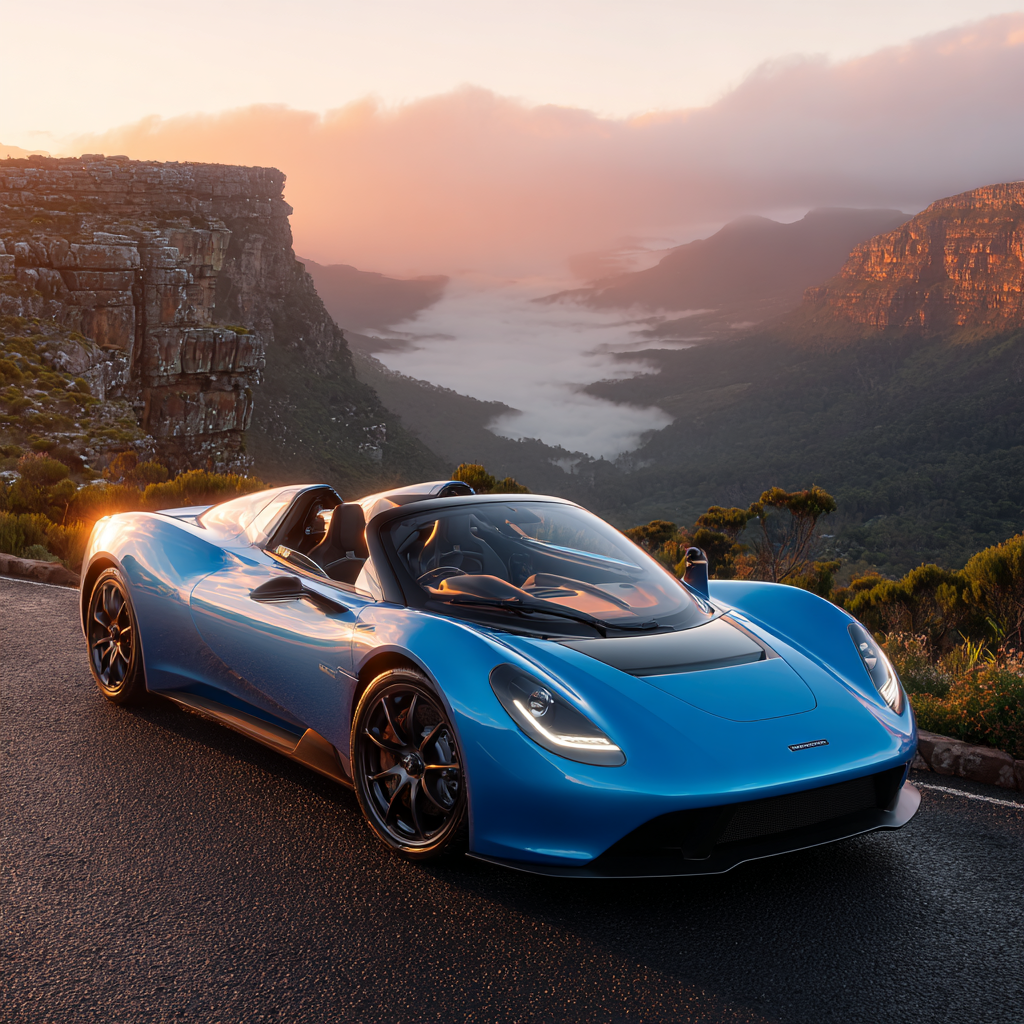
The interior of the T.33 Spider embodies Murray’s philosophy of simplicity and driver focus. The dominant element is a 120 millimeter analog rev counter, floodlit and defiantly analog, positioned centrally in the instrument cluster. Calibrated to 11,100 rpm, it serves as a constant reminder of the engine’s capabilities.
Flanking the central tachometer are two secondary displays that provide climate control and infotainment information. There is no central touchscreen, a deliberate rejection of the current trend toward screen dominated interiors. Wireless Apple CarPlay and Android Auto are available through the infotainment system, but they do not intrude on the analog character of the cabin.
Tactile Controls
All primary controls are designed for tactile satisfaction. The carbon fiber steering wheel is trimmed in leather. The pedals, gear shift lever, and switchgear are machined from aluminum alloy, providing a precision feel that plastic components cannot match. The shift lever moves through an H pattern gate with mechanical engagement that communicates directly with the transmission.
Seating and Materials
The lightweight, race inspired carbon fiber seats are trimmed in a combination of leather and Alcantara. Each car is tailored to its owner’s specifications as part of the personalized customer journey that Gordon Murray Automotive provides.
A unique interior feature of the Spider is the rear bulkhead trim between the seats, which is now body colored rather than black or gray. With the roof panels removed and the rear glass lowered, this color flash flows into the cabin, subtly enhancing the feeling of openness and connecting the interior to the exterior.
Storage and Practicality
Despite its exotic nature, the T.33 Spider is designed for usability. Total luggage capacity is 295 liters, distributed among three compartments. The front trunk, or frunk, provides storage for the roof panels when they are removed, and also accommodates additional luggage. Two side compartments, located ahead of the rear wheels and accessed through doors concealed in the rear haunches, each offer 90 liters of capacity.
This level of storage is sufficient for six suitcases, making the T.33 Spider a genuine grand tourer capable of covering long distances with two occupants and their belongings. The fuel tank holds 75 liters, providing a range of approximately 400 miles with standard gearing or 440 miles with an optional overdrive sixth gear.
Driving Experience
On Road Character
The T.33 Spider is designed to be driven, not simply collected. Its low weight, responsive steering, and linear power delivery combine to create a car that communicates with the driver constantly. Every surface irregularity, every change in camber, every shift in available grip is transmitted through the chassis and steering, allowing the driver to place the car precisely on the road.
The naturally aspirated V12 provides power in a progressive, predictable manner. There is no sudden surge of boost, no electronic intervention to manage torque delivery. The driver modulates throttle input directly, feeling the engine build power as the revs climb toward the 11,100 rpm redline. The sound, amplified by the ram induction airbox and the open roof, provides constant feedback on engine load and rpm.
On Track Behavior
When driven at the limit, the T.33 Spider reveals the depth of its engineering. The double wishbone suspension maintains tire contact through cornering, braking, and acceleration. The carbon ceramic brakes provide fade free stopping power lap after lap. The aerodynamic package generates downforce that presses the car into the pavement at high speeds, enhancing stability without compromising the car’s balance.
The rear wheel drive configuration, combined with the limited slip differential and the driver adjustable traction and stability control systems, allows the driver to rotate the car on corner entry and manage power delivery on exit. The electronic aids can be switched off entirely for experienced drivers who prefer to manage the car’s behavior without intervention.
The Sound
The acoustic experience of the T.33 Spider is central to its appeal. The Cosworth V12 produces a high frequency wail as it climbs toward its redline, a sound that is increasingly rare in an era of turbocharging and electrification. The ram induction airbox is specifically designed to amplify and enhance the engine’s sound, delivering it directly to the cabin.
With the roof panels removed and the rear glass lowered, the sound is even more immediate. The engine sits directly behind the cabin, and there is no roof to reflect or absorb its voice. The driver hears every induction pulse, every exhaust note, every mechanical movement of the valvetrain.
Usability
Despite its performance capabilities, the T.33 Spider is designed for daily use. The suspension, while precisely calibrated, is not punishing on rough roads. The steering is light enough for maneuvering at low speeds but weights up appropriately as velocity increases. The luggage capacity is sufficient for weekend trips, and the 400 mile range means fewer stops for fuel.
Gordon Murray has described the T.33 as the car you should have if you can only have one supercar. It is designed to fulfill multiple roles: weekend toy, track day tool, grand tourer, and daily driver. Few vehicles in this performance tier can make that claim.
What Makes the T.33 Spider Stand Out in 2026
The Naturally Aspirated V12
In 2026, a naturally aspirated V12 engine is an anomaly. The automotive industry has moved decisively toward turbocharging, hybridization, and electrification. Small displacement turbocharged engines produce equivalent power with lower emissions and better fuel economy, but they cannot replicate the throttle response, the linear power delivery, or the acoustic experience of a high revving naturally aspirated twelve.
The Cosworth GMA.2 represents the culmination of decades of engine development experience. It is lightweight, compact, and responsive in ways that forced induction engines cannot match. For enthusiasts who value the sensory aspects of driving, this engine alone justifies the T.33 Spider’s existence.
The Manual Transmission
The six speed manual gearbox is equally significant. Automatic transmissions, whether traditional torque converter units or modern dual clutch designs, shift faster and deliver better acceleration numbers. But they remove the driver from the act of selecting gears, reducing engagement to pressing a paddle or simply letting the car decide.
The H pattern shifter in the T.33 Spider requires the driver to participate actively in the driving process. Matching revs on downshifts, selecting the right gear for a corner exit, feeling the mechanical engagement as the synchromesh does its work these experiences are central to the T.33’s appeal. An automatic rev matching function is available for drivers who want consistent downshifts, but it can be disabled for those who prefer to heel toe themselves.
Lightweight Construction
At 1,108 kilograms dry, the T.33 Spider is exceptionally light by modern supercar standards. Most competitors weigh 1,500 kilograms or more, carrying the mass of hybrid systems, luxury equipment, and structural reinforcements. The T.33’s low weight pays dividends in every aspect of its performance: acceleration, braking, cornering, and fuel efficiency.
The iStream construction method makes this low weight possible without compromising safety or rigidity. The carbon aluminum monocoque provides the strength of a racing structure at a fraction of the weight of a traditional steel chassis. Every component, from the transmission casing to the wheels, has been optimized to shed grams without sacrificing durability.
Usability and Practicality
The T.33 Spider offers a level of practicality that is unusual in its segment. The 295 liter luggage capacity, the 400 mile range, the ability to stow the roof panels onboard these features mean the car can be used for actual travel, not just for Sunday morning drives.
Gordon Murray’s insistence on usability reflects his belief that supercars should be driven, not stored. The T.33 Spider is designed to cover distance, to accommodate luggage, to provide comfort for long journeys. It is a car for people who actually drive, not simply collect.
Timeless Design
The exterior styling of the T.33 Spider deliberately avoids trendy elements that would date quickly. There are no oversized grilles, no floating roofs, no complex creases that will look dated in a decade. Instead, Murray has created a shape defined by proportion, surface quality, and balance principles that have characterized great car design for generations.
This timeless approach means the T.33 Spider will age gracefully. It will not look like a product of its era in ways that become embarrassing as fashion moves on. It will simply look right, now and in the future.
Production and Exclusivity
Hand Built Craftsmanship
Each T.33 Spider is hand built at Gordon Murray Automotive’s new headquarters at Highams Park in Windlesham, England. A single technician oversees the assembly of each car from start to finish, stamping their name on the completed vehicle. This approach ensures a level of attention to detail that mass production cannot replicate.
Buyers are invited to visit the factory during construction, to meet the person building their car, and to specify every detail of the interior and exterior. This personalized customer journey is one of the seven principles that guide the company, and it creates a connection between owner and machine that is rare in the modern automotive world.
Limited Production
Only 100 examples of the T.33 Spider will be built, matching the production run of the coupe. This exclusivity ensures that the car will remain rare, but it also reflects the company’s commitment to quality over quantity. Building more cars would require compromises in craftsmanship and attention to detail that Gordon Murray Automotive is unwilling to make.
All 100 Spiders were allocated to buyers quickly, many of them existing Gordon Murray Automotive customers who understood what the car represents. While the official price was approximately 1.37 million pounds at launch, secondary market values have already appreciated as collectors recognize the significance of the model.
The Future of Gordon Murray Automotive
The T.33 S Variant
In addition to the coupe and Spider, Gordon Murray Automotive is developing a more track focused T.33 S variant. This model will offer increased power, reduced weight, and more aggressive aerodynamic elements for buyers who prioritize circuit performance over road comfort. Specific details have not yet been released, but the S model is expected to follow the same limited production formula as its siblings.
The T.50 and T.50s
The T.50 coupe and T.50s track car represent the halo models in the Gordon Murray Automotive lineup. The T.50, with its three seat layout and active fan aerodynamics, is a direct spiritual successor to the McLaren F1. Production of these models is now complete, with all 100 examples delivered to customers.
The Special Vehicle Division
Gordon Murray Automotive has established a Special Vehicle Division to create ultra limited, high cost variants for collectors who demand the ultimate expression of the company’s capabilities. The S1 LM, a track only evolution of the T.50s, sold at auction for 15.8 million pounds, demonstrating the demand for these bespoke creations.
Conclusion
The Gordon Murray T.33 Spider represents a remarkable achievement in an automotive world that has largely moved away from the values it embodies. It offers a naturally aspirated V12 engine that spins to 11,100 rpm, a six speed manual transmission with an H pattern gate, a lightweight carbon aluminum structure, and a timeless design that prioritizes proportion over aggression.
Yet the T.33 Spider is not simply a collection of specifications. It is the product of a clear philosophy, applied consistently by a designer who has spent decades thinking about what makes a great driver’s car. It prioritizes feel over numbers, engagement over convenience, and driving pleasure over spec sheet victories.
In 2026, as the automotive industry accelerates toward electrification and automation, the T.33 Spider stands as a counterargument. It demonstrates that there is still demand for analog engagement, for mechanical precision, for the connection between car and driver that only a lightweight, responsive, driver focused machine can provide.
For the 100 buyers who will acquire a T.33 Spider, it offers something beyond performance. It offers the knowledge that their car was designed by one of history’s greatest automotive engineers, built by hand by craftsmen who care about their work, and engineered to deliver an experience that is becoming increasingly rare. It is a car for people who drive, not simply for people who collect.
And in that regard, it is a fitting continuation of the legacy that Gordon Murray began with the McLaren F1 more than three decades ago. The T.33 Spider is not a retro car, not a recreation, not a nostalgia play. It is a modern machine built on timeless principles, and it will reward its owners for as long as they choose to drive it.

