

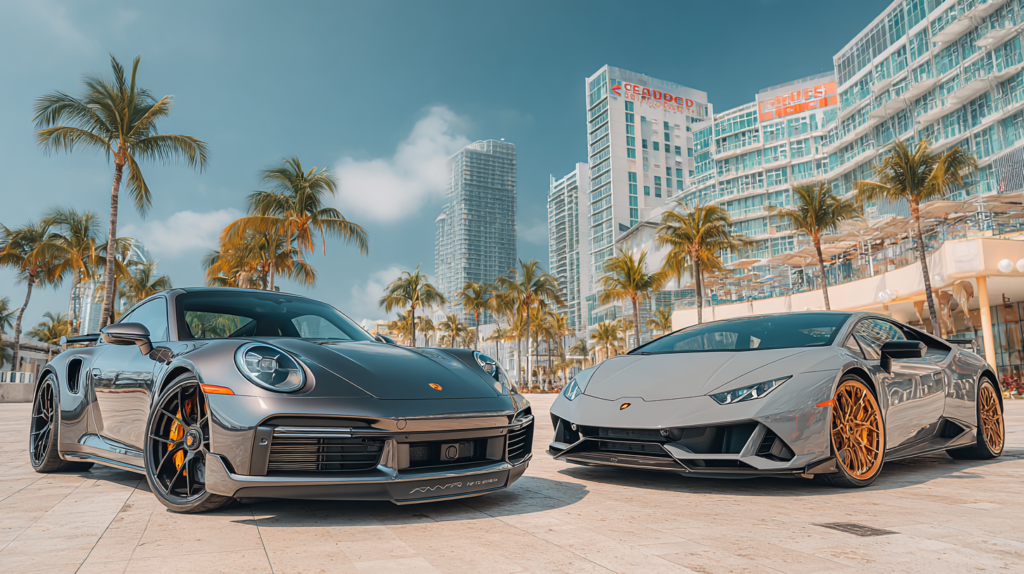
The Porsche 911 Turbo S and the Lamborghini Huracán EVO represent two distinct approaches to high-performance motoring. The Turbo S is the ultimate expression of the everyday supercar. It combines blistering acceleration with all-weather traction, a comfortable interior, and the usability of a daily driver. The Huracán EVO is the drama machine. It is loud, aggressive, and unapologetically flamboyant. Its naturally aspirated V10, all-wheel-drive system, and sharp styling make it a car that demands attention.
Both cars are capable of extraordinary speed. Both are expensive, exclusive, and desirable. But they are designed for very different drivers. This article compares the Porsche 911 Turbo S and the Lamborghini Huracán EVO across performance, handling, design, daily usability, and value to determine which one you would drive every day and which one you would save for the weekends.
The Contenders: Two Very Different Personalities
Porsche 911 Turbo S: The Mature Supercar
The 911 Turbo S is the flagship of the 911 lineup. It uses a 3.7 liter twin-turbocharged flat-six engine producing 640 horsepower. The car features Porsche’s advanced all-wheel-drive system, rear-axle steering, and adaptive suspension. The design is aggressive, but it is still recognizable as a 911. The Turbo S is designed to be used every day, in any weather, without compromise.
Lamborghini Huracán EVO: The Drama Machine
The Huracán EVO is the mid-cycle update of Lamborghini’s V10 supercar. It uses a 5.2 liter naturally aspirated V10 engine producing 631 horsepower. The car features Lamborghini’s all-wheel-drive system with rear-wheel steering and advanced torque vectoring. The design is sharp, angular, and aggressive. The Huracán is designed to be an event every time you drive it.
Powertrain and Performance
Porsche 911 Turbo S
The Turbo S’s flat-six engine is a masterpiece of forced induction. The twin turbochargers provide massive low-end torque, with peak torque available from 2,500 rpm. The engine produces 640 horsepower at 6,750 rpm and 590 lb-ft of torque from 2,500 to 4,000 rpm.
- Displacement: 3.7 liters
- Configuration: Twin-turbo flat-six
- Horsepower: 640 hp at 6,750 rpm
- Torque: 590 lb-ft from 2,500 to 4,000 rpm
- Transmission: 8-speed dual-clutch
- Drive: All-wheel drive
- 0-60 mph: 2.6 seconds
- Top Speed: 205 mph
- Curb Weight: 1,640 kg
Lamborghini Huracán EVO
The Huracán’s V10 is one of the last naturally aspirated engines in its class. The engine produces a distinctive, high-pitched wail as the revs climb toward the 8,500 rpm redline. The power delivery is linear and progressive, with a surge of torque in the upper rev range.
- Displacement: 5.2 liters
- Configuration: Naturally aspirated V10
- Horsepower: 631 hp at 8,000 rpm
- Torque: 443 lb-ft at 6,500 rpm
- Transmission: 7-speed dual-clutch
- Drive: All-wheel drive
- 0-60 mph: 2.9 seconds
- Top Speed: 202 mph
- Curb Weight: 1,542 kg
Performance Verdict
The Porsche is significantly quicker in a straight line. Its 640 horsepower and 590 lb-ft of torque, combined with the dual-clutch transmission and all-wheel-drive system, allow it to launch harder and accelerate faster than the Lamborghini. The Turbo S’s 2.6 second 0 to 60 time is 0.3 seconds quicker than the Huracán’s.
The Lamborghini’s naturally aspirated engine is slower, but it is more dramatic. The V10’s high-pitched wail and linear power delivery create an experience that the Porsche’s turbocharged flat-six cannot match.
Chassis and Handling
Porsche 911 Turbo S: Precision and Stability
The Turbo S uses Porsche’s advanced all-wheel-drive system with rear-axle steering. The system provides exceptional traction in all conditions. The rear-axle steering improves maneuverability at low speeds and stability at high speeds.
The suspension is adaptive, with settings that range from comfortable to firm. The car is incredibly stable at high speeds, with minimal body roll and precise turn-in.
Lamborghini Huracán EVO: Agility and Drama
The Huracán’s all-wheel-drive system is rear-biased, giving it the feel of a rear-wheel-drive car. The rear-wheel steering, which turns the rear wheels in the opposite direction to the front wheels at low speeds and in the same direction at high speeds, improves agility.
The suspension is firm, transmitting road imperfections to the cabin. The car feels smaller and more agile than the Porsche, with quicker turn-in and more adjustability.
Handling Verdict
The Porsche is the more stable and predictable car. It inspires confidence in all conditions, from wet roads to high-speed highway cruising. The Lamborghini is the more agile and playful car. It is more engaging to drive at the limit, but it is less forgiving.
The Turbo S is the better car for daily driving. The Huracán is the better car for weekend thrills.
Design and Styling
Porsche 911 Turbo S: Understated Aggression
The Turbo S’s design is aggressive but understated. The wider body, larger air intakes, and prominent rear wing signal its performance capabilities, but it is still recognizable as a 911. The car is available in a range of colors, but it does not scream for attention.
The interior is luxurious and driver-focused. The seats are comfortable and supportive, and the cabin is quiet at highway speeds.
Lamborghini Huracán EVO: Unapologetic Drama
The Huracán’s design is sharp, angular, and aggressive. The front end features a prominent grille and large air intakes. The side profile shows the massive side intakes and the sharp lines. The rear end is characterized by a prominent diffuser and quad exhaust outlets.
The interior is dramatic, with a fighter jet-inspired cockpit, a digital instrument cluster, and a central touchscreen.
Design Verdict
The Lamborghini is the more dramatic and attention-grabbing car. It stops traffic and draws a crowd. The Porsche is more understated, appealing to drivers who prefer to fly under the radar.
Daily Usability and Practicality
Porsche 911 Turbo S: The Everyday Supercar
The Turbo S is designed for daily use. The ride is compliant, the cabin is quiet, and the seats are comfortable for long journeys. The car has a front trunk with enough space for a weekend bag, and the rear seats offer additional storage.
The all-wheel-drive system provides traction in rain and snow, making the Turbo S a year-round car. The fuel economy, while not class-leading, is reasonable for a 640 horsepower supercar.
Lamborghini Huracán EVO: The Weekend Toy
The Huracán is less practical for daily use. The ride is firm, the cabin is loud, and the seats are less comfortable for long journeys. The car has a small front trunk that can hold a small bag, but there is no additional storage.
The all-wheel-drive system provides traction, but the car’s low ground clearance and wide body make it challenging in urban environments. The fuel economy is poor, even by supercar standards.
Usability Verdict
The Porsche is the clear winner for daily use. It is comfortable, practical, and usable in all weather conditions. The Lamborghini is best reserved for weekends and special occasions.
Driving Experience
On the Road
The Turbo S is a car that can be driven every day without compromise. The engine provides effortless power, the transmission shifts smoothly, and the suspension absorbs road imperfections. The car is quiet, comfortable, and refined.
The Huracán is a car that demands attention. The engine is loud, the ride is firm, and the steering is heavy. The car is not relaxing, but it is thrilling. Every drive feels like an event.
On the Track
On a track, both cars are exceptional. The Turbo S is faster, with a power advantage that makes it quicker on circuits with long straights. The Huracán is more engaging, with a naturally aspirated engine that rewards high revs and a chassis that rotates eagerly on corner entry.
The Turbo S is a car that flatters the driver. It is fast, stable, and predictable. The Huracán is a car that challenges the driver. It rewards skill and punishes mistakes.
The Sound
The Porsche’s flat-six produces a deep, guttural rumble at low speeds and a sharp roar at full throttle. The sound is refined but not particularly distinctive.
The Lamborghini’s V10 produces one of the best sounds in the automotive world. The engine wails to an 8,500 rpm redline with a high-pitched shriek that is both thrilling and intoxicating.
Value and Ownership
Pricing
The Porsche 911 Turbo S has a base price of approximately $200,000. The Lamborghini Huracán EVO has a base price of approximately $210,000. The cars are similarly priced, but the Porsche holds its value better over time.
Depreciation
The Porsche 911 Turbo S is known for strong resale value. The Lamborghini Huracán depreciates more quickly, though the naturally aspirated V10 may help it hold value better than turbocharged alternatives.
Ownership Costs
Maintaining a Porsche is less expensive than a Lamborghini. Service intervals are longer, parts are more readily available, and the dealer network is larger. The Huracán’s V10 requires specialized service and parts that are more expensive.
Which One is Right for You?
Choose the Porsche 911 Turbo S if:
- You want a car that you can drive every day, in any weather. The Turbo S is comfortable, practical, and usable year-round.
- You value understated design and brand heritage. The 911 is timeless and recognizable without being flashy.
- You prioritize speed and performance over drama. The Turbo S is faster and more capable than the Huracán.
- You plan to keep the car for several years. The Porsche holds its value better and is less expensive to maintain.
Choose the Lamborghini Huracán EVO if:
- You want a car that is an event every time you drive it. The Huracán’s V10, sharp styling, and dramatic presence are unmatched.
- You prioritize emotion and engagement over practicality. The Huracán is less comfortable, but it is more thrilling.
- You want to attract attention. The Lamborghini stops traffic and draws a crowd wherever it goes.
- You are willing to accept higher ownership costs and faster depreciation.
Specifications Summary
| Specification | Porsche 911 Turbo S | Lamborghini Huracán EVO |
|---|---|---|
| Engine | 3.7L twin-turbo flat-six | 5.2L naturally aspirated V10 |
| Horsepower | 640 hp at 6,750 rpm | 631 hp at 8,000 rpm |
| Torque | 590 lb-ft from 2,500 to 4,000 rpm | 443 lb-ft at 6,500 rpm |
| Transmission | 8-speed dual-clutch | 7-speed dual-clutch |
| Drive | All-wheel drive | All-wheel drive |
| 0-60 mph | 2.6 seconds | 2.9 seconds |
| Top Speed | 205 mph | 202 mph |
| Redline | 7,200 rpm | 8,500 rpm |
| Curb Weight | 1,640 kg | 1,542 kg |
| Base Price | $200,000 | $210,000 |
Conclusion
The Porsche 911 Turbo S and the Lamborghini Huracán EVO are two of the finest performance cars ever built. They represent two very different philosophies of speed.
The Turbo S is the everyday supercar. It is fast, comfortable, practical, and usable in any weather. It is a car that you can drive to work, to the grocery store, and to the track, all in the same week. It is mature, refined, and understated.
The Huracán EVO is the drama machine. It is loud, aggressive, and unapologetically flamboyant. Its naturally aspirated V10 wails to an 8,500 rpm redline, and its sharp styling turns heads wherever it goes. It is a car for weekends, for special occasions, and for drivers who want to feel alive every time they get behind the wheel.
The Porsche is the car you would drive every day. The Lamborghini is the car you would drive on weekends.
Both are exceptional. Both will be remembered as legends. And both prove that there is no single way to go fast.

