

For the better part of a decade, the McLaren 720S and the Ferrari F8 Tributo have defined the mid-engine supercar segment. The 720S was McLaren’s second-generation Super Series car, following the 650S. It introduced a radical new design language, a more powerful 4.0 liter twin-turbo V8, and a chassis that set new standards for ride comfort and handling precision. The F8 Tributo was Ferrari’s final mid-engine V8 supercar before the brand moved to hybrid powertrains. It was a refinement of the 488 GTB, with more power, improved aerodynamics, and a more engaging driving experience.
To this day, both cars are benchmarks. They represent the pinnacle of internal combustion engineering before the industry shifted toward hybridization and electrification. This article compares the McLaren 720S and the Ferrari F8 Tributo across performance, handling, design, driving experience, and value to determine which mid-engine supercar earns the money, the emotion, and the crowd.
The Contenders: Two Philosophies of Speed
McLaren 720S: Lightweight, Agile, Technical
McLaren’s philosophy has always centered on lightweight construction and chassis precision. The 720S uses a carbon fiber monocoque that weighs just 100 kilograms. The body is shaped for aerodynamic efficiency, with a drag coefficient of just 0.32. The car’s 4.0 liter twin-turbo V8 produces 710 horsepower.
Ferrari F8 Tributo: Powerful, Refined, Emotional
Ferrari’s F8 Tributo is a tribute to the brand’s V8 heritage. The name means “tribute” in Italian, and the car honors the engines that have powered Ferrari’s mid-engine supercars for decades. The F8 uses a 3.9 liter twin-turbo V8 producing 710 horsepower. The car’s design is a blend of classic Ferrari styling and modern aerodynamics.
Powertrain and Performance
McLaren 720S
The 720S’s M840T engine is a 4.0 liter twin-turbo V8. It produces 710 horsepower at 7,500 rpm and 568 lb-ft of torque at 5,500 rpm. The redline is 8,500 rpm. The engine features a flat-plane crank, lightweight internals, and dual twin-scroll turbochargers.
- Displacement: 4.0 liters
- Configuration: Twin-turbo V8
- Horsepower: 710 hp at 7,500 rpm
- Torque: 568 lb-ft at 5,500 rpm
- Transmission: 7-speed dual-clutch
- Drive: Rear-wheel drive
- 0-60 mph: 2.7 seconds
- Quarter mile: 10.2 seconds at 140 mph
- Top Speed: 212 mph
- Curb Weight: 1,328 kg dry
Ferrari F8 Tributo
The F8’s F154 engine is a 3.9 liter twin-turbo V8. It produces 710 horsepower at 8,000 rpm and 568 lb-ft of torque at 3,250 rpm. The redline is 8,000 rpm. The engine features a flat-plane crank and a hot vee turbocharger layout that reduces lag.
- Displacement: 3.9 liters
- Configuration: Twin-turbo V8
- Horsepower: 710 hp at 8,000 rpm
- Torque: 568 lb-ft at 3,250 rpm
- Transmission: 7-speed dual-clutch
- Drive: Rear-wheel drive
- 0-60 mph: 2.8 seconds
- Top Speed: 211 mph
- Curb Weight: 1,435 kg dry
Performance Verdict
The McLaren is slightly quicker to 60 miles per hour, with a time of 2.7 seconds compared to the Ferrari’s 2.8 seconds. The 720S is also lighter, with a dry weight of 1,328 kilograms compared to the F8’s 1,435 kilograms. The power-to-weight ratio of the 720S is approximately 1.87 horsepower per kilogram, while the F8’s is approximately 1.64 horsepower per kilogram. The McLaren has a clear advantage in straight-line performance.
Chassis and Handling
McLaren 720S: The Benchmark for Ride and Handling
The 720S uses a carbon fiber monocoque that is extremely rigid and light. The suspension is a double-wishbone design with adaptive dampers. The system, called Proactive Chassis Control, replaces traditional anti-roll bars with hydraulic actuators that adjust in milliseconds.
The result is a car that rides with exceptional compliance on public roads while remaining flat and composed through corners. The steering is precise and communicative, providing excellent feedback about available grip.
Ferrari F8 Tributo: The Evolution of the 488
The F8 uses a chassis derived from the 488 GTB, with modifications for increased rigidity and reduced weight. The suspension is double-wishbone at all four corners, with adaptive dampers. The car features Ferrari’s Side Slip Control system, which manages torque delivery and stability to allow the driver to control oversteer.
The F8’s steering is quick and direct, with good feedback. The car is stable and predictable at the limit, with a slight tendency toward understeer that builds driver confidence.
Handling Verdict
The McLaren is the more agile and responsive car. Its lighter weight and sophisticated chassis control system make it feel smaller and more nimble than the Ferrari. The 720S rotates eagerly on corner entry and provides exceptional feedback.
The Ferrari is the more stable and predictable car. It is easier to drive quickly, with a power advantage that makes it faster on circuits with long straights. But the McLaren is the more engaging car to drive at the limit.
Aerodynamics
McLaren 720S: The Active Aero Pioneer
The 720S features an active aerodynamic system that adjusts the rear wing based on speed and driving mode. In high downforce mode, the wing deploys to increase grip. In low drag mode, the wing retracts to reduce resistance. The system improves high-speed stability and cornering grip.
Ferrari F8 Tributo: The S-Duct Innovation
The F8 features an S-duct aerodynamic system derived from the 488 Pista. The system channels airflow from the front bumper to the hood, increasing downforce at the front axle without adding drag. The car also features active aerodynamic elements, including a rear wing that deploys at speed.
Aerodynamics Verdict
Both cars generate significant downforce. The 720S’s active wing system is more sophisticated, but the F8’s S-duct is more integrated into the bodywork. The McLaren is the more efficient car, with a lower drag coefficient. The Ferrari is the more stable car at high speeds.
Design and Styling
McLaren 720S: Technical and Dramatic
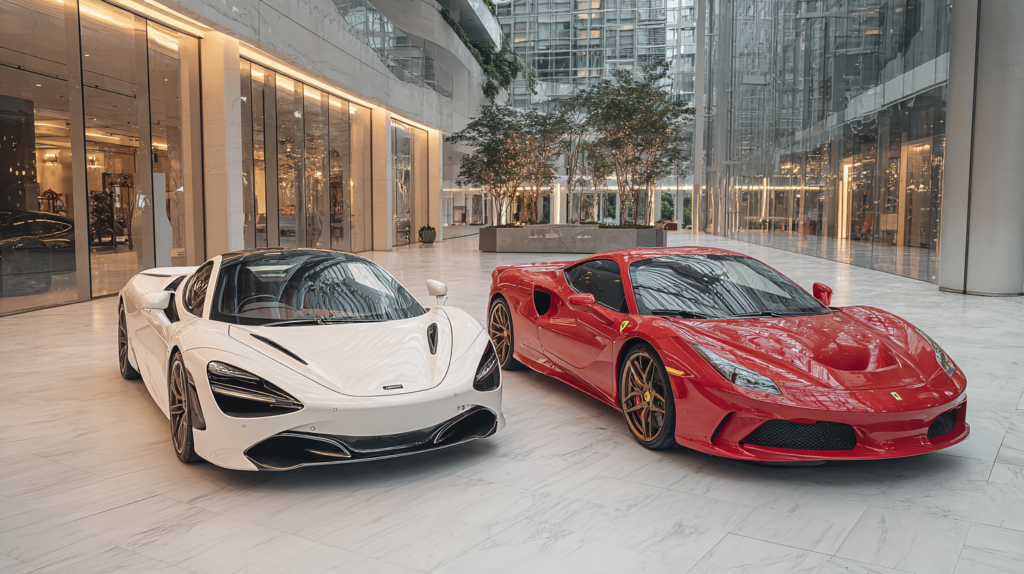
The 720S’s design is radical and futuristic. The front end features the “eye socket” headlights, which integrate the headlamps into large air intakes. The side profile shows the dihedral doors and the massive side intakes. The rear end is characterized by a prominent diffuser and twin exhaust outlets.
The interior is driver-focused, with a digital instrument cluster that folds away in track mode. The seats are supportive and comfortable, and the cabin is well-insulated.
Ferrari F8 Tributo: Elegant and Aggressive
The F8’s design is more classic. The front end features a prominent grille and slim headlights. The side profile shows the large side intakes that feed cooling air to the engine and brakes. The rear end is characterized by quad exhaust outlets and a prominent diffuser.
The interior is luxurious, with leather and Alcantara upholstery and a digital instrument cluster. The seats are comfortable and supportive, and the cabin is quiet at highway speeds.
Design Verdict
The McLaren is the more dramatic and distinctive car. Its radical design stands out in any setting. The Ferrari is the more elegant and refined car, with a timeless design that will age gracefully.
Driving Experience
On the Road
The McLaren is the more comfortable car for daily driving. Its adaptive suspension absorbs road imperfections without transmitting harshness to the cabin. The cabin is relatively quiet, and the seats are supportive for long journeys.
The Ferrari is firmer, but it is still acceptable for daily use. The ride is more communicative, with more road feel transmitted to the driver. The cabin is slightly louder, with more engine noise and road noise.
On the Track
Both cars are exceptional on a track. The McLaren’s lighter weight and agile chassis make it more rewarding to drive at the limit. The car rotates eagerly on corner entry and provides exceptional feedback. The Ferrari’s power advantage makes it faster on circuits with long straights.
The 720S feels more alive. The steering is more direct, the chassis communicates more clearly, and the car responds to inputs with immediacy. The F8 feels more clinical. It is faster and more predictable, but it is less engaging.
The Sound
The McLaren’s V8 produces a sharp, metallic wail at high rpm. The sound is technical and precise, but it lacks the emotion of the Ferrari’s engine. The Ferrari’s V8 produces a deeper, more muscular roar, with a character that is more traditional and engaging.
Value and Ownership
Pricing
The McLaren 720S has a base price of approximately $300,000. The Ferrari F8 Tributo has a base price of approximately $280,000. The Ferrari is slightly less expensive, but both cars are in the same price range.
Depreciation
Both cars have experienced significant depreciation since their introduction. The 720S and F8 have settled into a stable market, with well-maintained examples trading for $180,000 to $220,000. The Ferrari tends to hold its value slightly better due to brand prestige.
Ownership Costs
Maintaining a McLaren is more expensive than a Ferrari. Service intervals are shorter, parts are more expensive, and the dealer network is smaller. The Ferrari’s simpler systems and larger dealer network result in lower ownership costs.
Which One is Right for You?
Choose the McLaren 720S if:
- You prioritize handling precision and driver engagement. The 720S is lighter, more agile, and more rewarding to drive at the limit.
- You value technical innovation and dramatic design. The 720S’s radical styling and active aero are distinctive.
- You want a car that is comfortable enough for daily driving. The 720S’s ride quality is exceptional for a supercar.
- You prioritize track performance over brand prestige. The 720S is faster and more capable on a circuit.
Choose the Ferrari F8 Tributo if:
- You value brand prestige and emotional engagement. The Ferrari badge and V8 sound are unmatched.
- You want a car that is faster in a straight line. The F8’s power advantage makes it quicker on circuits with long straights.
- You prefer a more elegant and refined design. The F8’s styling is classic and timeless.
- You want lower ownership costs and better resale value. The Ferrari is less expensive to maintain and holds its value better.
Specifications Summary
| Specification | McLaren 720S | Ferrari F8 Tributo |
|---|---|---|
| Engine | 4.0L twin-turbo V8 | 3.9L twin-turbo V8 |
| Horsepower | 710 hp at 7,500 rpm | 710 hp at 8,000 rpm |
| Torque | 568 lb-ft at 5,500 rpm | 568 lb-ft at 3,250 rpm |
| Transmission | 7-speed dual-clutch | 7-speed dual-clutch |
| Drive | Rear-wheel drive | Rear-wheel drive |
| 0-60 mph | 2.7 seconds | 2.8 seconds |
| Top Speed | 212 mph | 211 mph |
| Dry Weight | 1,328 kg | 1,435 kg |
| Base Price | $300,000 | $280,000 |
Conclusion
The McLaren 720S and the Ferrari F8 Tributo are two of the greatest mid-engine supercars ever built. They represent the pinnacle of internal combustion engineering before the industry moved toward hybridization.
The 720S is the more technically accomplished car. Its lightweight carbon fiber monocoque, sophisticated chassis control system, and active aerodynamics make it one of the best handling cars ever built. It is more agile, more comfortable, and more rewarding to drive at the limit.
The F8 Tributo is the more emotional car. Its V8 engine produces a sound that is traditional and engaging. Its design is elegant and timeless. Its brand prestige is unmatched.
Which car earns the money, the emotion, and the crowd? The answer depends on what you value most. If you want the most capable and technically advanced supercar, the McLaren 720S is the clear choice. If you want the most emotional and prestigious supercar, the Ferrari F8 Tributo is the better option.
Both are exceptional. Both will be remembered as legends. And both prove that the internal combustion supercar is far from dead.

