
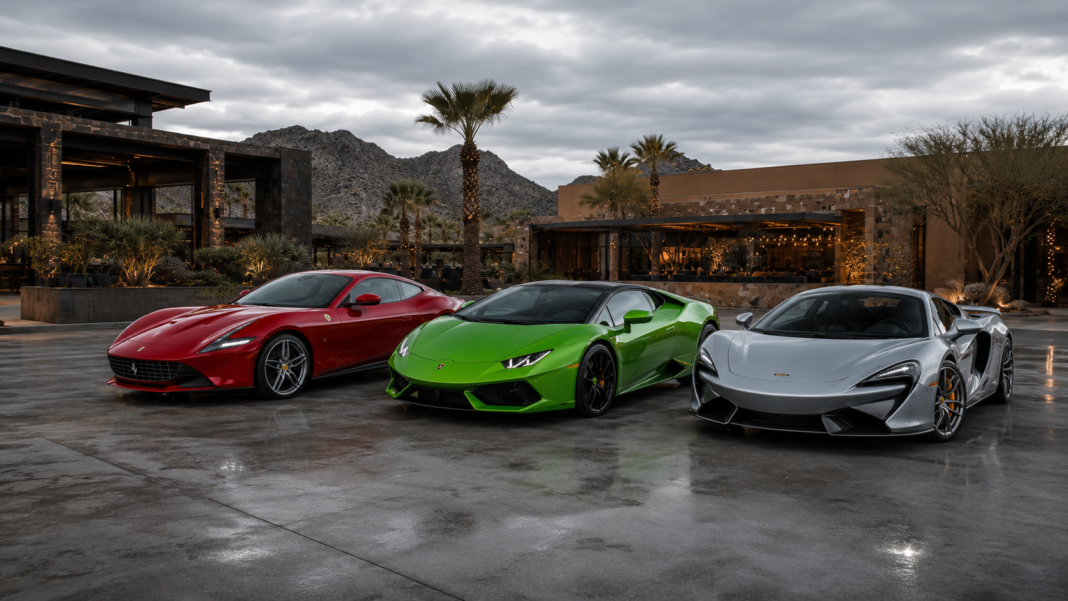
The Scottsdale Road corridor in North Scottsdale is a stretch of pavement lined with luxury dealerships. Ferrari, Lamborghini, McLaren, and Porsche all have a presence here. On a typical Saturday morning, the parking lots are filled with cars whose combined value exceeds the GDP of a small island nation.
A red Ferrari Roma sits in the showroom with a price tag of $250,000. A few miles away, a green Lamborghini Huracán Evo is listed at $280,000. Across the street, a silver McLaren Artura is priced at $240,000.
What does $200,000 actually buy in the supercar world? The average new car in the United States costs around $48,000. A $200,000 supercar costs more than four times that. Where does the money go? This article breaks down the costs, line by line.
The Bill of Materials: What the Parts Cost
Every car starts as a collection of parts. The bill of materials for a supercar is significantly higher than that of a mainstream car. But the difference is not as large as the final price suggests.
A high performance twin turbo V8 engine costs approximately $30,000 to $40,000 to manufacture. A dual-clutch transmission adds another $10,000 to $15,000. The carbon ceramic brakes on a supercar can cost $10,000 to $15,000 per axle. The wheels and tires, specially developed for the car, can add $5,000 to $10,000.
The total bill of materials for a $200,000 supercar is approximately $80,000 to $100,000. That is roughly double the bill of materials for a $50,000 sports car. But it is not four times as much.
Research and Development: The Hidden Cost
The bill of materials is only part of the story. The research and development costs for a new supercar can be enormous. A new engine platform costs hundreds of millions of dollars to develop. A new chassis, a new transmission, a new aerodynamic package each of these adds tens of millions.
These costs must be amortized over the number of units sold. A mainstream car might sell 100,000 units per year. A supercar might sell 1,000 to 5,000 units over its entire life. The development cost per unit is much higher.
A mainstream car might allocate $1,000 per unit for development. A supercar might allocate $20,000 or more.
The Hand-Built Premium
Supercars are not assembled on a production line by robots. They are hand built by skilled technicians. The engine in a Ferrari is assembled by a single master technician. The leather interior of a Bentley is stitched by craftspeople who have trained for years.
This hand built quality is part of the supercar appeal. It is also expensive. The labor cost for a hand built supercar can be $10,000 to $20,000 higher than for a mass produced car.
The Marketing Halo
Supercar manufacturers spend heavily on marketing. The global launch event, the Formula 1 sponsorship, the print advertisements, the social media campaigns all of these add to the cost.
Marketing costs for a supercar are typically 5 to 10 percent of the vehicle price. On a $200,000 car, that is $10,000 to $20,000.
The Exclusivity Premium
Supercar manufacturers deliberately limit production. Scarcity drives demand. The limited production numbers mean that each car must carry a higher share of fixed costs.
The exclusivity premium is the amount you pay for the privilege of owning a car that few others can have. It is difficult to quantify, but it is real. A $200,000 supercar might have a $30,000 to $50,000 exclusivity premium baked into the price.
The Dealership Margin
The dealership needs to make a profit. The margin on a new supercar is typically 8 to 12 percent. On a $200,000 car, that is $16,000 to $24,000.
Some supercars sell for more than the MSRP due to high demand. That additional money goes to the dealer, not the manufacturer.
The Scottsdale Math: A Case Study
The Ferrari Roma in the Scottsdale showroom is priced at $250,000. Where does the money go? An estimated breakdown:
- Bill of Materials: $90,000
- Research and Development (amortized): $25,000
- Hand-built labor: $15,000
- Marketing: $15,000
- Exclusivity premium: $40,000
- Dealership margin: $25,000
- Transportation and preparation: $5,000
- Manufacturer profit: $35,000
Total: $250,000
The numbers are estimates, but the pattern is clear. The manufacturing cost of the physical parts is less than half the selling price. The rest is development, exclusivity, and profit.
What You Are Really Paying For
When you spend $200,000 on a supercar, you are paying for:
- Engineering: The development of a low volume, high performance machine costs millions. You are paying a share of that.
- Exclusivity: You are paying for the right to own a car that few others can have.
- Craftsmanship: You are paying for hand built quality and attention to detail.
- Marketing: You are paying for the Formula 1 team and the global launch event.
- The Badge: You are paying for the history, the heritage, and the brand.
You are not paying $200,000 for $200,000 worth of metal, glass, and rubber. You are paying for a story.
The Value Proposition: Is It Worth It?
Whether a $200,000 supercar is worth the money depends on what you value. If you value transportation, a $30,000 sedan does the same job. If you value speed, a $70,000 Corvette is almost as fast. If you value exclusivity, craftsmanship, and emotion, the supercar has no substitute.
The supercar buyer is not paying for a car. They are paying for an experience.
The Scottsdale Sunset
The Ferrari Roma pulls out of the showroom and heads toward the McDowell Mountains. The driver accelerates onto the open road, the engine note climbing, the wind rushing past. The car is expensive, impractical, and excessive.
The driver smiles. That is what $200,000 buys.
Cost Comparison: Supercar vs Mainstream
| Component | Mainstream Car ($50k) | Supercar ($200k) | Difference |
|---|---|---|---|
| Engine | $5,000 | $35,000 | $30,000 |
| Transmission | $2,000 | $12,000 | $10,000 |
| Brakes | $1,000 | $12,000 | $11,000 |
| Tires | $500 | $3,000 | $2,500 |
| Interior | $3,000 | $15,000 | $12,000 |
| Development per unit | $1,000 | $20,000 | $19,000 |
| Labor | $5,000 | $20,000 | $15,000 |
| Marketing | $1,000 | $15,000 | $14,000 |
| Dealer margin | $4,000 | $20,000 | $16,000 |
| Total | $22,500 | $152,000 | $129,500 |
The table shows the difference. The supercar’s parts are more expensive, but the real difference is in development, labor, marketing, and margin.
Conclusion
The $200,000 supercar is not a rational purchase. It is an emotional one. The money buys engineering, exclusivity, craftsmanship, and a story. It does not buy transportation.
Whether that is worth it is a question only the buyer can answer.
The Ferrari Roma disappears into the Arizona desert. The sun sets. The driver is alone with the car and the road. For that driver, the $250,000 was money well spent. For the driver of a Honda Civic on the same road, it might not be.
That is the nature of the supercar. It is not for everyone. It is not meant to be.

