
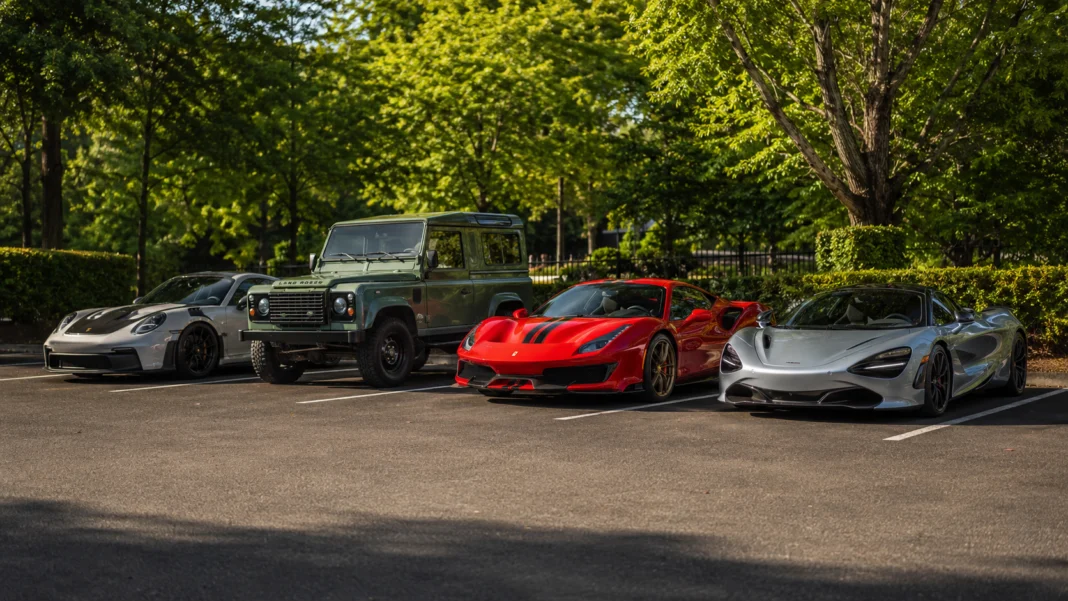
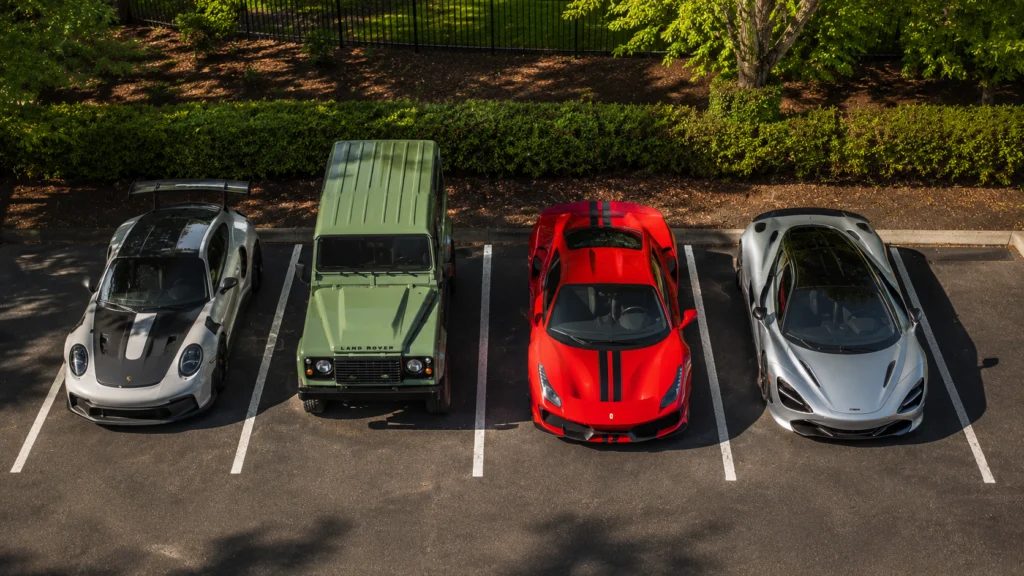
Imagine the sun setting over the Potomac River and a parking lot in Great Falls, Virginia, already full. A line of cars stretches down the block. A Porsche 911 GT3 RS parks next to a vintage Land Rover Defender. A Ferrari 488 Pista idles next to a modified Honda Civic Type R. A McLaren 720S is surrounded by teenagers taking photos. The crowd is a mix of retirees in driving shoes, tech workers in hoodies, and families pushing strollers.
Car meets have existed for decades. But something has changed in the last ten years. What was once a niche hobby for gearheads has become a mainstream cultural phenomenon. Car meets now attract thousands of attendees. They generate millions of views on YouTube and TikTok. They have become community events, art installations, and social media spectacles.
This article tells the story of how car meets went mainstream. Katie’s Cars & Coffee in Great Falls, Virginia, is a good example of the arc: a small weekend gathering of friends that grew into one of the best-known meets in the country.
The Location: Katie’s Cars & Coffee, Great Falls, Virginia
Katie’s is not the largest car meet in the country. It is not the most famous. But it is one of the most consistent. Every Saturday morning, rain or shine, cars gather in this suburban strip mall. The owner of the coffee shop is not a car enthusiast. He simply allowed the first few cars to park in his lot. The crowd grew organically.
The meet is a microcosm of the larger trend. The cars range from a $15,000 Mazda Miata to a $3 million Bugatti Chiron. The attendees range from teenagers who cannot drive yet to retirees who have owned dozens of cars. The common thread is a shared passion for cars and a desire to be around people who share that passion.
The Early Days: A Niche Hobby (2000 to 2010)
Before social media, car meets were smaller and more insular. Enthusiasts found each other through forums like NASIOC for Subaru owners, VWVortex for Volkswagen fans, and FerrariChat for the well-heeled. Meets were organized on message boards. Attendance was measured in dozens, not hundreds.
The cars were more specialized. A meet might be exclusively for European exotics or Japanese imports. There was less cross-pollination between different car cultures.

The Saturday morning Cars & Coffee format was pioneered in Southern California. The idea was simple: a casual gathering where any car was welcome, and the only requirement was a love of automobiles.
The Social Media Tipping Point (2010 to 2015)
The rise of Instagram and Facebook groups transformed car meets. Suddenly, it was easy to organize events and share photos. A meet that once required days of forum planning could be set up with a single post.
The visual nature of Instagram was a perfect fit for car culture. A well-photographed car could attract hundreds of attendees. A video of a burnout could go viral.
Katie’s Cars & Coffee grew rapidly during this period. The meet was featured on several popular car blogs. Photos of the stunning lineup spread across social media. Word of mouth did the rest.
The YouTube Effect (2015 to 2020)
YouTube creators like Supercar Suspects, Vehicle Virgins, and DDE (Daily Driven Exotics) began filming at car meets. A car that appeared in a popular video became famous overnight. Owners started bringing their most exotic cars specifically to be filmed.
Car meets became content farms. Creators walked the lots with cameras, interviewing owners and filming walkarounds. A successful video could generate millions of views and thousands of dollars in ad revenue.
This created a feedback loop. More people attended meets hoping to be featured. More content drew more viewers, who then attended meets themselves. The cycle accelerated.
The Mainstream Tipping Point (2020 to 2024)
The pandemic had a paradoxical effect on car culture. With other forms of entertainment closed, people turned to cars. Driving was a safe activity. Car meets were held outdoors. The sense of community was appealing after months of isolation.
During this period, car meets exploded in popularity. Events that once drew 200 cars began drawing 2,000. The demographic shifted. More women attended. More families attended. More people who had never considered themselves car enthusiasts showed up to see the spectacle.
Katie’s Cars & Coffee became a victim of its own success. The lot could no longer accommodate the crowd. Cars parked on the grass. Traffic backed up onto the main road. Local residents complained. The meet was forced to implement rules and limit attendance.

The Katie’s Experience: A Saturday Morning in Great Falls
The meet officially starts at 7:00 AM. The dedicated attendees arrive by 6:00 AM to secure a good spot. The early morning light is perfect for photography. The coffee shop opens early, and the line for lattes is as long as the line for cars.
A young man in a hoodie is filming a walkaround of a Lamborghini Huracán for his YouTube channel. He has 50,000 subscribers. He is not famous, but he is part of the ecosystem.
A father and son are standing next to a Porsche 911. The father is explaining the difference between a Carrera and a Turbo. The son is listening, but he is also watching the McLaren across the lot.
A group of retirees are sitting in lawn chairs behind their vintage Alfa Romeos. They have been coming to Katie’s for years. They remember when the meet was small enough that everyone knew everyone’s name.
A security guard is directing traffic. The meet has become so large that paid security is now required.
The Criticism: What Has Been Lost
Not everyone is happy with the mainstreaming of car meets. Some long-time attendees complain that the events have lost their intimacy. The sense of community has been diluted by the sheer number of people.
There is also a safety concern. Some meets have been shut down due to reckless behavior. Burnouts, drifting, and street racing have become associated with car culture, and not all meets are well-behaved.
Katie’s has avoided major incidents. The organizers have been proactive about enforcing rules. But the tension remains.
The Future of Car Meets
Car meets are not going away. They have become too large and too popular. But they are evolving.
Some meets are becoming ticketed events. This helps control attendance and provides funding for security and cleanup. Others are moving to larger venues, such as racetracks and fairgrounds.
The Cars & Coffee format is spreading globally. There are now events in Australia, Japan, and across Europe. The basic formula remains the same: a casual gathering, open to all cars, with a focus on community.
The Katie’s Sunset
The sun is fully up now. The lot is full. The coffee shop is bustling. The cars will start leaving around 9:00 AM. The meet will be over until next Saturday.

A young woman is taking a photo of a Ferrari Roma. She posts it to Instagram with the caption “Caffeine and horsepower.” It will get a hundred likes.
A man in his 60s is talking to a teenager about his 1967 Mustang. The teenager is asking about the restoration process. The man is happy to share.
A kid is running between the cars, pointing at each one. He cannot pronounce “Lamborghini” yet, but he knows the colors.
The Mainstreaming of Enthusiasm
The rise of car meets is a story about the mainstreaming of enthusiasm. What was once a niche hobby is now a cultural touchstone. Cars are no longer just transportation. They are art, entertainment, and community.
The car meet is the physical manifestation of this shift. It is a place where a $15,000 Miata and a $3 million Bugatti can coexist. It is a place where a teenager and a retiree can share a passion.
Katie’s Cars & Coffee will be full again next Saturday. The cars will be different. The crowd will be similar. The coffee will be hot.
The rise of car meets is not a trend. It is a transformation.
Key Takeaways
- Social media and YouTube accelerated the growth of car meets by making it easy to organize events and share content.
- The pandemic created a surge in interest as people sought safe outdoor activities.
- Car meets have become mainstream cultural events, attracting thousands of attendees and generating millions of online views.
- The community has expanded to include women, families, and people who were not previously car enthusiasts.
- Safety and crowd management have become significant challenges for large meets.
- The Cars & Coffee format has spread globally, with events on multiple continents.
Conclusion
The rise of car meets is a testament to the enduring power of automotive passion. A hobby that once existed in garages and on forums has burst into the open. Car culture is now a part of mainstream culture.
Katie’s Cars & Coffee is quiet now. The cars are gone. The coffee shop is empty. But next Saturday, the lot will fill again.
The engines will rumble. The cameras will click. The community will gather.
That is the story of car meets. It is not about the cars. It is about the people who love them. And there are more of those people now than ever before.
Gear Picks for This Story
 Driver GearAlpinestars Tech-1 Z v3 Racing GlovesSee What It Does →
 Stay SafeGarmin Dash Cam 67WSee How It Helps →
 Detail Like a ProGriot's Garage Orbital PolisherSee How It Works →
 Stay SafeVIOFO A329S 4K Dual Dash CamSee the Specs →
As an Amazon Associate, VeloxTrend earns from qualifying purchases.

