
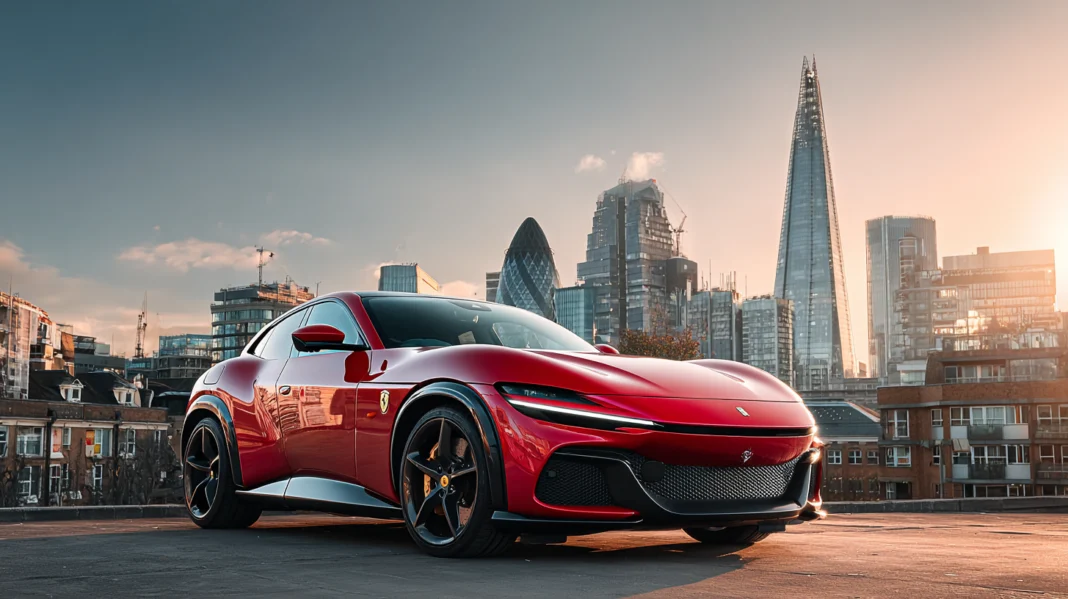
For decades, Ferrari resisted the SUV trend. While rivals like Porsche, Lamborghini, and Aston Martin embraced the luxury utility vehicle market with increasing success, Ferrari remained committed to sports cars and grand tourers. The company’s leadership repeatedly stated that an SUV was not in the brand’s DNA, that Ferrari would not follow the market into a segment that seemed at odds with its performance heritage.
The Purosangue changed that. Introduced in 2022 as Ferrari’s first production four door, four seat vehicle, the Purosangue is a car that defies easy categorization. Ferrari does not call it an SUV. The company prefers the term “FUV” for Ferrari Utility Vehicle, a designation that emphasizes its distinctiveness from the growing field of luxury performance SUVs. But regardless of the label, the Purosangue is a significant departure for the brand.
This article provides a comprehensive review of the Ferrari Purosangue, examining its performance specifications, design philosophy, interior accommodations, and how it compares to rivals in the luxury performance utility segment.
The Purosangue Philosophy: A Ferrari First
The name Purosangue translates to “thoroughbred” in Italian, a deliberate choice that signals the car’s connection to Ferrari’s core identity. The Purosangue was not designed to be an SUV that happens to have a Ferrari badge; it was designed to be a Ferrari that happens to have four doors and a raised ride height.
The development team approached the Purosangue with the same philosophy that guides Ferrari’s sports cars. The car features a naturally aspirated V12 engine, a configuration that Ferrari has largely abandoned in its other models in favor of turbocharged V8s and hybrid V6s. The engine is mounted in the front, but the car’s weight distribution is optimized for handling, with the transaxle mounted at the rear and the engine positioned behind the front axle line.
The result is a vehicle that drives like a Ferrari, not like an SUV. It is a car that prioritizes performance and driver engagement above cargo capacity or off road capability. It is a Ferrari first, and a utility vehicle second.
Powertrain and Performance
The V12 Engine
The Purosangue is powered by a 6.5 liter naturally aspirated V12 engine, designated F140 IA. This engine is a derivative of the unit that powered the 812 Superfast and the Daytona SP3, with modifications to suit the Purosangue’s packaging requirements.
The engine produces 715 horsepower at 7,750 rpm and 528 lb ft of torque at 6,250 rpm. The specific output is 110 horsepower per liter, and the engine revs to 8,250 rpm. The sound is unmistakably Ferrari, with a deep, muscular tone at low speeds and a sharp, high pitched wail as the revs climb.
The naturally aspirated V12 is a rarity in the modern automotive landscape, where turbocharging and electrification have become the norm. Its inclusion in the Purosangue is a statement of Ferrari’s commitment to preserving the character that has defined the brand for decades.
Transmission and Drive
Power is transmitted to all four wheels through an eight speed dual clutch transmission. The gearbox is mounted at the rear of the car in a transaxle configuration, contributing to the car’s near perfect weight distribution. The transmission provides rapid shifts, with shift times measured in milliseconds in the most aggressive driving modes.
The all wheel drive system is a development of the system used in the FF and GTC4Lusso. Under normal conditions, the system sends power primarily to the rear wheels, with front wheel engagement only when needed for traction or stability. The system can also distribute torque between the front wheels, providing torque vectoring that enhances cornering performance.
Acceleration and Speed
The Purosangue accelerates from 0 to 100 kilometers per hour in 3.3 seconds. The 0 to 200 kilometers per hour sprint takes approximately 11.0 seconds. The quarter mile is completed in approximately 11.2 seconds.
Top speed is rated at over 310 kilometers per hour, making the Purosangue one of the fastest production SUVs ever built.
Weight and Balance
The Purosangue has a dry weight of approximately 2,030 kilograms, with a curb weight of approximately 2,300 kilograms. Despite this weight, the car’s weight distribution is 49 percent front, 51 percent rear, a figure that contributes to its agile handling.
The low center of gravity, achieved through careful packaging of the engine and transmission, helps to minimize body roll and maintain composure through corners.
Chassis and Dynamics
Suspension System
The Purosangue features a double wishbone front suspension and a multi link rear suspension, both constructed from lightweight aluminum. The system includes semi active dampers that can adjust their characteristics based on driving mode and road conditions.
Ferrari has developed a unique active suspension system for the Purosangue that uses electric motors to control wheel motion. This system, which the company calls Ferrari Active Suspension Technology, provides exceptional body control while maintaining ride comfort. The system can actively counteract body roll during cornering, keeping the car flat and stable.
Steering
The electric power steering is calibrated for the Purosangue’s performance focus. The system provides appropriate weighting and feedback, with a level of communication that is exceptional for a vehicle in this class. The steering ratio is quick, requiring minimal input to change direction.
The rear wheel steering system, which turns the rear wheels in the opposite direction to the front wheels at low speeds and in the same direction at high speeds, enhances agility and stability.
Brakes
The braking system uses carbon ceramic discs with 16.1 inch front discs and six piston calipers, and 15.0 inch rear discs with four piston calipers. The system provides exceptional stopping power, with consistent pedal feel and resistance to fade during repeated hard stops.
Wheels and Tires
The Purosangue rides on 22 inch front wheels and 23 inch rear wheels as standard, with 21 inch and 22 inch options available. The tires are developed specifically for the Purosangue, with a compound and construction that balance performance and comfort. The tire sizes are 255/35 ZR22 front and 315/30 ZR23 rear.
Design
Exterior Styling
The Purosangue’s exterior design is unmistakably Ferrari. The front end features a prominent grille with a mesh pattern that references Ferrari’s classic grand tourers. The headlights are slim and integrated into the bodywork, with LED elements that provide distinctive lighting.
The side profile shows the proportions of a four door vehicle, but with a fastback roofline that gives it the silhouette of a shooting brake. The rear doors are rear hinged, a design element that improves access to the rear seats and echoes the doors of the Ferrari 500 Superfast from the 1960s. The rear hinges require the front doors to be opened first, but the system provides a wide opening for entry and exit.
The rear end features a full width light bar, a prominent diffuser, and quad exhaust outlets. The design is clean and understated, with none of the aggressive aerodynamic elements that characterize Ferrari’s sports cars.
Aerodynamics
The Purosangue’s aerodynamic development focused on managing airflow for stability and cooling. The front splitter directs air under the car, while the underbody panels manage airflow to reduce drag and minimize lift. The rear diffuser accelerates airflow beneath the car, generating downforce at the rear axle.
The car’s active aerodynamic elements include a rear spoiler that deploys at high speeds to increase downforce. The system is integrated with the car’s electronic controls, adjusting automatically based on speed and driving mode.
Color and Personalization
The Purosangue is offered with a range of exterior colors, including the classic Rosso Corsa red that has become synonymous with Ferrari. The brand’s Tailor Made personalization program allows buyers to specify unique colors, materials, and details, ensuring that each car reflects its owner’s preferences.
Interior and Accommodations
Cabin Design
The interior of the Purosangue reflects Ferrari’s commitment to luxury and driver engagement. The dashboard features a 10.2 inch digital instrument cluster that can be configured to display performance data, navigation, and vehicle information. The passenger faces a dedicated 10.2 inch touchscreen that provides access to infotainment and vehicle functions.
The driver’s seat is positioned slightly forward of the passenger seat, a design element that creates a sense of separation and emphasizes the driver focus. The steering wheel is flat bottom, with integrated controls for the car’s systems. The paddle shifters are mounted on the steering column, ensuring they remain in the same position regardless of steering angle.
Seating and Space
The Purosangue features four individual seats, each with its own shape and support. The seats are heavily bolstered to hold occupants during cornering, with leather and Alcantara upholstery. The front seats are power adjustable with heating, cooling, and massage functions. The rear seats are equally well appointed, with power adjustment and heating.

The rear seats are mounted slightly higher than the front seats, providing a theater seating arrangement that improves visibility for rear passengers. The legroom and headroom in the rear are generous, making the Purosangue suitable for four adults on long journeys.
Cargo Space
The cargo area, accessed through a power liftgate, offers sufficient space for luggage or sporting equipment. With the rear seats in place, the cargo capacity is approximately 15 cubic feet. Folding the rear seats expands this to approximately 45 cubic feet, providing space for larger items.
Materials and Craftsmanship
The interior materials reflect Ferrari’s commitment to craftsmanship. The leather is sourced from premium tanneries, and the Alcantara is applied with care. The carbon fiber trim is finished to show its weave, and the metal accents are machined from solid aluminum.
Technology Features
The Purosangue is equipped with a comprehensive suite of technology features. The infotainment system includes navigation, Apple CarPlay, Android Auto, and a premium audio system. The digital instrument cluster can be configured to display performance data, including g forces, lap times, and power distribution.
Driver assistance features include adaptive cruise control, lane departure warning, blind spot monitoring, and automatic emergency braking.
Is It Really an SUV?
The SUV Question
Ferrari has been careful to avoid the SUV label. The company calls the Purosangue an FUV, or Ferrari Utility Vehicle, a designation that emphasizes its distinctiveness from the growing field of luxury performance SUVs. But by any objective measure, the Purosangue fits the SUV definition: it is a four door, four seat vehicle with a raised ride height and all wheel drive.
However, the Purosangue differs from traditional SUVs in several key ways. Its naturally aspirated V12 engine, its rear transaxle layout, and its focus on performance over utility set it apart from competitors like the Lamborghini Urus and Aston Martin DBX. The Purosangue is a Ferrari first, and a utility vehicle second.
How It Differs from Traditional SUVs
The Purosangue’s driving experience is significantly different from a traditional SUV. The car’s low center of gravity, rear weight bias, and active suspension system allow it to handle with composure that rivals many sports cars. The steering is precise and communicative, the engine responds immediately to throttle inputs, and the chassis remains flat through corners.
The car’s interior is also different from a traditional SUV. The four individual seats, the driver focused cockpit, and the high quality materials create an environment that is more sports car than family hauler.
How It Compares to Sports Cars
The Purosangue is not a sports car. Its weight, its ride height, and its dimensions prevent it from matching the agility of a mid engine Ferrari like the 296 GTB or the F8 Tributo. But it offers a level of performance that is exceptional for a vehicle of its size, and it provides the practicality and space that sports cars cannot match.
For buyers who need four seats and cargo capacity but do not want to compromise on performance, the Purosangue offers a solution that no sports car can provide.
How the Purosangue Stacks Up Against Rivals
Against the Lamborghini Urus
The Lamborghini Urus is the Purosangue’s most direct competitor. It is a four door SUV with a 4.0 liter twin turbocharged V8 producing 657 horsepower.
The Urus’s advantage is its power and its drama. The Lamborghini produces more power than the Purosangue, and its aggressive styling and sharp angles create a visual presence that the Ferrari cannot match.
The Purosangue’s advantage is its engine and its handling. The naturally aspirated V12 provides a sound and a character that the Urus’s turbocharged V8 cannot match. The Ferrari’s chassis tuning is also more refined, with a level of composure and feedback that the Urus cannot achieve.
Against the Aston Martin DBX707
The Aston Martin DBX707 is a four door SUV with a 4.0 liter twin turbocharged V8 producing 697 horsepower.
The DBX707’s advantage is its power and its interior. The Aston Martin produces slightly less power than the Purosangue, but its interior is more luxurious, with higher quality materials and more advanced technology.
The Purosangue’s advantage is its engine and its driving dynamics. The V12’s character and sound are qualities that the Aston Martin’s V8 cannot match. The Ferrari’s chassis tuning is also more engaging, with a level of feedback that the DBX cannot achieve.

Against the Porsche Cayenne Turbo GT
The Porsche Cayenne Turbo GT is a four door SUV with a 4.0 liter twin turbocharged V8 producing 631 horsepower.
The Cayenne Turbo GT’s advantage is its handling. Porsche’s chassis tuning is widely regarded as the benchmark in the SUV segment, and the Cayenne’s steering, suspension, and brake feel are exceptional.
The Purosangue’s advantage is its engine and its exclusivity. The V12 provides a character that the Porsche’s V8 cannot match, and the Ferrari’s limited production numbers make it a rarer, more exclusive vehicle.
Against the Rolls Royce Cullinan
The Rolls Royce Cullinan is a four door SUV with a 6.7 liter twin turbocharged V12 producing 563 horsepower.
The Cullinan’s advantage is its luxury. The Rolls Royce’s interior is unmatched in the segment, with materials, craftsmanship, and ride quality that set the standard for luxury.
The Purosangue’s advantage is its performance and its driving dynamics. The Ferrari is significantly quicker than the Cullinan, and its handling is far more engaging. The Purosangue is a driver’s car, while the Cullinan is a passenger’s car.
Against the BMW XM
The BMW XM is a four door SUV with a 4.4 liter twin turbocharged V8 hybrid producing 738 horsepower.
The XM’s advantage is its power and its efficiency. The BMW produces more power than the Purosangue, and its plug in hybrid system provides electric only capability.
The Purosangue’s advantage is its engine and its character. The V12’s sound and feel are qualities that the BMW’s V8 cannot match. The Ferrari’s driving dynamics are also more engaging, with a level of feedback that the XM cannot achieve.

Value Proposition
Pricing
The Ferrari Purosangue carries a base price of approximately $400,000, with final prices varying based on options and personalization. This pricing places it in the upper tier of the luxury performance SUV segment, above the Lamborghini Urus and Aston Martin DBX707, and approaching the Rolls Royce Cullinan.
Depreciation
Ferraris traditionally hold their value well, and the Purosangue is expected to follow this trend. As the brand’s first four door vehicle, it may benefit from collector interest, though its production numbers are expected to be higher than limited edition models.
Ownership Costs
Maintaining a Purosangue involves higher costs than mainstream vehicles. Service intervals are annual or every 10,000 miles, with costs varying based on the service required. The tires, sized 255/35 ZR22 front and 315/30 ZR23 rear, are expensive to replace.
The Experience Factor
For many buyers, the value proposition of a Ferrari extends beyond financial considerations. The brand’s heritage, the V12 engine, and the sense of occasion that comes with owning a Ferrari are factors that cannot be quantified on a spreadsheet.
Specifications Summary
| Specification | Value |
|---|---|
| Engine | 6.5L naturally aspirated V12 |
| Horsepower | 715 hp at 7,750 rpm |
| Torque | 528 lb ft at 6,250 rpm |
| Transmission | 8 speed dual clutch |
| Drive | All wheel drive |
| 0-100 km/h | 3.3 seconds |
| 0-200 km/h | 11.0 seconds |
| Top Speed | 310+ km/h |
| Weight | 2,030 kg dry |
| Cargo Capacity | 15 cu ft (seats up), 45 cu ft (seats folded) |
| Base Price | $400,000 |
Conclusion
The Ferrari Purosangue is a car that defies easy categorization. It is a four door, four seat vehicle with a raised ride height and all wheel drive, but Ferrari prefers to call it an FUV, not an SUV. It is powered by a naturally aspirated V12 engine, a configuration that Ferrari has largely abandoned in its other models. It is a car that prioritizes performance and driver engagement above cargo capacity or off road capability.
The Purosangue is not an SUV in the traditional sense. Its driving dynamics, its engine character, and its interior focus are all distinctly Ferrari. It is a car that can be driven on a winding road with the same composure that a 296 GTB brings to a racetrack. It is a car that rewards the driver with feedback, precision, and engagement.
Against its rivals, the Purosangue holds its own. It offers more character than the Lamborghini Urus, more engagement than the Aston Martin DBX707, more exclusivity than the Porsche Cayenne Turbo GT, more performance than the Rolls Royce Cullinan, and more refinement than the BMW XM. It is a car that combines the practicality of a four door vehicle with the soul of a Ferrari.
For buyers who need four seats and cargo capacity but do not want to compromise on performance, the Purosangue makes a compelling case. It is a Ferrari first, and a utility vehicle second. And in 2026, it stands as one of the most distinctive and capable vehicles in its class.
Popular With VeloxTrend Readers
 Essential ToolDEWALT 20V MAX 1/2 Impact Wrench DCF899BExplore the Specs →
 Creator GearNeewer Heavy Duty Suction Cup Car Mount 20lbSee the Specs →
 Tech UpgradeVeepeak OBDCheck BLE Bluetooth ScannerExplore the Specs →
 Stay SafeThinkware U1000 4K Dash CamSee the Specs →
As an Amazon Associate, VeloxTrend earns from qualifying purchases.

