
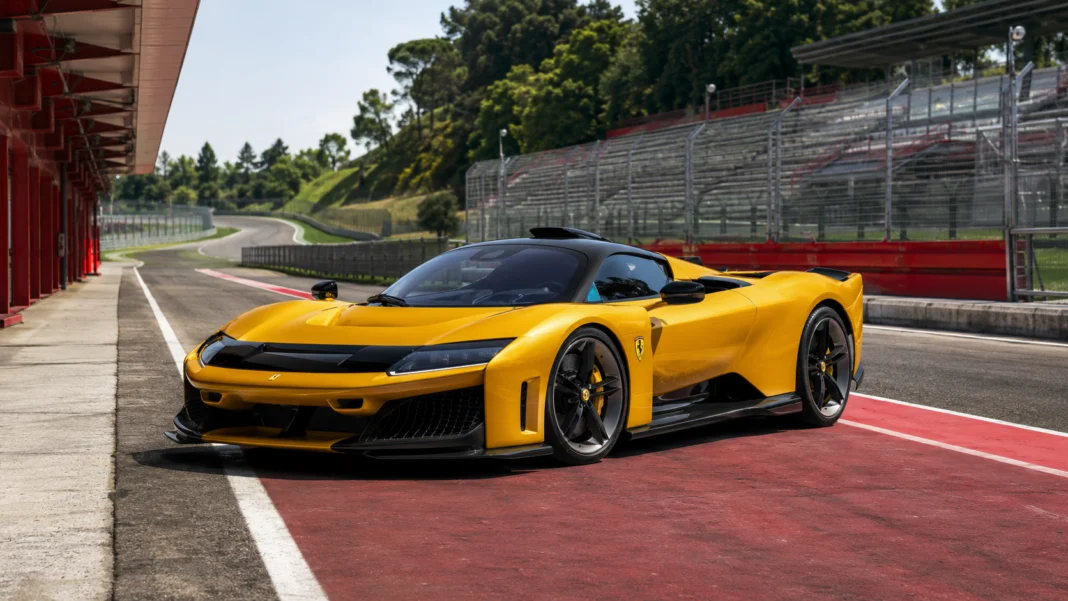
The Autodromo Enzo e Dino Ferrari in Imola is the track where Ferrari chose to unveil the F80 in October 2024. The circuit, with its sweeping curves and demanding elevation changes, is a fitting stage for a car that inherits technology from Ferrari’s endurance racing program. Close your eyes and picture a single F80 in the pit lane at sunset, its carbon fiber body glinting in the fading light, its 1,200 horsepower hybrid powertrain ready to demonstrate what happens when Le Mans-winning DNA is transferred to the road.
The F80 is Ferrari’s sixth halo supercar, following the 288 GTO, F40, F50, Enzo, and LaFerrari. It is also the most significant departure from tradition in the lineage. Out goes the operatic V12 of the LaFerrari. In comes a twin-turbo V6 hybrid that produces 1,184 horsepower and is packed with technology derived directly from the 499P race car that won the 24 Hours of Le Mans in 2023, 2024, and 2025. This article explores how Ferrari translated Le Mans technology into a road-legal hypercar that will be produced in a limited run of 799 examples.
The Engine: A V6 with Racing Pedigree
The F80’s powertrain is the most significant departure from Ferrari’s supercar tradition. Instead of a naturally aspirated V12, the F80 uses a 3.0-liter, 120-degree twin-turbo V6. This engine is closely related to the unit in the 296 GTB and, more importantly, the 499P that has dominated the World Endurance Championship.

The 499P’s V6 is a fully load-bearing engine, meaning it serves as a structural component of the chassis, with the suspension mounted directly onto it. The race engine delivers a regulation-limited maximum output of 680 horsepower from its 3.0-liter displacement. The F80’s engine, freed from racing restrictions, produces 900 horsepower on its own. This gives it a specific power output of 300 horsepower per liter, a record for a Ferrari road car.
The engine’s compactness was a key factor in its selection. Ferrari evaluated V12, V8, and even full EV powertrains before settling on the 120-degree V6. The wide-angle V6 allowed engineers to achieve the power and efficiency targets while unlocking substantial aerodynamic benefits.
The Hybrid System: Three Motors, No Plug
The F80’s hybrid system is derived from the 499P’s Energy Recovery System, which uses an 800V battery developed with Formula 1 expertise. Three electric motors complement the V6.
Two motors are mounted at the front axle, delivering up to 282 horsepower and enabling torque vectoring and all-wheel drive capability. A third motor, an MGU-K (Motor Generator Unit Kinetic), is sandwiched between the V6 and the eight-speed dual-clutch transmission, sending 80 horsepower to the rear wheels.
The F80’s motors are the first Ferrari has designed and manufactured entirely in-house. The battery is a 2.3 kWh unit using lithium-cell chemistry derived from Formula 1, packaged in a carbon fiber monocoque casing. Unlike the 296 GTB and SF90 Stradale, the F80 does not have a plug-in hybrid function. It cannot be driven in electric-only mode. The hybrid system is closed-loop, designed solely for performance enhancement.
The combined output of the V6 and the three electric motors is 1,184 horsepower (1,200 PS), making the F80 the most powerful road-going Ferrari ever built.

Boost Optimization: Learning the Track
The F80’s powertrain includes a feature called Boost Optimization. Once activated, the driver takes a sighting lap of the chosen circuit. The F80 logs the curves and straights, analyzing where a performance boost might be most useful. On the next lap, the system is ready to deploy that extra power at the optimal moments.
Aerodynamics: 1,000 kg of Downforce
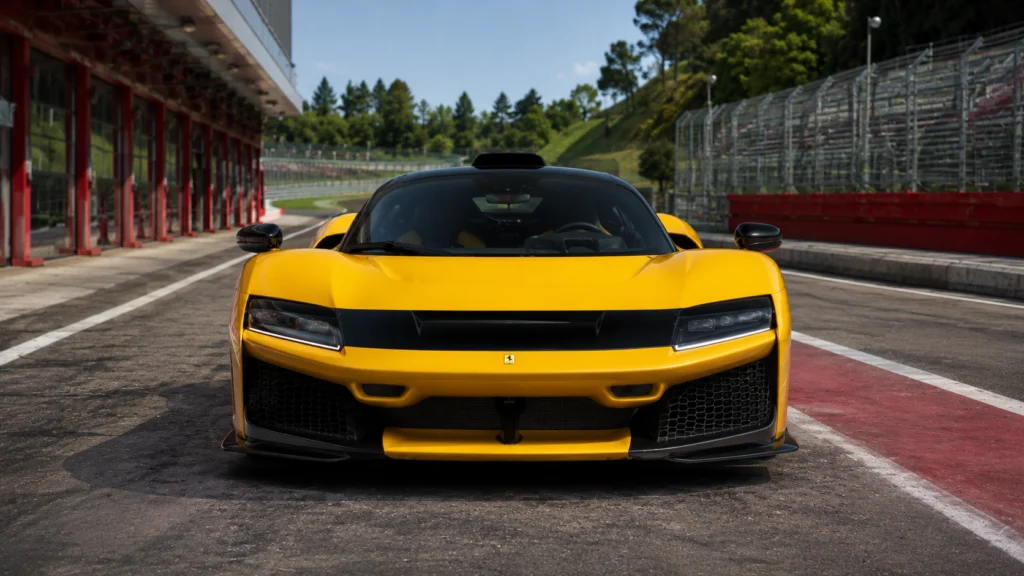
The F80’s aerodynamic package is among the most extreme ever fitted to a road car. It generates 1,000 kilograms of downforce at 250 kilometers per hour, surpassing the Porsche 911 GT3 RS’s 860 kilograms at 285 km/h.
The aerodynamic system combines multiple elements. The active rear wing can adjust its angle of attack, switching between a High Downforce configuration for braking and cornering and a Low Drag position for reduced resistance on straights. The front end features an S-Duct with a triple-wing configuration inspired by the 499P. The flat underbody includes a 1.8-meter diffuser, three times longer than the LaFerrari’s. An active suspension system, derived from the Purosangue SUV, contributes to ground effect by minimizing body roll during cornering.
The suspension also incorporates 3D-printed upper arms, produced using additive manufacturing technology at Maranello.
The “1+” Cabin: Driver-Centric Design
The F80’s cabin is a departure from traditional supercar layouts. The cockpit is designed to feel like a single-seater, with a “1+” configuration that emphasizes the driver. The passenger seat is set further back and upholstered in muted colors, making it visually recede into the interior. The driver’s seat is adjustable, while the passenger position is fixed.

This arrangement allowed Ferrari to narrow the cockpit, reducing width and drag. The center console is angled sharply toward the driver, and there is no central infotainment screen. The F80 also features a new, smaller steering wheel with physical buttons, a welcome departure from the touch-sensitive controls of the SF90 and 296.
The Imola Evening
The sun has fully set over the Imola Circuit. The F80 has completed its demonstration laps. Its V6, with the help of the MGU-H electric turbo technology, has delivered the 1,200 horsepower that makes it the most powerful Ferrari road car ever built. The 1,000 kg of downforce has kept it planted through the curves. The driver, cocooned in the “1+” cockpit, has experienced a level of performance that was previously the domain of race cars.
The F80 is not a car for everyone. It is a limited-edition hypercar produced in 799 examples, each costing approximately $3.9 million. But it represents a significant moment in Ferrari’s history. It is the first Ferrari hypercar powered by a V6, the first to use electric turbo technology, and the first to be directly derived from Le Mans-winning race car engineering.
The LaFerrari was the last of the naturally aspirated V12 hypercars. The F80 is the first of the V6 hybrid era. The lineage continues. The technology evolves. But the goal remains the same: to build a car that is as fast and capable on the track as it is usable on the road.
Gear Picks for This Story
 EV LifeTesla Wall Connector Gen 3Check Compatibility →
 Paddock StyleSPARCO Martini Racing TeeSee the Design →
 Style UpRay-Ban Aviator Classic SunglassesSee the Design →
 Paddock StyleScuderia Ferrari Puma Polo ShirtSee the Design →
As an Amazon Associate, VeloxTrend earns from qualifying purchases.

