
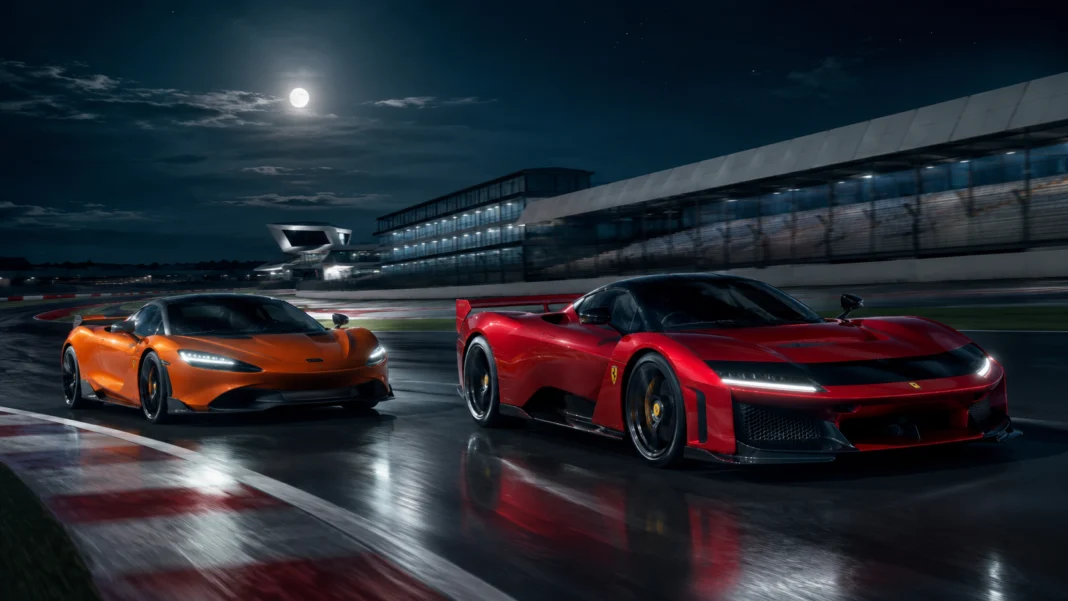
Think of the lights of the Silverstone Circuit glowing in the distance as two cars sit side by side in the pit lane, engines idling. On one side, the Ferrari F80, a 1,200-horsepower V6 hybrid that represents the pinnacle of Maranello’s engineering. On the other, the McLaren W1, a 1,258-horsepower V8 hybrid that continues the legacy of the F1 and P1. It is the rematch every enthusiast wants to see.
The comparison is inevitable. Both cars are the successors to the LaFerrari and the P1, two of the most iconic hypercars of the previous decade. Both cars use hybrid powertrains to deliver over 1,200 horsepower. Both cars are limited to around 400 units, and both cars cost millions of dollars. But the similarities end there. The F80 and the W1 represent two very different philosophies of what a halo hypercar should be.
The Powertrains: V6 vs V8
The Ferrari F80 uses a 3.0-liter twin-turbo V6 with a 120-degree angle, producing 900 horsepower on its own. Three electric motors, two on the front axle and one integrated into the transmission, add another 300 horsepower, bringing the total system output to 1,200 horsepower. The engine is derived from the 499P that won the 24 Hours of Le Mans in 2023, 2024, and 2025, and it features electric turbo technology that eliminates lag.
The McLaren W1 uses a 4.0-liter twin-turbo V8 producing 916 horsepower on its own, making it the most powerful internal combustion engine McLaren has ever built. A single electric motor, mounted after the transmission, adds another 340 horsepower, bringing the total system output to 1,258 horsepower. The engine revs to 9,200 rpm and features both port and direct injection, hollow sodium-filled intake valves, and plasma-spray cylinder liners.

The Hybrid Systems: Different Approaches
The F80’s hybrid system is designed for boost optimization. The driver takes a sighting lap, and the car logs the curves and straights, analyzing where a performance boost might be most useful. On the next lap, the system deploys that extra power at the optimal moments. The F80 cannot be driven in electric-only mode. The hybrid system is closed-loop, designed solely for performance enhancement.
The W1’s hybrid system is designed for constant power delivery. The electric motor is mounted after the transmission’s clutches, feeding torque through the even gears in parallel with the engine. This allows the W1 to deliver a combined 1,258 horsepower and 1,340 Nm of torque. The electric motor can power the car for short distances at low speeds, but the primary focus is on performance.
The Aerodynamics: Ground Effect vs Active Aero
The F80’s aerodynamic package is among the most extreme ever fitted to a road car. It generates 1,000 kilograms of downforce at 250 kilometers per hour, achieved through an active rear wing, an S-Duct with a triple-wing configuration, a flat underbody with a 1.8-meter diffuser, and an active suspension system that minimizes body roll.
The W1’s aerodynamic package is a fully ground effect system. The car generates all of its downforce underneath the car, massively improving drag while delivering unprecedented grip and downforce. The system includes an active front splitter and the McLaren Active Long Tail, a rear wing that extends 300 mm backward in Race mode to work with the underfloor and rear diffuser. The entire aerodynamic package produces 1,000 kilograms of downforce, five times more than in road mode.
The Weight: A Significant Difference
The F80’s dry weight is approximately 1,500 kilograms, while the W1’s dry weight is just 1,399 kilograms. The W1 is significantly lighter, a difference that is felt in the car’s agility and responsiveness.
The Silverstone Evening
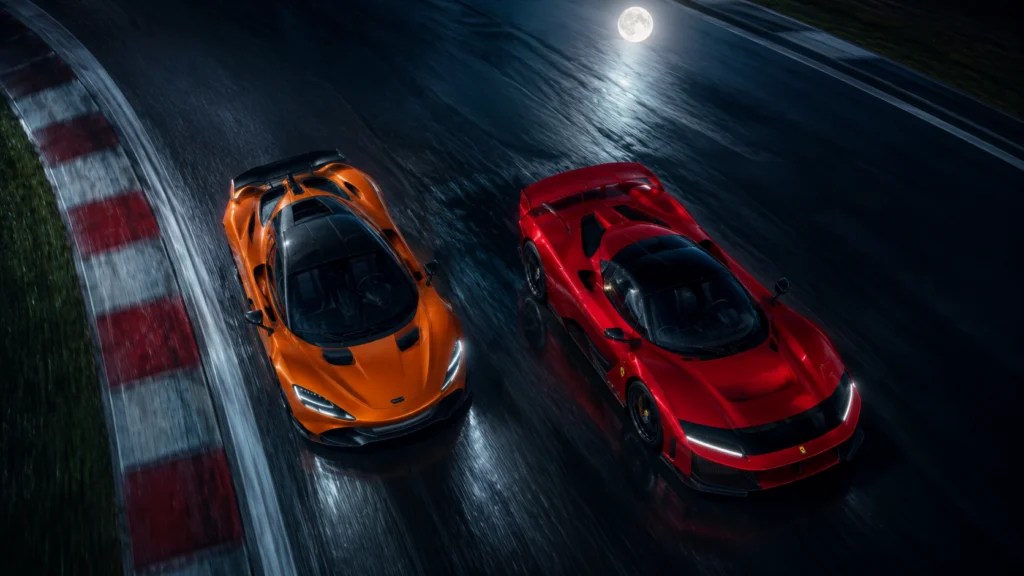
The two cars have completed their demonstration laps. The Ferrari F80 has delivered the 1,200 horsepower that makes it the most powerful Ferrari road car ever built. The McLaren W1 has delivered the 1,258 horsepower that makes it the most powerful McLaren ever built. The lap times are close, but the experience is different.
The F80 is a car that demands respect. The power is immense, and the car requires a skilled driver to extract its full potential. The active aerodynamics and hybrid system work in harmony to deliver a driving experience that is both brutal and precise.
The W1 is a car that rewards precision. The lighter weight and ground-effect aerodynamics make it feel more agile and responsive. The hybrid system delivers power in a linear, predictable manner, and the chassis communicates clearly with the driver.
The Verdict
The Ferrari F80 and McLaren W1 are two of the most impressive hypercars ever built. The F80 is a technological tour de force, a car that pushes the boundaries of what is possible with a V6 hybrid powertrain. The W1 is a return to the analog driving experience, a car that prioritizes weight reduction and driver engagement over sheer power.
The choice between them depends on what you value most. The F80 is faster, more powerful, and more technologically advanced. The W1 is lighter, more agile, and more engaging. Both are extraordinary. Both are legends. The rematch is a draw.
Gear Picks for This Story
 EV LifeChargePoint Home Flex EV ChargerCheck Compatibility →
 Track ReadyAlpinestars Tech-1 Z v3 Racing GlovesSee What It Does →
 Driver GearOMP First-S Racing SuitSee What It Does →
 Paddock StyleSPARCO Martini Racing TeeSee the Design →
As an Amazon Associate, VeloxTrend earns from qualifying purchases.

