
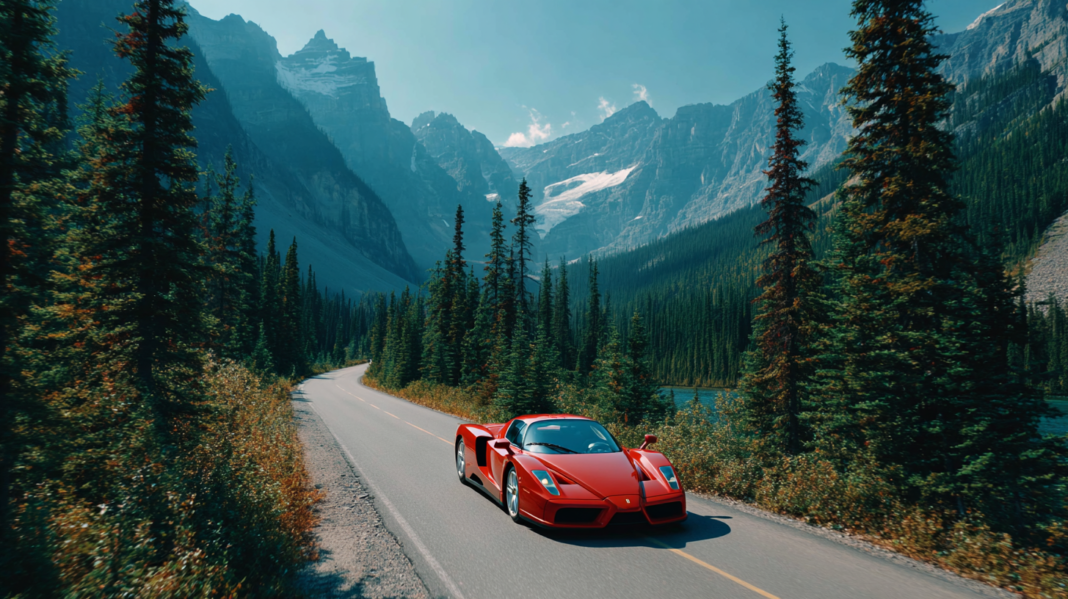
The Ferrari Enzo occupies a unique place in automotive history. Named for the company’s founder, it was intended to be the ultimate expression of Ferrari’s engineering capabilities. It was the first Ferrari to incorporate Formula 1 technology directly into a road car, with a carbon fiber monocoque, a semi-automatic paddle-shift transmission, and advanced aerodynamics derived from the F1 program. It was a car that blurred the line between race car and road car.
Produced from 2002 to 2004, the Enzo was limited to 400 units (plus one additional unit donated to charity). It was the successor to the F40 and F50, and it set a new standard for what a road-going supercar could be. Its 6.0 liter naturally aspirated V12 produced 651 horsepower, and its top speed exceeded 217 miles per hour. It was the fastest and most technologically advanced Ferrari ever built at the time.
This article provides a comprehensive examination of the Ferrari Enzo, including its development history, engineering, performance, design, and why it remains one of the most significant supercars of its era.
The Genesis: A Tribute to the Founder
The Enzo was conceived as a tribute to Enzo Ferrari, who had died in 1988. The company wanted to create a car that embodied his vision: a machine that prioritized performance above all else, that used the latest technology, and that would be a worthy successor to the F40 and F50.
The development team was led by Luca di Montezemolo (Ferrari’s chairman) and included engineers who had worked on the company’s Formula 1 program. The goal was to create a car that was as close to an F1 car as possible while remaining road-legal.
The Enzo was unveiled at the 2002 Paris Motor Show. The response was overwhelmingly positive, and all 400 units were sold to pre-selected customers before production began.
The Name
The car was named Enzo in honor of Enzo Ferrari, the company’s founder. This was a significant departure from Ferrari’s naming conventions, which typically used engine displacement or other technical specifications. The choice of a personal name reflected the car’s significance to the company.
Engineering: Formula 1 for the Road
The Carbon Fiber Monocoque
The Enzo was one of the first production Ferraris to use a carbon fiber monocoque. The structure was a single-piece carbon fiber tub that provided exceptional rigidity and occupant protection while minimizing weight. The monocoque was manufactured using aerospace-grade materials and processes, with careful attention to fiber orientation and layup sequence.
The subframes were also made of carbon fiber, as were the body panels. The result was a dry weight of approximately 1,255 kilograms (2,766 pounds).
The V12 Engine
The Enzo was powered by a 6.0 liter naturally aspirated V12 engine, designated the F140 B. This engine was derived from the V12 used in the 1990s Formula 1 cars, with modifications for road use. It produced 651 horsepower at 7,800 rpm and 485 lb-ft of torque at 5,500 rpm. The redline was 8,200 rpm.
The engine featured a 65-degree V angle, four valves per cylinder, and a dry-sump lubrication system. The intake system used individual throttle bodies, contributing to the engine’s immediate throttle response. The exhaust system was tuned to produce a distinctive sound, with a high-pitched wail at high rpm.
The Transmission
The Enzo featured a semi-automatic transmission with paddle shifters mounted on the steering column. This was a significant departure from Ferrari’s traditional manual transmissions, and it reflected the company’s commitment to Formula 1 technology. The transmission was a six-speed automated manual, with a single clutch and an electro-hydraulic actuation system.
The paddle shifters allowed the driver to change gears without taking their hands off the steering wheel. The upshift paddle was on the right, and the downshift paddle was on the left. The shift times were rapid, with the transmission changing gears in approximately 150 milliseconds.
The Suspension
The Enzo featured double-wishbone suspension at all four corners, with pushrod-actuated dampers. This configuration, derived from Formula 1, allowed for precise control over wheel motion and reduced unsprung weight. The suspension was adjustable, with settings for ride height, camber, and damping.
The Brakes
The braking system used carbon ceramic discs with six-piston calipers at the front and four-piston calipers at the rear. The carbon ceramic brakes provided exceptional stopping power, with consistent pedal feel and resistance to fade during track use. They were a pioneering feature for a production car.
The Aerodynamics
The Enzo’s aerodynamic development was led by engineers from Ferrari’s Formula 1 program. The car featured an active front splitter and a rear wing that deployed at speed, generating downforce without excessive drag. The underbody was flat, with a large diffuser that accelerated airflow beneath the car.
The aerodynamic package generated significant downforce, keeping the car planted at high speeds. The Enzo was one of the first production cars to achieve such high levels of downforce without the use of a large fixed rear wing.
Performance
Acceleration and Speed
The Enzo accelerated from 0 to 60 miles per hour in 3.1 seconds. The 0 to 100 miles per hour sprint took approximately 6.6 seconds. The quarter mile was completed in approximately 11.0 seconds at 133 miles per hour. Top speed was 217 miles per hour (350 kilometers per hour).
These figures made the Enzo the fastest production Ferrari ever built at the time, and it was competitive with the best supercars of its era.
Fiorano Lap Time
The Enzo set a lap time of 1 minute 24.9 seconds at Ferrari’s Fiorano test track. This was significantly faster than the F50 (1 minute 32.0 seconds) and the F40 (1 minute 35.0 seconds). The Enzo’s lap time demonstrated its track capability.
Design: The Pencil of Ken Okuyama
Exterior Styling
The Enzo’s exterior was designed by Ken Okuyama, a Japanese designer working at Pininfarina. Okuyama had previously worked on the 2000 Ferrari Rossa concept and would later work on the Maserati Quattroporte and the Ferrari 599 GTB.
The Enzo’s design was functional and aggressive. The front end featured a prominent nose with a large central air intake and two smaller side intakes. The headlights were integrated into the bodywork, with a distinctive shape that echoed the Formula 1 cars of the era.
The side profile showed the mid-engine proportions, with a long wheelbase, short overhangs, and a cabin positioned forward of the rear axle. The doors opened upward in a butterfly configuration, providing access to the cabin.
The rear end was characterized by a prominent rear wing that deployed at speed, a large diffuser, and quad exhaust outlets. The taillights were slim and integrated into the bodywork.
Interior Design
The interior of the Enzo was focused entirely on the driver. The seats were carbon fiber racing buckets with leather upholstery, providing lateral support during cornering. The dashboard featured a digital instrument cluster with a central tachometer, a speedometer, and auxiliary gauges.
The steering wheel was a Formula 1-inspired unit with integrated controls for the car’s systems. The paddle shifters were mounted on the steering column, and the start button was located on the wheel. The driver could control the suspension settings, the traction control, and other functions without taking their hands off the wheel.
The interior was stripped back compared to grand tourers, but it was not spartan. The materials were of high quality, and the craftsmanship was excellent.
The Driving Experience
On Road Character
The Enzo was a demanding car to drive. The semi-automatic transmission required the driver to use the paddle shifters; there was no automatic mode. The clutch was aggressive, and the car lurched at low speeds. The steering was heavy at low speeds, and the ride was firm.
Yet for drivers who were willing to meet its demands, the Enzo rewarded. The engine responded immediately to throttle inputs, with power building linearly to the 8,200 rpm redline. The steering provided exceptional feedback, and the chassis communicated every detail of the road surface.
On Track Behavior
When driven on a track, the Enzo revealed the depth of its engineering. The brakes provided consistent stopping power lap after lap, with a pedal feel that inspired confidence. The chassis remained composed through corners, with the aerodynamic downforce providing grip that mechanical systems alone could not achieve.
The car’s rear-wheel-drive layout and lack of electronic aids (beyond basic traction control) required skill to manage. The Enzo rewarded smooth, precise inputs and punished abrupt actions.
The Sound
The V12 engine’s sound was one of the Enzo’s defining characteristics. The engine produced a high-pitched wail as the revs climbed toward the 8,200 rpm redline. The sound was sharp, urgent, and deeply satisfying, with a quality that distinguished it from every other production engine.
The Enzo’s Legacy
A New Standard
The Enzo set a new standard for supercars. It demonstrated that Formula 1 technology could be adapted for road use, and it established the template that Ferrari would follow for years to come. The LaFerrari, which succeeded the Enzo, used a hybrid system and even more advanced aerodynamics, but it owed a clear debt to the Enzo.
Collector Status
The Enzo is one of the most sought-after collector cars in the world. Its limited production run of 400 units, its status as a tribute to the company’s founder, and its legendary performance have driven values to significant heights. Well-maintained Enzos trade for millions of dollars, and they are prized by collectors worldwide.
The Ferrari Supercar Lineage
The Enzo is the third in Ferrari’s line of supercars. The F40 (1987) was the last car personally approved by Enzo Ferrari. The F50 (1995) was a more refined, road-focused car. The Enzo (2002) was the most technologically advanced of the three. The LaFerrari (2013) followed as a hybrid hypercar.
Each of these cars represents a different era of Ferrari engineering. The Enzo is the bridge between the analog F50 and the hybrid LaFerrari.
How the Enzo Stacks Up Against Rivals
Against the Porsche Carrera GT
The Porsche Carrera GT was the Enzo’s most direct competitor. It featured a 5.7 liter naturally aspirated V10 producing 603 horsepower.
The Carrera GT’s advantage was its analog character. The Porsche’s manual transmission, unassisted steering, and lack of electronic aids created a driving experience that was pure and engaging.
The Enzo’s advantage was its technology and its power. The Ferrari’s paddle-shift transmission and carbon fiber monocoque were more advanced than the Porsche’s, and its 651 horsepower exceeded the Carrera GT’s 603.
Against the Mercedes-Benz SLR McLaren
The Mercedes-Benz SLR McLaren was a front-engined grand tourer with a 5.4 liter supercharged V8 producing 617 horsepower.
The SLR’s advantage was its luxury and its daily usability. The Mercedes was more comfortable and more practical than the Enzo.
The Enzo’s advantage was its performance and its track capability. The Ferrari was faster, lighter, and more agile than the SLR.
Against the Bugatti Veyron
The Bugatti Veyron was introduced in 2005, shortly after the Enzo ended production. It featured an 8.0 liter quad-turbocharged W16 producing 987 horsepower.
The Veyron’s advantage was its power and its top speed. With 987 horsepower and a top speed of 253 miles per hour, the Bugatti was in a different performance class.
The Enzo’s advantage was its weight and its handling. The Ferrari was significantly lighter than the Veyron, and its chassis was tuned for cornering rather than straight-line speed.
Against the McLaren F1
The McLaren F1 was produced from 1992 to 1998. It featured a 6.1 liter naturally aspirated V12 producing 618 horsepower and a central driving position.
The F1’s advantage was its engineering purity and its driver focus. The McLaren’s central driving position, manual transmission, and lightweight construction created an experience that was unique.
The Enzo’s advantage was its technology and its power. The Ferrari’s paddle-shift transmission and carbon fiber monocoque were more advanced than the McLaren’s.
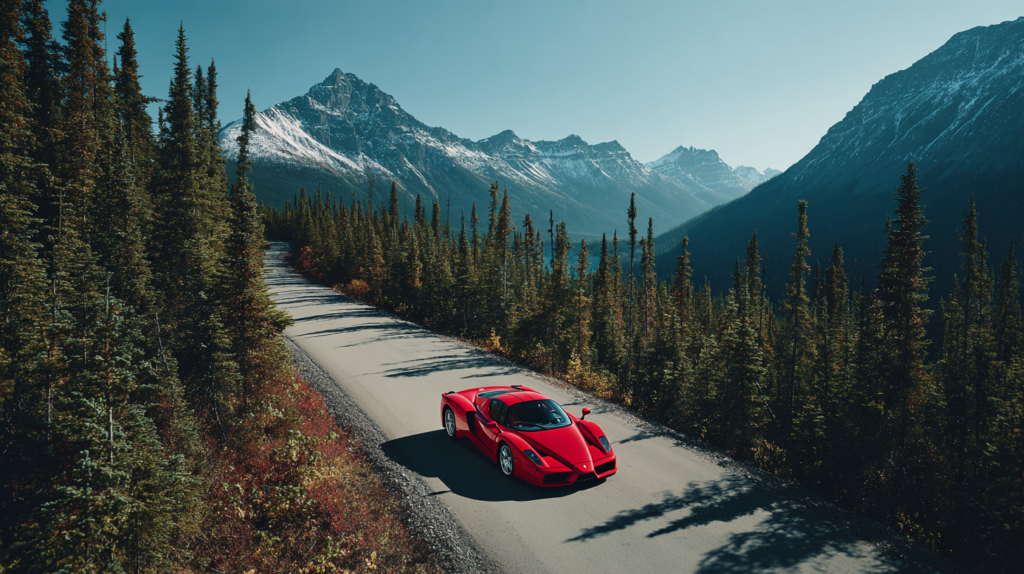
The Enzo’s Place in Automotive History
The Ferrari Enzo is one of the most significant supercars ever built. It was the first Ferrari to incorporate Formula 1 technology directly into a road car, with a carbon fiber monocoque, a semi-automatic paddle-shift transmission, and advanced aerodynamics derived from the F1 program. It was a car that blurred the line between race car and road car.
The Enzo was not a perfect car. It was demanding to drive, and its semi-automatic transmission was not as refined as modern dual-clutch units. But it was a car that represented the pinnacle of Ferrari’s engineering capabilities, and it remains one of the most revered supercars of its era.
Today, the Enzo is a legend. It is a car that is recognized by enthusiasts around the world, and it is one of the most desirable collector cars in existence. Its legacy lives on in every Ferrari supercar that followed.
Specifications Summary
| Specification | Value |
|---|---|
| Engine | 6.0L naturally aspirated V12 |
| Horsepower | 651 hp at 7,800 rpm |
| Torque | 485 lb-ft at 5,500 rpm |
| Redline | 8,200 rpm |
| Transmission | 6-speed semi-automatic |
| Drive | Rear wheel drive |
| 0-60 mph | 3.1 seconds |
| Top Speed | 217 mph |
| Weight | 1,255 kg dry |
| Production | 400 units (+1 charity unit) |
| Fiorano Lap Time | 1 minute 24.9 seconds |
Conclusion
The Ferrari Enzo is one of the most significant supercars ever built. It was the first Ferrari to incorporate Formula 1 technology directly into a road car, with a carbon fiber monocoque, a semi-automatic paddle-shift transmission, and advanced aerodynamics derived from the F1 program. It was a car that blurred the line between race car and road car.
The Enzo was not the most powerful supercar of its era, nor the fastest, nor the most technologically advanced in every way. But it was a car that represented the pinnacle of Ferrari’s engineering capabilities, and it set a new standard for what a road-going supercar could be.
Today, the Enzo is a legend. Its limited production run of 400 units, its status as a tribute to the company’s founder, and its legendary performance have made it one of the most desirable collector cars in the world. It is a car that is recognized by enthusiasts everywhere, and it remains a symbol of Ferrari’s commitment to performance.
The Enzo’s legacy lives on in every Ferrari supercar that followed. The LaFerrari, the SF90 Stradale, and the upcoming electric hypercars all owe a debt to the Enzo. It was a car that changed Ferrari, and it changed the supercar segment. The Ferrari Enzo is a legend, and it will forever be remembered as one of the greatest cars ever built.

