
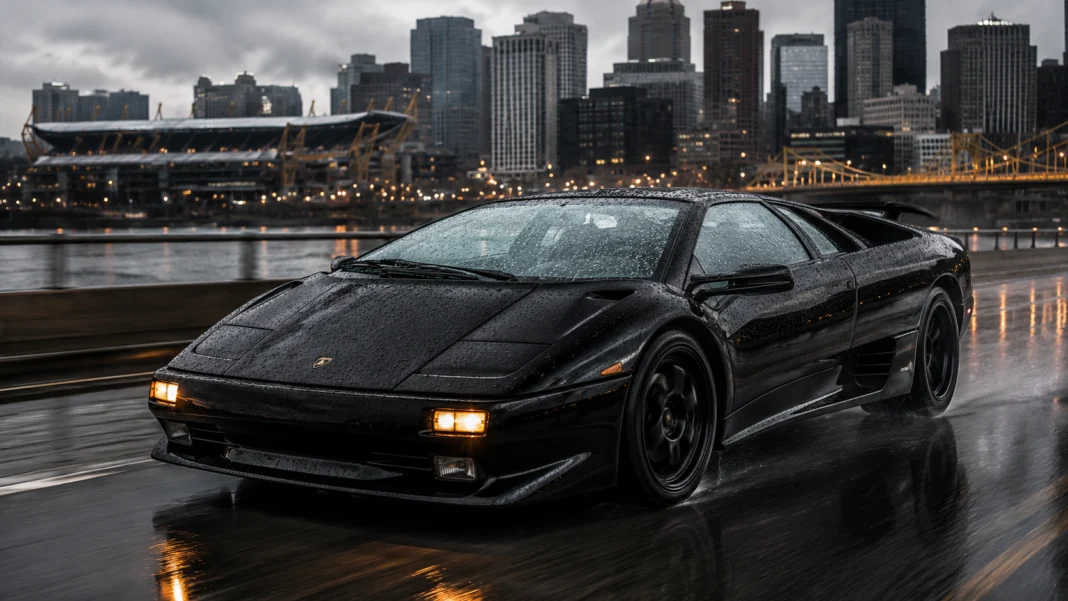
Think of the lights of the Roberto Clemente Bridge reflecting off the Allegheny River as a low, impossibly wide car glides through the streets of Pittsburgh’s North Shore, its scissor doors catching the glow of PNC Park and a deep V12 rumble echoing off the stadium walls. Few cars fit that picture better than the Lamborghini Diablo, the car that defined the 1990s supercar era, and a machine that embodies excess in every conceivable way.
The Diablo arrived in 1990 carrying the weight of replacing the Countach, a cultural icon that had defined bedroom walls for two decades. Somehow, the Diablo managed to continue that legacy without losing the madness that made its predecessor so memorable. It was faster, wider, and even more dramatic, pushing beyond 200 mph at a time when that still felt almost unbelievable.
The Birth of a Legend
The Diablo’s story began in 1985 with Project 132, Lamborghini’s plan to create the fastest production car in the world. The design was initially conceived by Marcello Gandini, the legendary designer behind the Miura and Countach, but was partially revised by Chrysler’s design center after the American company became the majority shareholder in 1987.
The car was officially presented on January 21, 1990, during Lamborghini Day at the Sporting in Monte Carlo. It was an immediate commercial success, with orders arriving even before the official reveal.

The name Diablo honored a legendary fighting bull that fought against the matador José de Lara, “El Chicorro,” in 1869. It was a fitting name for a car that would become one of the most iconic supercars of all time.
The Powertrain: A V12 That Defined an Era
The heart of the original Diablo was a 5.7-liter naturally aspirated V12 engine producing 485 horsepower and 428 lb-ft of torque. The engine was mounted longitudinally behind the cabin, driving the rear wheels through a five-speed manual gearbox with a dogleg first gear.
The performance figures were staggering for their time. The Diablo accelerated from 0 to 62 mph in 4.5 seconds and reached a top speed of 325 km/h (202 mph), making it the fastest production car in the world at launch. At the Nardò circuit in Italy, it achieved 337 km/h (209 mph).
The Diablo was a proper analog Lamborghini. There was no traction control, no stability systems, and no electronic safety net. The steering had weight, the gearshift demanded a deliberate hand, and the whole car felt alive underneath the driver. Even climbing in felt dramatic thanks to those iconic scissor doors.
The Evolution: VT, SV, and the 6.0
The Diablo underwent significant evolution over its 11-year production run. In 1993, Lamborghini introduced the Diablo VT, the brand’s first production four-wheel-drive super sports car. The “VT” stood for Viscous Traction, and the system improved stability and handling without sacrificing the car’s dramatic character.
In 1993, the special SE30 series was launched to commemorate Lamborghini’s 30th anniversary, with power increased to 523 horsepower. The Diablo SV (Sport Veloce) debuted in 1995 as a rear-wheel-drive model with 510 horsepower and an adjustable rear wing.
The VT Roadster arrived in December 1995, Lamborghini’s first mass-produced 12-cylinder open-top model. It was the fastest open car on the road in 1996.
In 1999, following Audi’s acquisition of Lamborghini, the Diablo received a significant restyling designed by Luc Donckerwolke, the brand’s first in-house designer. The engine grew to 6.0 liters, producing 529 horsepower and 605 Nm of torque, and ABS brakes were introduced. The Diablo GT, produced from 1999 to 2000, was the ultimate evolution, with 575 horsepower from its 6.0-liter V12 and extensive carbon fiber bodywork.
The Legacy: Why Values Have Climbed So Sharply
The Diablo marked the end of an era for Lamborghini, the final chapter before modern electronics and German ownership softened the edges. It still feels intimidating, theatrical, and slightly outrageous in a way modern supercars rarely do.

Collectors have taken notice. Values have climbed sharply, driven by a generation who grew up with the Diablo on their walls. A low-mileage 2000 Diablo VT 6.0 sold for $804,000 at auction. A Diablo GT, one of just 80 examples built, is estimated at up to $2.6 million.
The Diablo’s appeal lies in its honesty and originality. It has been preserved rather than restored, and increasingly that is exactly what collectors want. It represents a time when supercars were still dangerous, still dramatic, and still completely unforgettable.
The Pittsburgh Night
The Diablo has completed its drive along the North Shore. Its V12 has delivered the 485 horsepower that made it the fastest production car in the world in 1990. The scissor doors have caught the stadium lights, and the wide stance has filled the street. The driver has experienced a piece of automotive history, a car that defined the 1990s supercar era and has become a legend.
The Diablo is not a car for everyone. It is heavy, difficult to drive, and its performance has been surpassed by modern supercars. But it is a car that represents a moment in time, a car that captured the imagination of a generation and never let go. It is the car that defined excess, and it will forever be remembered as the definitive supercar of the 1990s. Few cars capture the spirit of the analog supercar era quite like a Diablo. It is an icon, a legend, and a machine that will never be forgotten.
Popular With VeloxTrend Readers
 Paddock StyleSPARCO Martini Racing TeeSee the Design →
 Detail Like a ProCERAKOTE Ceramic Headlight Restoration KitSee How It Works →
 Creator GearGoPro Max 2 360 CameraSee the Specs →
 Garage EssentialMobil 1 Extended Performance 5W-30 5qtExplore the Specs →
As an Amazon Associate, VeloxTrend earns from qualifying purchases.

