
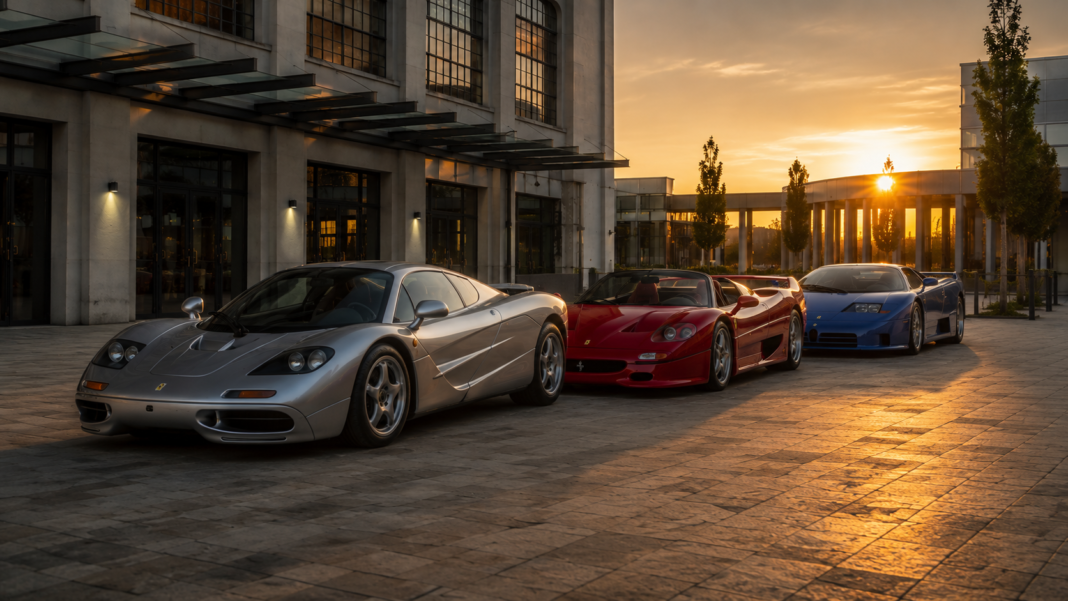
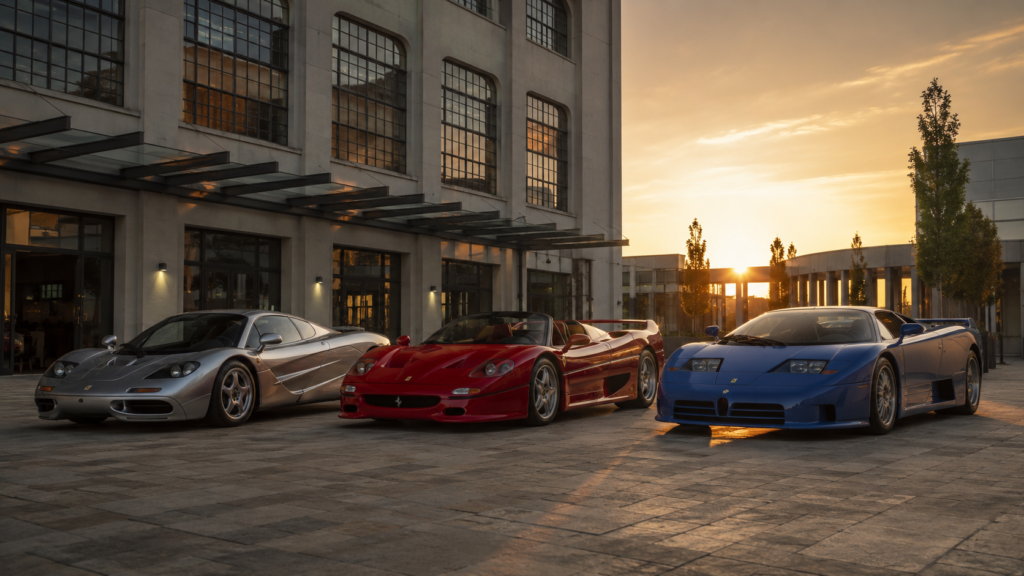
The sun is setting over the Lingotto building in Turin, the former Fiat factory with its famous rooftop test track. The air is cool, and the lights of the city are beginning to glow. In the courtyard of the Mirafiori Motor Village, three cars are parked in a line. They are not modern hybrids or electric hypercars. They are the machines that defined an era: the McLaren F1, the Ferrari F50, and the Bugatti EB110.
The 1990s were the decade that defined the modern hypercar. It was a decade of excess, of technological leaps, and of fierce competition. Three manufacturers raced to build the ultimate road car. Each took a different approach. Each produced a masterpiece. And together, they set the stage for the supercar wars that continue to this day.
The McLaren F1: The Purist’s Choice
The McLaren F1 is widely considered the greatest supercar of all time. It was the vision of Gordon Murray, a South African engineer who had designed multiple Formula 1 championship-winning cars. Murray’s goal was simple: build the ultimate driver’s car.
The F1 was a machine of extreme purity. It was powered by a 6.1 liter naturally aspirated V12 engine developed by BMW, producing 627 horsepower. The engine was mounted amidships, and power was sent to the rear wheels through a six-speed manual transmission.
The F1’s most distinctive feature was its central driving position. The driver sat in the middle of the car, with two passenger seats flanking them and positioned slightly behind. This layout provided an unobstructed view forward and a sense of being at the center of the car’s dynamics.
The F1 was also the fastest production car in the world at the time. It could accelerate from 0 to 60 miles per hour in 3.2 seconds and reach a top speed of 240 miles per hour. The record stood for over a decade.
The F1 was not a commercial success in the traditional sense. Only 106 units were built. But its legacy is unmatched. It is the car that every other supercar is measured against.
The Ferrari F50: The Race Car for the Road
The Ferrari F50 was Ferrari’s answer to the McLaren F1. It was introduced in 1995 to celebrate the company’s 50th anniversary. Only 349 units were built.
The F50 was a machine of extremes. Its 4.7 liter naturally aspirated V12 engine was derived from the V12 used in Ferrari’s Formula 1 cars. The engine produced 520 horsepower at 8,500 rpm and revved to 8,500 rpm.
The F50 was built around a carbon fiber monocoque, a technology derived directly from Formula 1. The suspension used pushrod actuated dampers, another Formula 1 feature. The car had no power steering, no servo brakes, and no ABS. It was raw, demanding, and uncompromising.
The F50 was not as fast as the McLaren F1. It could accelerate from 0 to 60 miles per hour in 3.8 seconds and reach a top speed of 202 miles per hour. But it was a more visceral experience. The sound of the V12, the feel of the unassisted steering, and the connection to the road made it a driver’s car in the purest sense.
The F50 was controversial. Some criticized its styling, which incorporated cues from contemporary F1 cars. Others found it less engaging than its predecessor, the F40. But over time, the F50 has gained appreciation for its purity and its connection to Ferrari’s racing heritage.
The Bugatti EB110: The Technological Pioneer
The Bugatti EB110 was the most technologically advanced of the three. It was introduced in 1991, four years before the F50 and three years before the F1. It marked the revival of the Bugatti brand after a hiatus of nearly 40 years.
The EB110 was powered by a 3.5 liter V12 engine with four turbochargers. The GT version produced 560 horsepower, and the Super Sport version produced 603 horsepower. The engine was mounted in the middle of the car, and power was sent to all four wheels through a six-speed manual transmission.
The EB110 was the first production car to use a carbon fiber monocoque. It was also one of the first to use all-wheel drive. The technology was years ahead of its time, and it established the template that would be followed by the Bugatti Veyron and Chiron.
The EB110 was the fastest production car in the world when it was introduced. The Super Sport could accelerate from 0 to 100 km/h in 3.2 seconds and reach a top speed of 351 km/h. It was also one of the most expensive cars on the market, with a price of approximately $300,000.
The EB110 was a commercial failure. The company went bankrupt in 1995, and only 139 examples were built. The timing was unfortunate. The car was launched during a global recession, and the market for high-priced supercars was limited. But the EB110’s legacy is significant. It proved that a small, ambitious manufacturer could build a world-class hypercar.
The Turin Evening: A Comparison of Approaches
The three cars are parked side by side. They are different, but they are all masterpieces.
The McLaren F1 is the purist’s choice. It is light, simple, and focused on the driver. The naturally aspirated V12 is responsive and intoxicating. The manual transmission is engaging. The central driving position is unique. The F1 is a car that rewards skill and connection.
The Ferrari F50 is the racer’s choice. It is raw, demanding, and uncompromising. The V12 is derived from Formula 1. The carbon fiber monocoque is state of the art. The lack of power steering and ABS is a statement. The F50 is a car that demands respect.
The Bugatti EB110 is the pioneer’s choice. It is technologically advanced, ambitious, and ahead of its time. The quad-turbo V12 is powerful. The carbon fiber monocoque is groundbreaking. The all-wheel drive is sophisticated. The EB110 is a car that predicted the future.
The Legacy: What the 1990s Left Behind
The 1990s supercar wars left a lasting legacy. The McLaren F1 set a benchmark for driver engagement that has never been surpassed. The Ferrari F50 proved that Formula 1 technology could be adapted for the road. The Bugatti EB110 established the template for the modern hypercar: quad-turbo, carbon fiber, and all-wheel drive.
The three cars also represent different approaches to the same problem. The F1 was about purity and driver connection. The F50 was about racing heritage and raw experience. The EB110 was about technology and ambition.
Each approach was valid. Each approach produced a masterpiece. And together, they define the 1990s as the decade that built the modern hypercar.
Key Takeaways
- The McLaren F1 was the purist’s choice, with a naturally aspirated V12, a central driving position, and a top speed of 240 mph.
- The Ferrari F50 was the race car for the road, with a Formula 1-derived V12, a carbon fiber monocoque, and no power steering or ABS.
- The Bugatti EB110 was the technological pioneer, with a quad-turbo V12, a carbon fiber monocoque, and all-wheel drive.
- The three cars represent different approaches to the same problem: building the ultimate road car.
- The 1990s supercar wars set the stage for the modern hypercar market.
Conclusion
The 1990s supercar wars were a defining moment in automotive history. Three manufacturers, three approaches, three masterpieces. The McLaren F1, the Ferrari F50, and the Bugatti EB110 each pushed the boundaries of what was possible. They each had their strengths and weaknesses. But together, they created a legacy that continues to influence the industry today.
The Mirafiori Motor Village is quiet now. The cars are gone. The engines are silent. But the debate continues. Which car was the best? The answer depends on who you ask. But one thing is clear: the 1990s were the decade that defined the modern hypercar.

