
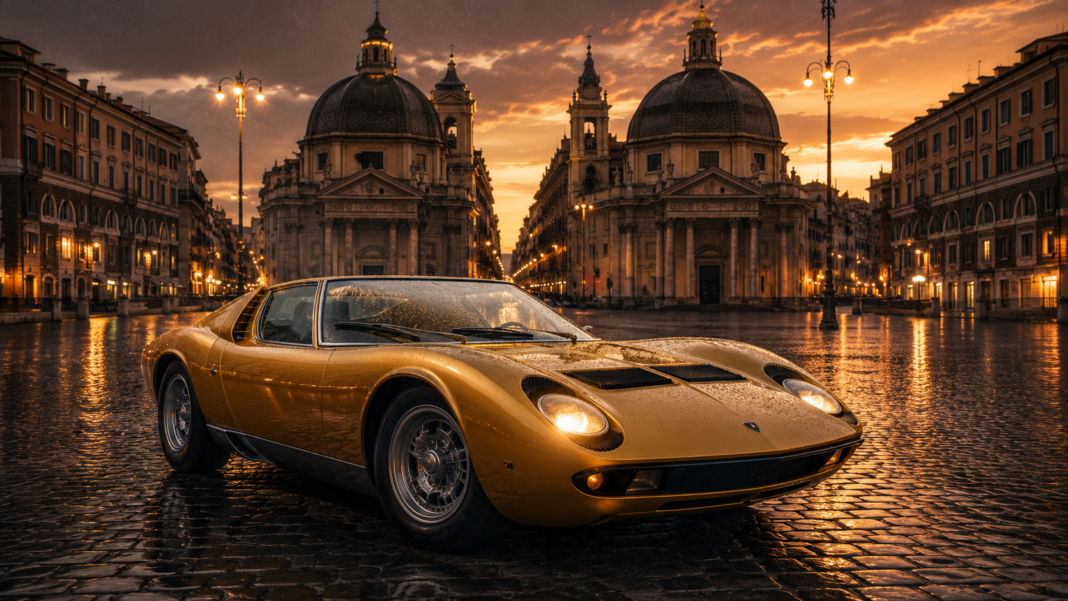
The sun is setting over the Piazza del Popolo, casting long shadows across the ancient cobblestones. The twin churches of Santa Maria dei Miracoli and Santa Maria in Montesanto frame the view, and the sound of a V12 engine echoing off the stone walls seems to transport the scene back to the late 1960s. This is Rome, a city of emperors and artists, of gladiators and engineers. It is the perfect place to remember a car that changed the automotive world forever.
The Lamborghini Miura did not just introduce a new car. It introduced a new category of automobile. It was the car that created the supercar. This is the full story of how Ferruccio Lamborghini, a group of rebellious engineers, and a mid-engine layout changed automotive history in 1966.
The Genesis: A Tractor Manufacturer’s Ambition
Ferruccio Lamborghini was not a car man, at least not at first. He had made his fortune building tractors. By the 1960s, he had become one of Italy’s great industrialists. He was also a car enthusiast. He owned a fleet of sports cars, including a Ferrari 250 GT.
The legend is well-known. Ferruccio was dissatisfied with his Ferrari, which he found too noisy and rough for proper road use. He complained to Enzo Ferrari himself. According to the story, Enzo dismissed him, saying he was just a tractor maker who could not understand a real sports car.
Ferruccio decided to build his own car. In 1963, he founded Automobili Ferruccio Lamborghini in Sant’Agata Bolognese. His goal was not to beat Ferrari on the track. He wanted to build a refined, luxurious grand tourer that could be driven every day. His first models, the 350 GT and 400 GT, were successful, establishing Lamborghini as a serious competitor.
The Rebel Engineers: The P400 Project
While Ferruccio focused on grand tourers, a group of his young engineers had different ideas. Gian Paolo Dallara, Paolo Stanzani, and Bob Wallace were working on a secret project in their spare time, against the wishes of the company founder. They envisioned a road car with racing pedigree, something that could win on the track and be driven on the street.
The car was codenamed P400. The “P” indicated the positioning of the engine, and the “400” the 4-liter displacement. The design was revolutionary. They mounted the V12 engine transversely behind the cockpit and ahead of the rear wheels, a layout that had not been seen in a production road car. This mid-engine layout would become the standard for high-performance sports cars.
Ferruccio was initially not keen. He preferred the grand touring philosophy. But the engineers persuaded him to let them display a rolling chassis at the 1965 Turin Auto Show. He thought it would be a provocative marketing tool, but the interest was enormous. People placed orders without even seeing a fully constructed car.
The Debut: Geneva 1966
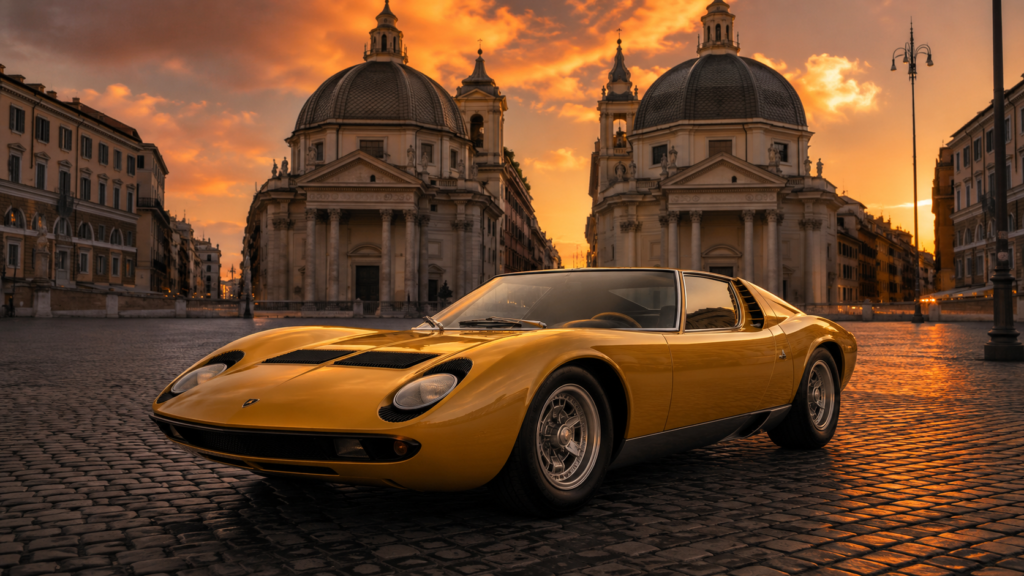
The complete Miura was revealed at the Geneva Motor Show in March 1966. The styling, created by Marcello Gandini at Carrozzeria Bertone, was a sensation. The car was exceptionally low, measuring just 110cm in height. The distinctive “eyelashes” around the headlights, the sleek bodywork, and the louvered rear window all contributed to its dramatic appearance.
The car was so new that the engine was not installed in the show car. It was filled with ballast and locked shut. But the audience did not care. The Miura was an instant success, and the term “supercar” was coined to describe it.
The Engineering: The Transverse V12
The Miura’s technical features were as impressive as its design. The V12 engine was mounted transversely to keep the wheelbase short. This required a unique casting to marry the engine and gearbox. The engine produced 350 horsepower at 7,000 rpm in the original P400. Over the years, power increased. The P400 S produced 370 horsepower at 7,700 rpm, and the Miura SV produced 385 horsepower at 7,850 rpm.
The car was the fastest production car in the world at launch. It could accelerate from 0 to 100 km/h in 6.7 seconds and reach a top speed of 280 km/h. The transverse layout and mid-engine positioning gave the car exceptional balance and handling.
The Evolution: S and SV
The Miura was continuously developed throughout its production run. The P400 S, introduced in 1968, featured slight aesthetic changes and a more comfortable interior. The Miura SV, introduced in 1971, was the most radical variant. It featured larger rear tires, widened wheel arches, a stronger chassis, and revised suspension. The “eyelashes” were also removed from the headlights. The SV is now the most desirable of the Miura variants, with only 150 units produced.
The Roman Sunset: The Miura in Pop Culture
The Miura’s impact extended beyond the automotive world. It became a cultural icon, sought after by rock stars and film stars. The car’s most famous role was in the 1969 film “The Italian Job,” where it appeared in the opening scenes. The film sealed the car’s status as a legend.
The Miura’s Legacy
The Miura ended production in 1973, after 764 units had been built. It was succeeded by the Countach, a car that would become even more dramatic. But the Miura’s legacy is unique. It created the supercar category. It proved that a mid-engine layout could work in a production road car. It established Lamborghini as a brand that would always push the limits of automotive design and engineering.
The sun has fully set over Rome. The Piazza del Popolo is quiet, but the memory of the Miura endures. It is the car that created the supercar, and it is a legend that will never fade.
Key Takeaways
- The Lamborghini Miura was the first mid-engine production car and the vehicle for which the term “supercar” was coined.
- It was developed by a team of rebellious engineers against the wishes of founder Ferruccio Lamborghini.
- The Miura’s transverse V12 and mid-engine layout set a new standard for high-performance sports cars.
- The car was continuously evolved into the P400 S and the more radical Miura SV.
- The Miura became a cultural icon, appearing in films and becoming a symbol of 1960s automotive design.
Conclusion
The Lamborghini Miura is not just a car. It is a piece of automotive history. It is the machine that defined a category and inspired generations of designers and engineers. The story of its creation, from a tractor manufacturer’s ambition to a group of rebellious engineers, is as compelling as the car itself.
The Miura is a testament to what can be achieved when passion, engineering, and a willingness to defy convention come together. It was the car that created the supercar. And it remains a symbol of what a car can be when it is built without compromise.

