
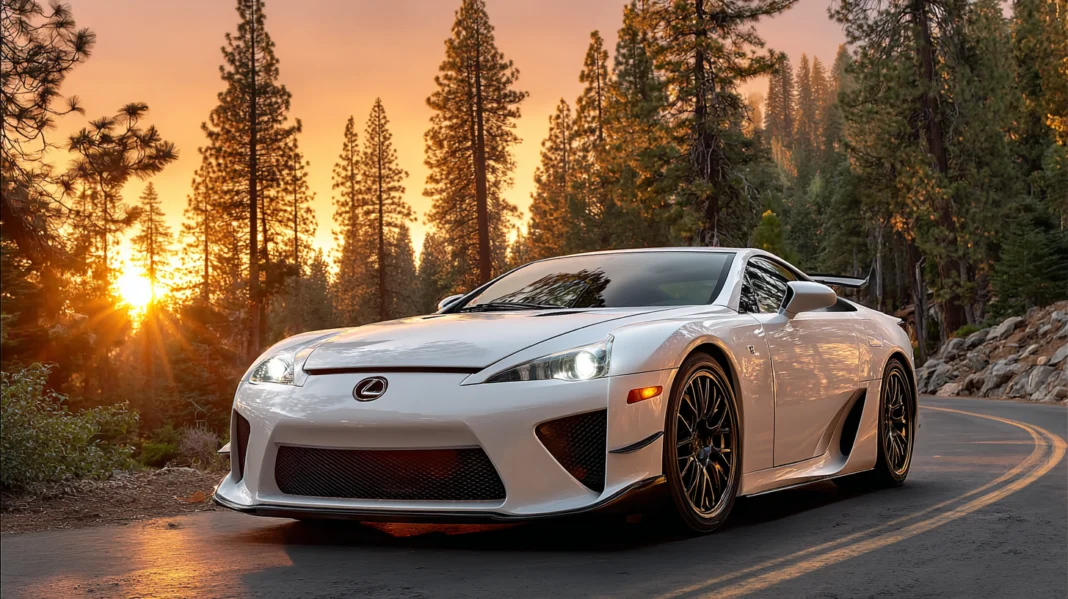
The Lexus LFA occupies a unique place in automotive history. Produced between 2010 and 2012, it was a car that prioritized engineering purity over commercial success, featuring a hand built 4.8 liter V10 engine that revved to 9,000 rpm and produced 552 horsepower. Only 500 units were built, and each was sold at a significant loss per vehicle. Today, the LFA is widely regarded as one of the greatest driver’s cars ever made, with values on the secondary market exceeding $1 million.
For more than a decade, enthusiasts have wondered whether Lexus would ever produce a true successor. The RC F and LC offered performance, but neither carried the LFA’s halo car status. Now, as the automotive industry accelerates toward electrification, Lexus appears ready to answer that question. The LFA successor, widely expected to be named the LFR, is in advanced development, with prototypes testing on circuits around the world.
This article compiles everything known about the upcoming Lexus LFA successor, including its expected powertrain, design, performance targets, and how it stacks up against rivals in performance, design, and value.
The Name: LFR
While Lexus has not officially confirmed the name, extensive reporting and prototype sightings indicate the LFA successor will be called the LFR. This naming convention follows Lexus’s existing performance nomenclature, where F denotes high performance models like the IS F and RC F. The R likely stands for Racing, reflecting the car’s close development relationship with the GR GT3 racing program.
The car has been spotted testing in multiple configurations on the Nürburgring and other circuits, and Lexus has shown related concept vehicles at automotive events, providing a clear preview of the production model’s design direction.
Powertrain: V8 Hybrid
The original LFA was celebrated for its naturally aspirated V10 engine, which produced a distinctive high frequency wail that many consider one of the best sounding engines ever made. The successor will take a different approach, reflecting changes in technology and emissions regulations.
Engine Specifications
The LFR is expected to be powered by a 4.0 liter twin turbocharged V8 engine. This represents a departure from the LFA’s V10, but the addition of hybrid technology is expected to more than compensate for the reduction in cylinder count. The engine is being developed in conjunction with Toyota’s Gazoo Racing division and shares technology with the GR GT3 race car.
Hybrid System and Total Output
The V8 engine will be paired with a self charging hybrid system, positioning the LFR as a hybrid rather than a plug in hybrid. The electric motor or motors are expected to be mounted at the rear, behind the driver and passenger, with some prototypes showing visible components when camouflage was removed.
Total system output is widely reported to be approximately 900 horsepower. This represents a substantial increase over the LFA’s 552 horsepower and places the LFR in direct competition with the most powerful hybrid supercars from European manufacturers.
Acceleration and Performance
With 900 horsepower and the instant torque provided by the hybrid system, the LFR is expected to accelerate from 0 to 100 kilometers per hour in approximately 2.5 seconds. This would make it significantly quicker than the LFA, which achieved the same sprint in approximately 3.6 seconds.
Top speed has not been confirmed, but given the power output and aerodynamic development, a figure in excess of 200 miles per hour is virtually certain. The car’s focus appears to be on track performance and acceleration rather than outright top speed records.
Transmission and Drive Configuration
The LFR is expected to feature a nine speed automatic transmission, with paddle shifters mounted on the steering wheel for manual control. The transmission is likely a dual clutch unit or a high performance torque converter design capable of handling the engine’s substantial torque output.
Drive configuration is expected to be all wheel drive, with the internal combustion engine driving one axle and the electric motor or motors driving the other. This configuration provides the traction necessary to deploy 900 horsepower effectively while also enabling torque vectoring capabilities that enhance cornering performance.
Chassis and Construction
Carbon Fiber and Aluminum
The LFR is expected to feature a carbon fiber body, reducing weight and providing the structural rigidity required for precise handling. The chassis itself is reported to be an aluminum spaceframe, combining the rigidity of a race derived structure with the repairability that road cars require.
This construction approach, combining carbon fiber body panels with an aluminum structure, is similar to that used by competitors in the supercar segment. It allows for a relatively low curb weight while maintaining the structural integrity needed for both road and track use.
Dimensions and Proportions

The LFR is expected to be larger than the original LFA, which measured 4,505 mm in length, 1,895 mm in width, and 1,220 mm in height. The new car’s dimensions will reflect modern safety standards and the packaging requirements of the hybrid powertrain, but the overall proportions a long hood, a rearward cabin, and a short rear deck will remain consistent with the front engine, rear drive layout.
Suspension and Brakes
The LFR is expected to use independent double wishbone suspension at all four corners, a configuration that provides precise control over wheel motion and allows for optimal tire contact patch management. The brakes will be carbon ceramic units with large diameter discs and multi piston calipers, providing the stopping power necessary for track use.
Prototypes have been spotted with large ceramic brake discs and substantial calipers visible through the wheels, indicating that the production car will have braking capability commensurate with its power output.
Design and Aerodynamics
Exterior Design
The LFR’s exterior design has been previewed by both concept vehicles shown at automotive events and the heavily camouflaged prototypes spotted on test circuits. The design is characterized by a low, wide stance, a long hood with sculpted vents, and aggressive aerodynamic elements.
The front fascia features large air intakes that feed cooling air to the engine and brakes. The headlights are expected to incorporate Lexus’s signature L shaped daytime running lights, executed as vertical elements that flank the main lighting units. The front splitter is substantial, contributing to the car’s downforce generation.
The side profile shows a long hood, a rearward cabin, and muscular haunches that house the rear wheels. Large vents behind the front wheels manage airflow from the wheel wells and feed cooling air to the rear mounted hybrid components.
The rear end is defined by a full width taillight assembly, a substantial diffuser, and quad exhaust outlets. Depending on the variant, a large fixed rear wing may be fitted, providing additional downforce for track oriented versions.
Aerodynamic Development
The LFR has been developed with significant attention to aerodynamics, a priority that is evident in the multiple prototype configurations spotted during testing. Three distinct versions have been observed: one with a large rear wing and aggressive front splitter, one with a smaller wing, and one with no wing at all.
This suggests that Lexus plans to offer the LFR in multiple variants with different aerodynamic packages, allowing buyers to choose between maximum downforce for track use and reduced drag for higher top speed.
The car’s aerodynamic development has been conducted alongside the GR GT3 race car, ensuring that the road car benefits from the same wind tunnel and computational fluid dynamics work that supports the racing program.
Multiple Variants
Beyond the aerodynamic packages, there are indications that Lexus may offer the LFR in multiple performance tiers. Some reports suggest three distinct versions: an entry level model, a mid level aero optimized variant, and a top level model with a large rear wing and carbon fiber front splitter. These variants could be distinguished by power output, with the top model receiving more aggressive tuning of the hybrid system.
Interior and Driver Focus
Cockpit Design
Prototype interiors have been photographed, revealing a cabin that appears nearly production ready. The interior features a combination of black and red materials, with carbon fiber trim and Alcantara upholstery contributing to the performance focused atmosphere.
The driver faces a flat bottom steering wheel with large paddle shifters mounted directly on the wheel rather than on the steering column. This placement allows the driver to keep their hands on the wheel while shifting during cornering. A digital instrument cluster provides essential driving information, and a central touchscreen handles infotainment functions.
Controls and Layout
The center console features a toggle switch gear selector, a departure from the traditional shift lever found in many sports cars. Climate controls are located below the central touchscreen, with physical buttons that allow operation without navigating through menus.
The seating position is low, as expected in a car with this performance focus. The seats themselves are expected to be carbon fiber shell units that provide lateral support during cornering while remaining comfortable enough for road use.
Technology Features
The LFR is expected to offer a full suite of modern technology features, including a premium audio system, navigation, and connectivity options. The infotainment system appears production ready on the prototypes, with a responsive interface and clear graphics.
Driver assistance features are likely to be available, though the car’s performance focus may limit the extent of automation. Systems such as adaptive cruise control and lane keeping assistance may be offered, but the LFR is unlikely to prioritize autonomous driving capability over driver engagement.

Racing Pedigree
GT3 Development
One of the most significant aspects of the LFR program is its close relationship with GT3 racing. Lexus has been developing a GR GT3 race car, and the LFR is expected to be the road legal version of that racing platform. This reverse engineering approach building the road car from the race car rather than the other way around ensures that the LFR’s engineering priorities are established by competition requirements.
The GR GT3 race car is expected to make its competition debut in 2026, with the road legal LFR following later in the year. This timeline aligns with the expected production schedule for the LFR.
Competition Intent
The development of a GT3 version signals that Lexus intends to compete seriously in international GT racing. The GT3 category is one of the most competitive in motorsport, with entries from Ferrari, Lamborghini, McLaren, Porsche, Mercedes AMG, and Aston Martin. Lexus’s commitment to developing a car capable of competing in this category demonstrates the seriousness of the LFR program.
For buyers, the racing connection adds authenticity to the LFR’s performance claims. A car developed alongside a GT3 racer benefits from the same engineering rigor, the same aerodynamic development, and the same focus on durability and performance.

Market Position and Competition
Expected Pricing
The original LFA carried a price of $375,000 when new, a figure that was widely discussed at the time. The LFR is expected to be significantly more accessible. Reports suggest a starting price of approximately $185,000 for the base model, positioning it as a more attainable halo car than its predecessor.
This pricing would place the LFR in competition with the Porsche 911 Turbo S, the Mercedes AMG GT, and the Audi R8, while still commanding a premium over the more mainstream performance cars in Lexus’s lineup. Higher performance variants with additional aerodynamic equipment and more aggressive tuning would likely carry higher prices.
Direct Competitors
The LFR’s primary competitors will be hybrid supercars from European manufacturers. The Ferrari 296 GTB, with its 819 horsepower V6 hybrid powertrain, is a direct rival. The McLaren 750S, while not hybridized, offers similar performance levels. The Lamborghini Temerario, which replaces the Huracán, is expected to feature a hybrid V8 powertrain and will compete in the same segment.
The Mercedes AMG GT 63 S E Performance, with its 805 horsepower plug in hybrid system, has been used as a benchmark during LFR development, with prototypes spotted following an AMG GT during testing. This suggests that Lexus is targeting performance levels comparable to or exceeding Mercedes’s most powerful hybrid.
Value Proposition
The LFR’s value proposition will be defined by its combination of performance, technology, and brand prestige. At an expected starting price of approximately $185,000, it would undercut the Ferrari 296 GTB and McLaren 750S by a substantial margin while offering comparable or superior power.
The LFA’s status as a collectible, with values that have appreciated significantly since production ended, may also influence the LFR’s appeal. If the LFR can capture a similar combination of engineering excellence and limited availability, it could follow the LFA’s trajectory as a desirable collector car.
The Electric LFA Concept
In late 2025, Lexus revealed an LFA Concept that has caused some discussion about the direction of the LFA successor. This concept, presented as a battery electric vehicle, features a completely different design language and powertrain from the hybrid LFR prototypes that have been spotted testing.
The electric LFA Concept is described as a bold reinterpretation of the LFA for the EV era, with a low slung coupe silhouette, an aluminum spaceframe, and an all electric powertrain. It is significantly larger than the original LFA.
The relationship between this electric concept and the hybrid LFR is not entirely clear. It may represent a separate model, perhaps an all electric variant that will join the LFR in Lexus’s performance lineup. Alternatively, it could be a design study that previews future Lexus sports cars without directly predicting the LFR’s final form.
What is clear is that Lexus is pursuing multiple paths for its performance future. The hybrid LFR, with its V8 engine and racing connection, represents one direction. The electric LFA Concept suggests that an all electric sports car is also under consideration.
How the LFR Stacks Up Against Rivals
Against Ferrari 296 GTB
The Ferrari 296 GTB combines a 3.0 liter V6 with a hybrid system to produce 819 horsepower. It accelerates from 0 to 100 km/h in approximately 2.9 seconds and has a top speed of over 330 km/h. The LFR’s expected 900 horsepower and 2.5 second 0 to 100 time would give it a significant advantage in straight line acceleration.

The Ferrari’s advantage lies in its brand prestige and its character. The V6, while smaller than the LFR’s V8, is tuned to deliver the emotional engagement that Ferrari customers expect. The LFR will need to match that engagement to compete effectively.
Against McLaren 750S
The McLaren 750S uses a 4.0 liter twin turbocharged V8 without hybrid assistance to produce 740 horsepower. It accelerates from 0 to 100 km/h in 2.7 seconds. The LFR’s hybrid system gives it a power advantage, and the electric motor’s instant torque should provide superior low end response.
McLaren’s advantage is its focus on lightweight construction and its reputation for handling precision. The 750S weighs significantly less than the LFR’s expected curb weight. Lexus will need to demonstrate that its carbon fiber and aluminum construction can deliver comparable handling.
Against Porsche 911 Turbo S
The Porsche 911 Turbo S uses a 3.7 liter twin turbocharged flat six to produce 640 horsepower. It accelerates from 0 to 100 km/h in 2.6 seconds. The LFR’s power advantage is substantial, but the 911 Turbo S benefits from Porsche’s decades of development and a loyal customer base.
Porsche’s advantage is its daily usability and its reputation for reliability. The 911 Turbo S can serve as both a track car and a daily driver, a combination that has made it one of the most successful performance cars on the market. The LFR will need to demonstrate similar versatility to compete.
Against Lamborghini Temerario
The Lamborghini Temerario, expected to replace the Huracán, will feature a hybrid V8 powertrain producing in excess of 900 horsepower. It will be the LFR’s most direct competitor, combining similar power levels with Lamborghini’s distinctive design and brand appeal.
Lamborghini’s advantage lies in its dramatic styling and its position as an established exotic car brand. The LFR will need to offer comparable visual impact and performance to compete with Lamborghini’s offering.
What We Still Don’t Know
Official Specifications
Lexus has not released official specifications for the LFR. The power output, acceleration figures, and pricing discussed in this article are based on reporting and speculation. Until Lexus makes an official announcement, these figures should be considered estimates.
Exact Release Date
The LFR is expected to debut in 2026, with some reports suggesting a debut at major motorsport events and others pointing to later in the year. The GT3 race car is expected to appear first, with the road legal version following.
North American Availability
While the LFR is expected to be sold in global markets, including North America, official confirmation is pending. Lexus’s commitment to the GT3 racing program suggests that the car will be homologated for sale in major markets.
Production Numbers
The LFA was limited to 500 units. Whether the LFR will follow a similar limited production strategy or be produced in larger numbers has not been announced. The car’s development alongside a GT3 race car suggests that a minimum production volume is required for homologation, but the ultimate number may be higher than the LFA’s 500 units.
Conclusion
The Lexus LFA successor, expected to be called the LFR, represents a significant moment for the brand. After more than a decade without a true halo car, Lexus is preparing to enter the hybrid supercar segment with a machine that combines a 4.0 liter twin turbo V8, a hybrid system, and an estimated 900 horsepower.
The car’s development alongside a GT3 race car ensures that its engineering priorities are established by competition requirements. The multiple prototype configurations observed during testing suggest that Lexus plans to offer variants with different aerodynamic packages and performance levels. The expected starting price of approximately $185,000 would make the LFR significantly more accessible than its predecessor while still positioning it as a premium offering.
The LFR will face formidable competition from Ferrari, McLaren, Lamborghini, and Porsche. These brands have decades of experience in the supercar segment and loyal customer bases. To succeed, the LFR will need to offer a combination of performance, character, and value that distinguishes it from these established players.
The original LFA achieved a kind of immortality through its engineering purity, its extraordinary V10 engine, and its rarity. The LFR cannot simply repeat that formula; the automotive landscape has changed too much. But it can honor the LFA’s legacy by pursuing the same commitment to engineering excellence, the same focus on driver engagement, and the same refusal to compromise.
For enthusiasts who have waited more than a decade for a proper LFA successor, the LFR appears to be shaping up as a worthy heir. It remains to be seen whether it can capture the same magic, but the signs are promising. The LFR is real, it is coming, and it promises to be one of the most significant performance cars of the decade.
Gear Picks for This Story
 Stay SafeThinkware U1000 4K Dash CamSee the Specs →
 Tech UpgradeVeepeak OBDCheck BLE Bluetooth ScannerExplore the Specs →
 Paddock StyleScuderia Ferrari Puma Polo ShirtSee the Design →
 Creator GearGoPro Enduro Battery 2-Pack Hero 13/12See the Specs →
As an Amazon Associate, VeloxTrend earns from qualifying purchases.

