
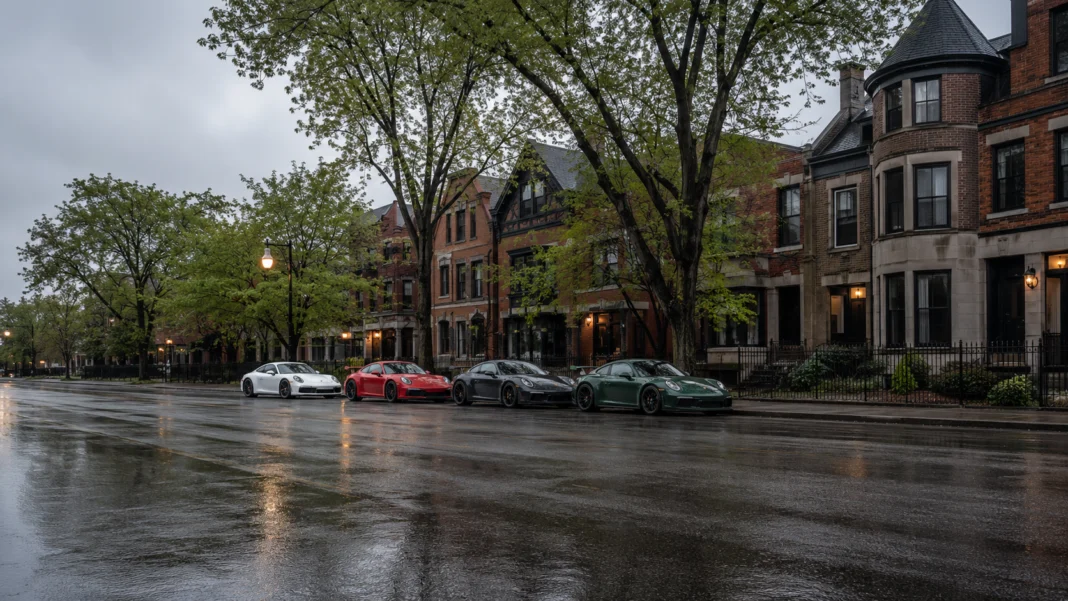
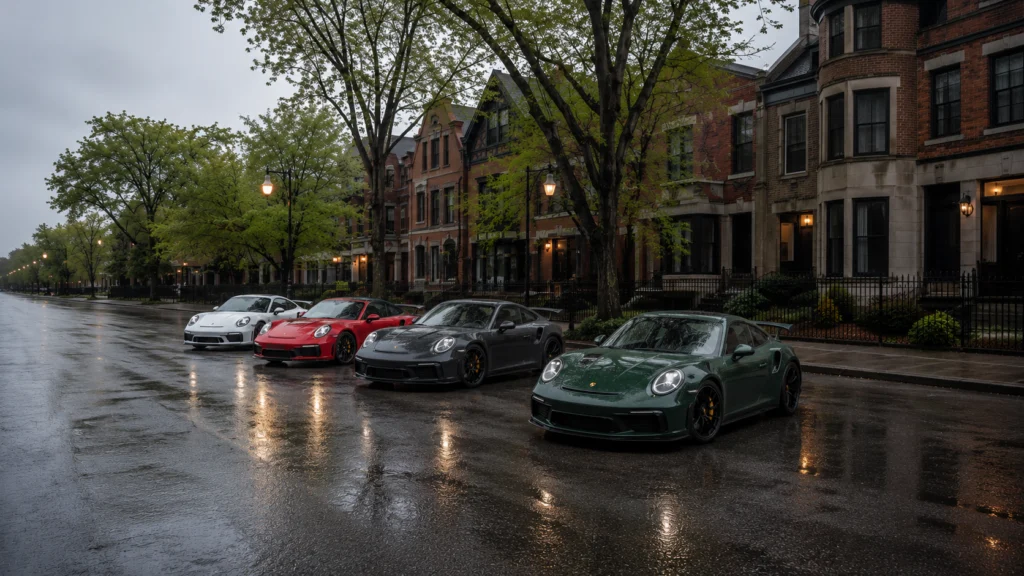
Picture soft rain falling on the streets of Roscoe Village, a historic neighborhood on Chicago’s north side. The vintage shops and corner cafes are quiet, and imagine a row of Porsche 911s parked along a side street. They are not the newest models, nor the most expensive. But together they show the bewildering variety of the modern 911 lineup.
The 911 lineup has never been more complex. There are Carreras, Carrera Ts, Carrera 4s, Carrera Ss, Carrera GTSs, Turbos, Turbo Ss, GT3s, GT3 RSs, Dakars, and Sport Classics. Choosing the right one requires understanding what you actually need, not what you think you want.
This guide breaks down every current 911 variant, what separates them, and which one actually matches your driving life.
The Location: Roscoe Village, Chicago, Illinois
Roscoe Village is a neighborhood of tree-lined streets and brick buildings. It is not a racetrack. It is not a canyon road. It is a place where people live, commute, and park on the street. The 911 owners here have learned that the best car is not always the fastest. It is the one that fits your life.
The 911 Philosophy: Rear Engine, Flat Six, Evolving
Every modern 911 shares a rear engine layout and a flat six engine. The 992 generation, introduced in 2019, is the current model. The lineup includes rear wheel drive and all wheel drive, naturally aspirated and turbocharged, coupe and convertible.
The key is understanding the hierarchy. The numbers and letters tell a story.
The Carrera: The Entry Point
Who it is for: The driver who wants a 911 for daily driving. The one who does not need the extra power of the S or GTS.
The car: The Carrera has a 3.0 liter twin turbo flat six producing 379 horsepower. The 0 to 60 time is 4.0 seconds with the dual-clutch transmission, or 4.2 seconds with the manual. The top speed is 182 miles per hour.
The Carrera is the lightest and most affordable 911. It is rear wheel drive, which means it is playful and engaging. The ride is compliant, and the cabin is comfortable.
What owners say: “The base Carrera is plenty fast for the street. I drive mine every day. It is comfortable, reliable, and fun.”
What to watch for: The base Carrera is often overlooked. Buyers assume they need an S. Test drive a base Carrera before you spend more money.

The Carrera S: The Sweet Spot
Who it is for: The driver who wants more power than the base Carrera but does not need the Turbo or GT3. The one who wants the best all-around 911.
The car: The Carrera S has a 3.0 liter twin turbo flat six producing 443 horsepower. The 0 to 60 time is 3.5 seconds with the dual-clutch transmission. The top speed is 191 miles per hour.
The Carrera S has larger brakes, wider tires, and a more aggressive suspension than the base Carrera. It is available with rear wheel drive or all wheel drive (Carrera 4S).
What owners say: “The Carrera S is the sweet spot. It has enough power to be exciting, but it is not as expensive as a Turbo or GT3. It does everything well.”
What to watch for: The Carrera S is popular. Used examples hold their value well.
The Carrera GTS: The Driver’s Carrera
Who it is for: The driver who wants a Carrera with the performance of a Turbo but the character of a naturally aspirated engine. The one who wants the best of both worlds.
The car: The Carrera GTS has a 3.0 liter twin turbo flat six producing 473 horsepower. The 0 to 60 time is 3.3 seconds. The top speed is 193 miles per hour.
The GTS is the top of the Carrera line. It has the engine from the Turbo (detuned), the chassis from the Carrera S, and unique styling cues. It is the driver’s Carrera.
What owners say: “The GTS is the Goldilocks 911. It is not as firm as the GT3, but it is sharper than the S. It is the perfect daily driver.”
What to watch for: The GTS is expensive. A well-optioned GTS approaches the price of a base Turbo.
The Turbo and Turbo S: The All Weather Supercar
Who it is for: The driver who wants the fastest 911 for the street. The one who needs all wheel drive for year round driving. The one who values effortless power.
The car: The Turbo S has a 3.7 liter twin turbo flat six producing 640 horsepower. The 0 to 60 time is 2.6 seconds. The top speed is 205 miles per hour.
The Turbo is rear wheel drive. The Turbo S is all wheel drive. Both are brutally fast. The all wheel drive provides confidence in rain and snow.
What owners say: “The Turbo S is a cheat code. It is so fast, so stable, so capable. It does not feel like a 640 horsepower car. It feels like a guided missile.”
What to watch for: The Turbo S is expensive to buy and expensive to maintain. The tires wear quickly. The brake rotors are costly.
The GT3: The Naturally Aspirated Purist
Who it is for: The driver who values driver engagement over straight line speed. The one who wants a high revving naturally aspirated engine. The one who tracks their car.
The car: The GT3 has a 4.0 liter naturally aspirated flat six producing 502 horsepower. It revs to 9,000 rpm. The 0 to 60 time is 3.2 seconds with the dual-clutch transmission, or 3.7 seconds with the manual. The top speed is 197 miles per hour.
The GT3 is rear wheel drive. The suspension is firm. The cabin is louder than other 911s. The car is designed for track use.
What owners say: “The GT3 is not a daily driver. The ride is punishing. The cabin is loud. But when you rev it to 9,000 rpm on a track, nothing else matters.”
What to watch for: The GT3 holds its value exceptionally well. Manual transmission cars are especially desirable.
The GT3 RS: The Track Weapon
Who it is for: The track day enthusiast. The driver who wants the most extreme naturally aspirated 911. The one who does not care about comfort.
The car: The GT3 RS has a 4.0 liter naturally aspirated flat six producing 518 horsepower. The 0 to 60 time is 3.0 seconds. The top speed is 184 miles per hour. The downforce is massive.
The RS has a fixed rear wing, a stiffer suspension, and reduced sound deadening. It is not a street car. It is a race car with license plates.
What owners say: “The RS is too much for the street. It is noisy, harsh, and impractical. But on a track, it is sublime.”
What to watch for: The RS is expensive. It is also rare. Used examples command high prices.
The Dakar: The Off Road 911
Who it is for: The adventurous driver. The one who wants to take their 911 on gravel roads and light trails. The one who appreciates rally heritage.
The car: The Dakar is a limited edition 911 designed for off road use. It has raised suspension, all wheel drive, and off road tires. The 3.0 liter twin turbo flat six produces 473 horsepower.
The Dakar is not a rock crawler. It is a gravel road machine. It is a tribute to Porsche’s 1984 Paris Dakar Rally victory.
What owners say: “The Dakar is the most fun you can have in a 911 on a dirt road. It is ridiculous. It is wonderful.”
What to watch for: The Dakar is a limited edition. Only 2,500 were built. Prices have already appreciated.

The Roscoe Village Decision: Which One Fits Your Life?
The owners gather at a corner cafe. They talk about their cars. They are not arguing. They are sharing.
The Carrera owner says, “I drive mine every day. It is perfect for the city.”
The Carrera S owner says, “I wanted more power, but I did not want the Turbo. The S is the sweet spot.”
The GTS owner says, “I track mine a few times a year. The GTS is the perfect dual purpose car.”
The Turbo S owner says, “I drive mine in the snow. The all wheel drive is a game changer.”
The GT3 owner says, “I have a second car for daily driving. The GT3 is for weekends and track days.”
The GT3 RS owner says, “I trailer mine to the track. It is too harsh for the street.”
The Dakar owner says, “I drive mine on gravel roads. It is the most fun I have ever had.”
The First-Time Buyer’s Checklist
Before you buy a 911, complete this checklist.
- Decide how you will use the car. Daily driver? Weekend toy? Track car?
- Set a realistic budget, including insurance and maintenance.
- Test drive multiple variants. A base Carrera may surprise you.
- Consider certified pre-owned. A two year old Carrera S is a better value than a new base Carrera.
- Get a pre-purchase inspection from a Porsche specialist.
- Budget for maintenance. Porsche parts are not cheap.
Conclusion
The Porsche 911 lineup is complex, but the choice is simpler than it seems. The base Carrera is for daily driving. The Carrera S is the sweet spot. The GTS is the driver’s Carrera. The Turbo S is the all weather supercar. The GT3 is the track day purist. The GT3 RS is the track weapon. The Dakar is the off road adventurer.
The rain has stopped in Roscoe Village. The 911s are parked along the street. The owners are drinking coffee. They are happy.
The best advice comes from the Carrera owner. “Do not overthink it. Drive them. The right one will speak to you. The numbers do not matter. The feeling matters.”
That is the truth of buying a 911. The right one is the one that makes you smile. Not the one with the highest horsepower. Not the one with the lowest price. The one that fits your life. The one that feels right. The one you want to drive.
Gear Picks for This Story
 Garage EssentialVeepeak OBDCheck BLE Bluetooth ScannerExplore the Specs →
 Tech UpgradeBlueDriver Pro OBD2 Bluetooth ScannerExplore the Specs →
 Paddock StyleScuderia Ferrari Puma Polo ShirtSee the Design →
 Detail Like a ProMothers CMX Ceramic Spray WaxSee How It Works →
As an Amazon Associate, VeloxTrend earns from qualifying purchases.

