
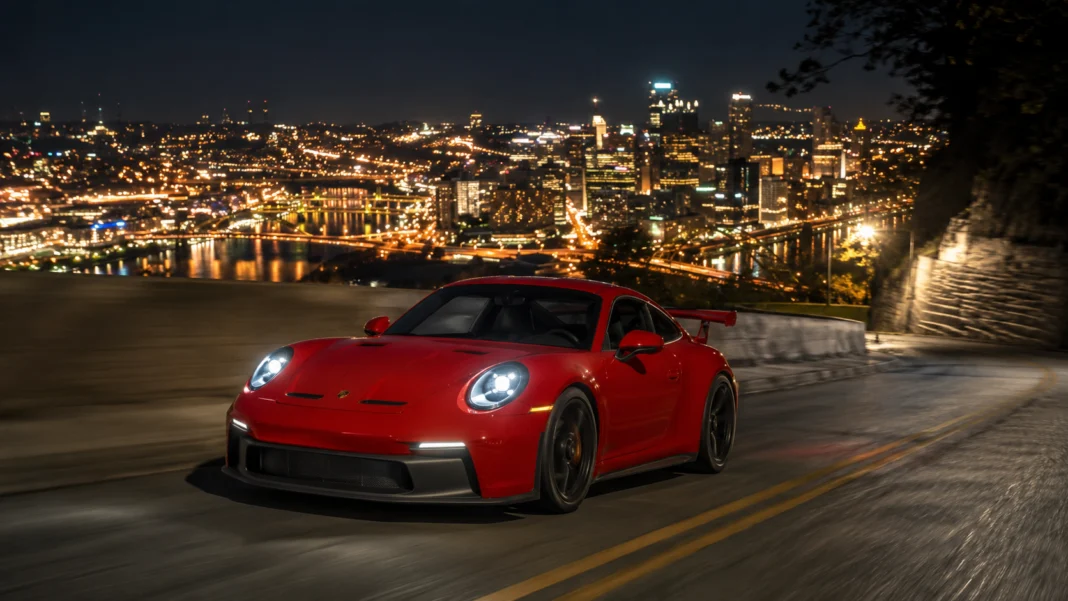
Picture the fog rolling in over the Monongahela River as a Guards Red Porsche 911 GT3 climbs the winding road toward Mount Washington. The city lights of Pittsburgh sprawl below, but the driver’s attention is fixed on the road ahead. The 4.0-liter flat-six wails to 9,000 rpm, the sound echoing off the hillside. This is not a car for the city. It is a car for moments like this.
The Porsche 911 GT3 has been the enthusiast’s choice in the iconic 911 lineup for 25 years. Priced at the level of a 911 Turbo but with rear-wheel drive and a race-ready manual gearbox option, it has long been the choice for drivers who value engagement over outright power. Now, the 992.2 generation has refined that formula with subtle but meaningful updates that make the GT3 more capable and more customizable than ever.
25 Years of the GT3
The 911 GT3 era started in March 1999 at the Geneva Motor Show when the first version, based on the 996.1 generation Porsche 911, was unveiled. Designed and developed as a road-legal track tool, that first-generation car replaced the iconic Porsche 911 RS. For Porsche, the 911 GT3 is the point where series production meets motorsport.
To mark its 25th anniversary, Porsche is releasing two versions simultaneously for the first time: a track-focused sports car with a rear wing and a more understated version with the Touring Package. The Touring Package, which dispenses with the fixed wing and preserves the classic 911 silhouette, has been part of the GT3 program since 2017. For the first time, rear seats are available as an option, specifically with the Touring Package, fulfilling a longstanding customer request.

The Engine: Still the Heart of the GT3
The GT3-unique 4.0-liter naturally aspirated flat-six engine has the same 510 PS (502 hp) output as before, but gains revised cylinder heads, sharper camshafts from the GT3 RS, improved oil coolers, and new throttle valves with better flow. Peak torque is 450 Nm (331 lb-ft), slightly lower than the previous model, but the final drive ratio is now eight percent shorter in both manual and PDK configurations. This compensates for the torque deficit and makes the car feel more responsive than ever.
The engine spins to 9,000 rpm, and the sound is a wonderful combination of intake roar and valvetrain scream. There is nothing else quite like it. The engine has been designed for current, significantly stricter exhaust standards and is equipped with two particulate filters and four catalytic converters. Despite this, Porsche has managed to maintain the power output through a series of optimization measures.
Transmission: Manual or PDK
The new 911 GT3 models are available with two gearbox choices: a six-speed GT sports manual transmission or a seven-speed PDK twin-clutch gearbox. Unlike the 911 Carrera, which uses eight gears, the GT3 retains seven gears to reduce weight and optimize performance.
The six-speed manual transmission features an ultra-short travel and delivers a direct connection between the powertrain and the driver. It also includes an AUTO BLIP function to mimic heel-and-toe action when downshifting. The manual gearbox is 17 kilograms lighter than the PDK.
The PDK gearbox delivers optimized shift times, rapid gear changes, and ideal acceleration. It can be driven in automatic mode or operated manually via steering wheel-mounted paddles or the central gearshift lever.
Suspension and Chassis: GT3 RS Engineering
Porsche’s motorsport experience has been integrated into the design and development of the 911 GT3. The front suspension uses a highly developed double-wishbone design that delivers precise turn-in, agility, high-speed braking stability, and exceptional cornering performance.

The new GT3 adopts the anti-dive system from the 911 GT3 RS. The lower control arm has a steeper angle, which generates torque to counteract suspension compression under braking, reducing pitching. This helps maintain consistent aerodynamic balance under heavy braking, which is important during corner entry at high speed on a track.
The dampers have been re-tuned to enhance control over bumps and circuit kerbs, and the bump stops have been shortened to extend wheel travel, reducing wheel load fluctuations. The result is a car that is more composed over rough surfaces and more predictable at the limit.
Rear-axle steering with a sports set-up is also fitted. At speeds up to approximately 50 km/h, the rear wheels turn in the opposite direction of the front wheels, effectively shortening the wheelbase and enhancing turn-in behavior. At speeds above 80 km/h, the rear wheels steer in the same direction as the front wheels, increasing cornering stability.
Aerodynamics: Improved Downforce
The new GT3 features a sharpened design in the front and rear, as well as improved aerodynamics. The redesigned front diffuser, the shape of the spoiler lip, and modified underbody air guides increase downforce and optimize airflow. Redesigned Matrix Design LED headlights consolidate the light functions and eliminate the need for additional lights in the front fascia, enabling an enlarged air inlet area.
Porsche uses specially developed, aerodynamically shaped trailing arms with a teardrop profile on the double-wishbone front axle. They increase downforce at high speeds and improve brake cooling. The rear wing on the GT3 features redesigned end plates that are now angled slightly outwards. The Touring Package dispenses with the fixed wing and uses an extendable rear spoiler with a Gurney flap.

Lightweight Design: The Pursuit of Low Weight
The new 911 GT3 goes all-in on lightweight design. New, silver-colored lightweight aluminum wheels reduce unsprung mass by roughly 1.5 kg compared to the previous model. Magnesium wheels, available with the Weissach Package or the Lightweight Package, save an additional 9 kg. A new 40 Ah lithium-ion lightweight battery shaves off another roughly 4 kg.
In the lightest configuration, the new 911 GT3 weighs just 1,420 kg. The Weissach Package, available for the first time in the 911 GT3, adds carbon fiber components including the anti-roll bar, coupling rods, shear panel on the rear axle, roof, side plates of the rear wing, exterior mirror top shells, and air blades in the front area.
The Mount Washington Evening
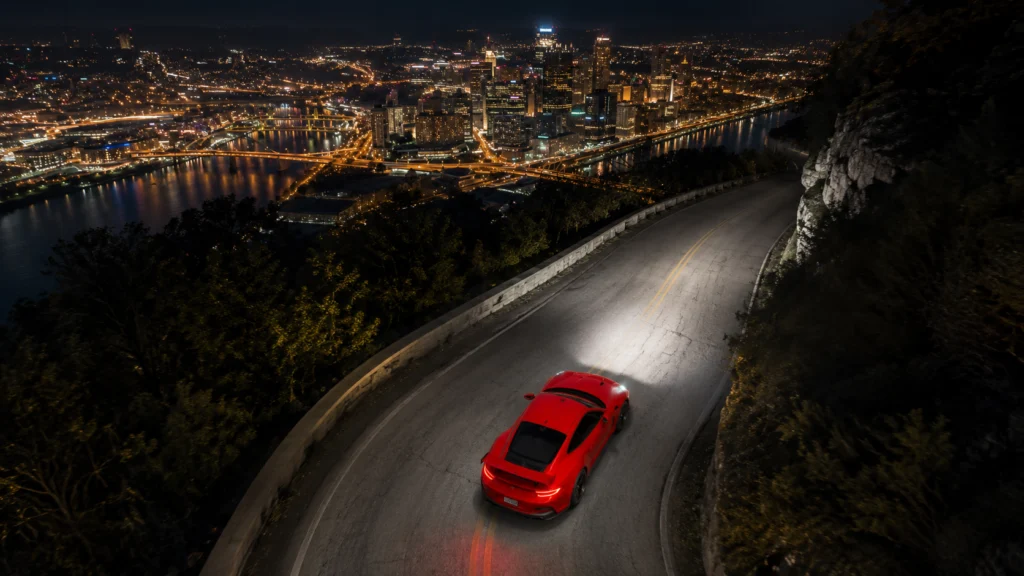
The fog has lifted slightly. The GT3 has completed its climb. Its 4.0-liter flat-six, with the help of the GT3 RS camshafts and revised cylinder heads, has delivered the 502 horsepower that makes it one of the most engaging sports cars on the road. The double-wishbone front suspension and re-tuned dampers have kept it composed through the corners. The driver, cocooned in the lightweight bucket seat, has experienced a level of performance that few cars can match.
The 911 GT3 is not a car for everyone. It starts at approximately $222,500 for the coupe and $224,495 for the Touring Package, with options pushing the price significantly higher. But it represents a significant moment in Porsche’s history. It is a celebration of 25 years of the GT3, and it proves that the naturally aspirated flat-six formula still reigns.
The GT3 is not just a car. It is a statement. It is a reminder that even in an era of hybridization and electrification, Porsche remains committed to the pure, unfiltered joy of driving. The 25th anniversary GT3 is the best yet. And it has never been better.
Gear Picks for This Story
 Road Trip ReadyRay-Ban Aviator Classic SunglassesTake a Closer Look →
 Stay SafeBlackVue DR970X-2CH Dash CamSee How It Helps →
 Paddock StyleRed Bull Racing F1 Team CapSee the Design →
 Tech UpgradeAutel MaxiSYS MS906 Pro ScannerExplore the Specs →
As an Amazon Associate, VeloxTrend earns from qualifying purchases.

