
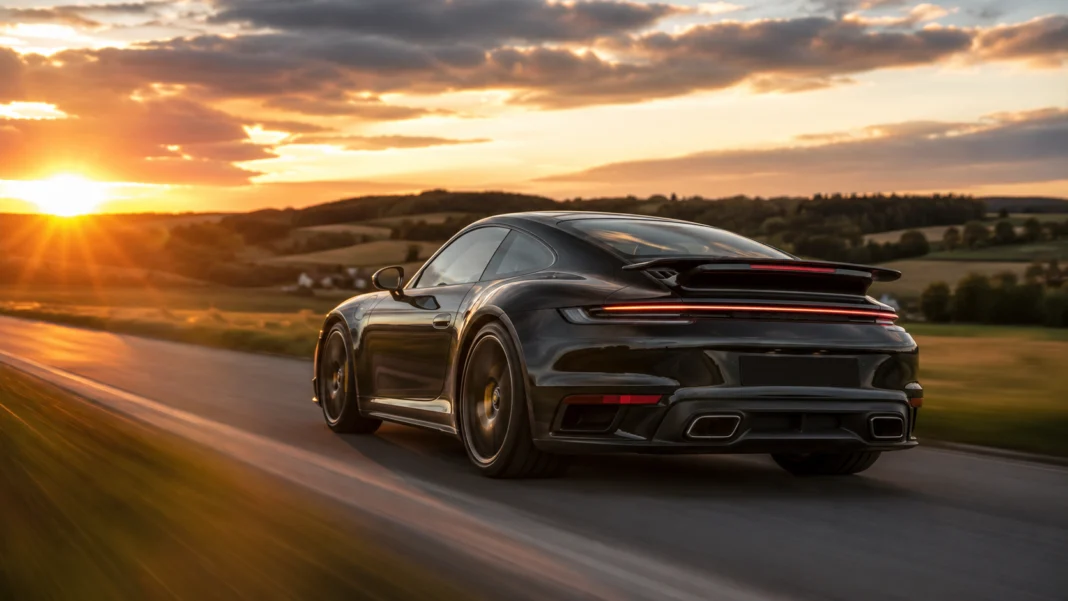
Weissach is the private development center where Porsche has honed its most significant models for decades. Picture the sun setting over its rolling hills, the test track quiet, the air still humming with the memory of the day’s activity, and a single car in the pit lane, its bodywork a study in purposeful evolution. That car is the new Porsche 911 Turbo S, the first hybrid top-of-the-range 911, and the car that proves electrification can enhance rather than compromise the world’s most complete performance car.
The 911 Turbo S has always been the benchmark for the combination of superior performance, long-distance comfort, exclusivity and everyday usability. Its predecessor was already considered the standard in the sports car world. Now the 992.2 generation has raised the bar significantly in all areas, introducing an innovative T-Hybrid powertrain that delivers 701 horsepower (711 PS) and makes the new Turbo S the most powerful production 911 ever built. This is the story of how Porsche added hybrid assistance without compromising what makes the Turbo S the world’s most complete performance car.
The T-Hybrid Powertrain: Performance Without Compromise
The heart of the new 911 Turbo S is its innovative T-Hybrid drive system. The newly developed, high-performance powertrain achieves a system output of 701 hp. Maximum torque is 590 lb-ft (800 Nm) and is available over an extremely wide rev range from 2,300 to 6,000 rpm. Peak horsepower is available across an especially broad powerband between 6,500 and 7,000 rpm. The power increase over its predecessor is 61 hp.
The T-Hybrid technology first appeared in the 911 Carrera GTS, but has been developed further for the top-of-the-range model. While a single electric exhaust gas turbocharger is integrated into the GTS system, two eTurbos are used in the new 911 Turbo S. The turbines and compressors were specifically designed to meet the requirements of the flagship model. The two eTurbos not only contribute to the considerable increase in power, but they also improve responsiveness, virtually eliminating turbo lag.
The T-Hybrid system uses a compact, 1.9 kWh, 400-volt high-voltage battery that weighs just 27 kg (approximately 60 pounds). An electric motor is integrated into the eight-speed PDK transmission, delivering power to the Porsche Traction Management all-wheel drive system. Crucially, unlike the Cayenne or Panamera hybrids, the 911 Turbo S cannot run on pure-electric power. The hybrid system is designed solely for performance enhancement, not for silent cruising. Porsche considered a plug-in hybrid, but that would have added 200 to 300 kilograms to the car’s weight. Instead, they chose a lightweight, performance-focused system that adds just 85 kilograms (approximately 180 pounds).

The engine itself has also been thoroughly reengineered. The 3.6-liter boxer engine features a new compression ratio and pistons, friction and weight reduction, an upgraded cooling system, and an improved combustion process. A new titanium exhaust system saves weight while enhancing both the aesthetics and the sound of the car.
Performance: Hypercar Acceleration Without the Hypercar Price
The performance figures are remarkable. The Turbo S Coupé accelerates from 0 to 60 mph in just 2.4 seconds, which is 0.2 seconds quicker than its predecessor. It reaches 124 mph (200 km/h) in 8.4 seconds, an improvement of 0.5 seconds. Top speed is 200 mph.
Despite producing far less total horsepower than some competitors, the Turbo S’s traction, gearing, and electric assist give it a launch advantage that is almost surreal. A decade ago, the 918 Spyder was the brand’s million-dollar hypercar halo; today, the Turbo S matches or beats it to key acceleration marks. The broad torque curve, the instant response of the eTurbos, and the seamless power delivery make the car feel as quick on the road as it is on the track.
The Chassis: Electro-Hydraulic Precision
The high-voltage system has enabled Porsche to equip the 911 Turbo S with electro-hydraulically controlled Porsche Dynamic Chassis Control (ehPDCC) as standard. This system reduces body roll when changing direction and increases agility when entering and exiting corners. The system works with cross-connected, active coupling rods, in which pressure is built up by oil volume flow depending on the driving situation. The stabilizers generate support forces and keep the vehicle in balance, making the sports car even more predictable and easier to drive despite the enormous power.
The braking system has also been upgraded. The standard Porsche Ceramic Composite Brake (PCCB) system is fitted with new brake pads, with a material mixture derived from motorsport. The brake disc diameter on the rear axle has been increased from 390 mm to 410 mm, making this the largest PCCB system Porsche has ever installed in a two-door model. The front discs measure 420 mm. A new generation of tires offers significantly improved dry handling while maintaining good wet performance, with rear tires now 10 mm wider at 325/30 ZR 21.

Aerodynamics: Intelligence in Motion
A new aerodynamic concept optimizes cooling and efficiency. Active, vertically arranged cooling air flaps in the front, an active front diffuser, a variable front spoiler, and the extendable and tilting rear wing work together as an efficient overall system. Depending on the driving situation, the system intelligently reduces lift or, when retracted, reduces drag. The drag coefficient of the Coupé has been reduced by up to 10 percent compared to its predecessor in the most efficient position. In wet mode, the front diffusers close to shield the front brake discs from excessive water spray, improving wet braking behavior.
The Nürburgring Proof: 14 Seconds Quicker
The proof of the Turbo S’s capability is the lap time on the Nürburgring Nordschleife. A lightly camouflaged 911 Turbo S achieved a time of 7:03.92 minutes under notarial supervision, approximately 14 seconds quicker than its predecessor. Porsche Brand Ambassador Jörg Bergmeister, who was involved in the development and set the official lap time, noted that the driver does not feel the weight gain. The car is much more agile, has more grip, and is significantly faster than its predecessor in all relevant sections of the track.
The Weissach Evening
The sun has fully set over the Weissach test track. The 911 Turbo S has completed its demonstration laps. Its T-Hybrid system, with the help of the twin eTurbos, has delivered the 701 horsepower that makes it the most powerful production 911 ever built. The ehPDCC suspension has kept it planted through the curves. The driver, cocooned in the driver-focused interior, has experienced a level of performance that was previously the domain of hypercars.
The 911 Turbo S is not a car for everyone. It is a top-of-the-range model with a starting price of $272,650 for the Coupé and $286,650 for the Cabriolet. But it represents a significant moment in Porsche’s history. It is the first 911 Turbo S with hybrid power, and it proves that electrification can enhance rather than compromise the benchmark.
The 911 Turbo S is not just a car. It is a statement. It is a reminder that even in an era of electrification, Porsche remains committed to the pure, unfiltered joy of driving. The hybrid system does not make the Turbo S more efficient; it makes it faster, more responsive, and more capable. The benchmark has been electrified. And it has never been better.
Gear Picks for This Story
 EV LifeEVDANCE Portable EV Charger 32ACheck Compatibility →
 Garage EssentialLiqui Moly 2041 Premium 5W-40 Motor Oil 5LExplore the Specs →
 Creator GearDJI Air 3S DroneSee the Specs →
 Paddock StyleScuderia Ferrari Puma Polo ShirtSee the Design →
As an Amazon Associate, VeloxTrend earns from qualifying purchases.

