
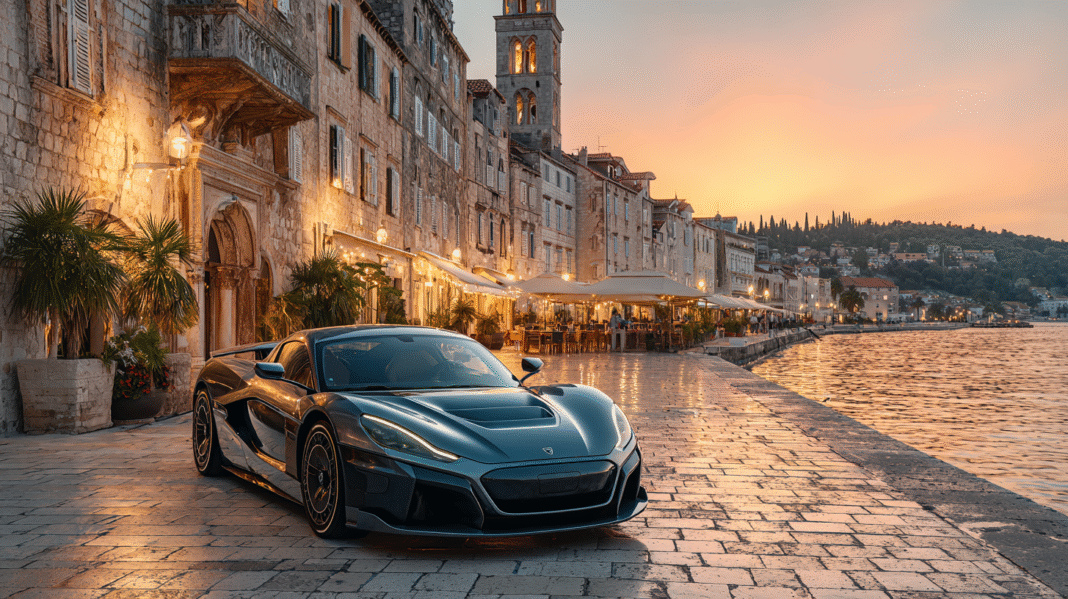
Sunrise in Split, Croatia
The air was crisp as the first light of dawn stretched over the Adriatic coastline. The narrow stone streets of Split were still quiet, the city’s Roman architecture glowing gently under the amber glow of street lamps. Down by the promenade, a whisper broke the silence — not from a combustion engine roaring to life, but from the futuristic hum of something far more revolutionary.
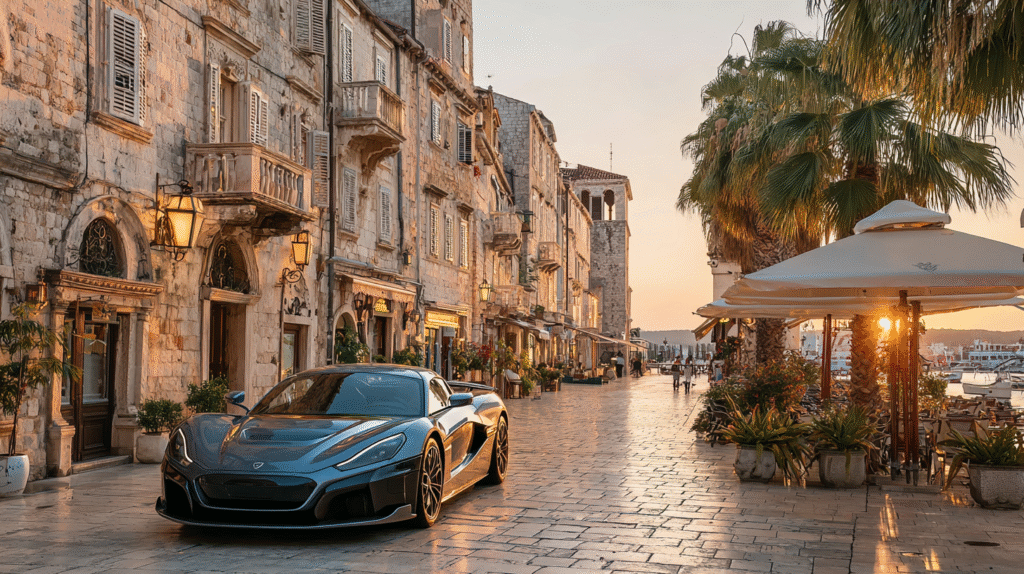
It was a Rimac Nevera, poised like a predator under the soft Croatian sky. Its low stance, muscular carbon-fiber body, and aggressive front end looked out of place in this ancient city, and yet — it felt right at home. It wasn’t here just to cruise. It was here to prove a point: electric cars aren’t just catching up — they’re leading the charge.
The Story Behind Rimac
Rimac Automobili, founded by Mate Rimac in Sveta Nedelja, Croatia, has gone from a garage-built BMW E30 conversion to creating the world’s fastest production electric hypercar. The Nevera is not just a statement of speed — it’s the product of innovation, obsession with detail, and Croatia’s entry into the elite club of hypercar builders.
Built from scratch and entirely in-house, the Nevera represents Rimac’s full vision of what electric performance can be when no compromises are made.
Powertrain: More Than Just Electric
The Rimac Nevera is powered by four independent electric motors — one at each wheel. Together, they produce a staggering 1,914 horsepower and 2,360 Nm (1,741 lb-ft) of torque. The car launches from 0 to 60 mph in just 1.74 seconds, making it quicker than a Bugatti Chiron, Tesla Model S Plaid, or anything else with four wheels.
More impressive is the 0 to 100 mph sprint, which it completes in 3.21 seconds, and the quarter mile in 8.25 seconds, verified and recorded by independent testing.
Top speed? An earth-shattering 258 mph.
This isn’t electric “catching up.” This is electric rewriting the rules.
Battery and Range
The Nevera’s 120 kWh lithium-manganese-nickel battery pack is not just about longevity — it’s about performance. Rimac’s T-shaped battery is structurally integrated into the monocoque chassis and strategically placed for perfect weight distribution and rigidity.
Range? Officially, the Nevera can travel up to 300 miles on a single charge under WLTP standards. But let’s be honest — no one’s buying this car for road trips. Still, having that range in your back pocket, along with ultra-fast 500 kW charging capabilities, is a testament to Rimac’s balanced approach to power and practicality.
Chassis and Aerodynamics
The Nevera rides on a carbon-fiber monocoque chassis, making it one of the stiffest cars ever built. This rigidity, combined with a complex active suspension system and all-wheel torque vectoring, gives the car agility typically associated with far lighter vehicles.
Its aerodynamics are fully active — the front splitter, rear diffuser, and wing adjust in real time depending on the drive mode and speed. Whether you’re slicing through a corner on the track or braking hard on a mountain descent, the car is constantly optimizing airflow and grip.
Interior: Futuristic, Not Gimmicky
Step inside the Nevera and you’re greeted by a blend of minimalist design and driver-centric technology. Three screens dominate the dash — one for the driver, one for the passenger, and a central infotainment display. Despite its hypercar pedigree, the cabin is surprisingly usable. It features real leather, exposed carbon, CNC-milled aluminum controls, and enough comfort to make short trips enjoyable.
What stands out is Rimac’s proprietary telemetry system. It records over 250 data channels in real time — from G-forces to steering angles to brake temperatures — which you can later review on the car’s interface or export to analyze on your laptop.
For those who track their cars religiously, this is a dream.
Driving Experience: Beyond Human Reflexes
The Nevera doesn’t just accelerate — it bends reality. The instant torque from the four motors delivers acceleration in a way that no internal combustion car ever could. You don’t wait for revs to build. You don’t shift. You just go.
Cornering is nearly telepathic. Thanks to the torque vectoring system dubbed R-AWTV (Rimac All Wheel Torque Vectoring), each wheel receives independent power based on the car’s yaw, pitch, and steering inputs. It’s not just smart — it’s surgical.
This makes the Nevera easy to drive fast, but with layers of complexity underneath for those who want to push the envelope.
Track Modes and Drift Control
The car comes with seven driving modes: Range, Comfort, Sport, Track, Drift, and two customizable modes. Drift mode is particularly exciting — allowing you to send more torque to the rear wheels for smoky slides, all without sacrificing control.
On the other end, Range mode optimizes everything — including ride stiffness and energy distribution — for maximum efficiency, even disabling unnecessary aerodynamic elements to reduce drag.
Safety and Tech
The Nevera is equipped with ADAS (Advanced Driver Assistance Systems) including adaptive cruise control, lane-keep assist, emergency braking, and more. Rimac plans to roll out over-the-air software updates to continuously improve features, including dynamic driving assistance.
The car also supports full OTA updates, a cloud-based telemetry system, and customizable traction thresholds — giving you F1-level control over how much grip and slip the car allows.
Limited Production, Unlimited Impact
Only 150 units of the Rimac Nevera will be produced globally, with each unit starting around $2.1 million. Each car is tailor-made for its buyer, with options for one-off paint colors, custom interiors, and performance fine-tuning.
While few will ever drive one, the Nevera sets a benchmark. It’s the poster child of what electric hypercars can be when budget and imagination are unlimited.
The Legacy of the Name
“Nevera” is a word from Croatian folklore that refers to a sudden Mediterranean storm — powerful, unexpected, and dramatic. It’s the perfect name. The Rimac Nevera didn’t arrive gradually or politely. It landed like lightning, disrupting every conversation about performance, combustion, and the future of driving.
Final Thoughts: The Electric Benchmark
The Rimac Nevera is not just fast. It’s not just beautiful. It’s a warning shot to the rest of the automotive world. While legacy brands race to catch up, Rimac has already crossed the finish line.
It proves that electric cars are no longer about compromise. They can be the loudest — even if they’re silent. The boldest — even if they’re elegant. The fastest — without burning a drop of gasoline.
In 2025, the Rimac Nevera is more than a car. It’s a revolution with four seats and nearly two thousand horses.

