
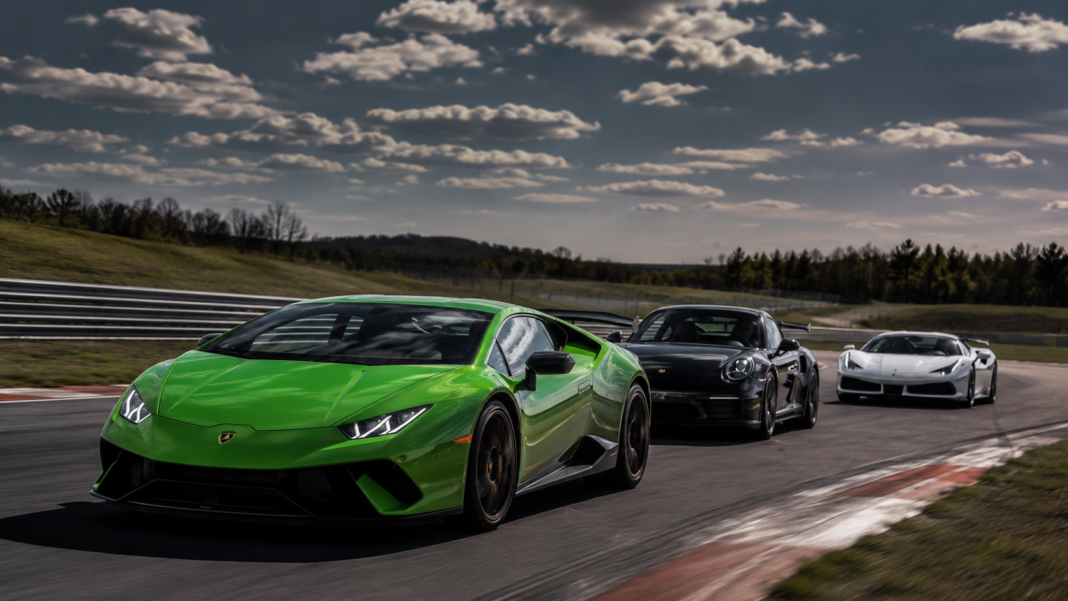
The morning mist is still hanging over the hills of western Pennsylvania as a line of supercars rolls into the paddock at the Pittsburgh International Race Complex in Wampum. A Lamborghini Huracán Performante, its V10 crackling. A Porsche 911 Turbo S, squat and purposeful. A Ferrari SF90 Stradale, its hybrid system silent for now. They are all different. They all have one thing in common: sophisticated all-wheel-drive systems that bear almost no resemblance to what you would find in a family SUV.
AWD in supercars is not about getting through a snowstorm. It is about putting 1,000 horsepower to the pavement, about rotating the car through a corner with surgical precision, and about making the driver feel like a hero. This article explains how these systems work, from torque vectoring to rear-biased platforms to electronically controlled differentials.
The Location: Pittsburgh International Race Complex, Wampum, Pennsylvania
The Pittsburgh International Race Complex is a 2.8 mile road course that hosts track days, club races, and high performance driving events. The track has 19 turns, elevation changes, and long straights that test both car and driver. It is the perfect place to understand the difference between a commuter AWD system and a supercar system.
The Supercar AWD Difference
The AWD system in a family SUV is designed for traction. It sends power to the wheels with grip when you lose traction on a slippery surface. It is reactive, slow, and predictable.
The AWD system in a supercar is designed for performance. It is proactive, fast, and capable of distributing torque with millisecond precision. It can send power to the outside rear wheel in a corner to rotate the car. It can send power to the front axle only when needed. It can create torque vectoring that makes the car feel like it is on rails.
The Anatomy of a Supercar AWD System
The Engine and Transmission
Most supercar AWD systems start with a longitudinal engine mounted behind the driver. The engine sends power to a transmission, which is typically a dual-clutch unit. The transmission sends power to the rear wheels directly, and to the front wheels through a transfer case or a separate electric motor.
The Center Differential
The center differential distributes torque between the front and rear axles. In a supercar, this is not a simple fixed split. The system can vary the torque distribution from 0 percent front to 50 percent front, depending on conditions and driver inputs.
The Rear Differential
The rear differential distributes torque between the rear wheels. In a supercar, this is often an electronically controlled limited-slip differential. It can send torque to the outside rear wheel during cornering, reducing understeer and improving traction.
The Torque Vectoring System
Torque vectoring is the most important feature of a supercar AWD system. It allows the car to actively distribute torque between the rear wheels, and sometimes between the front wheels as well. The result is a car that can be rotated into a corner, held on a precise line, and powered out with maximum traction.
How Torque Vectoring Works
Torque vectoring works by braking the inside rear wheel during a corner. This creates a yaw moment that rotates the car into the corner. The system then sends more torque to the outside rear wheel, which pushes the car through the corner.
The effect is subtle but significant. The car feels smaller, more agile, and more responsive. The driver can carry more speed through corners and exit with more traction.
Rear-Biased Platforms
Most supercar AWD systems are rear-biased. This means that the car is primarily rear-wheel drive, and the front axle is engaged only when needed. The rear bias gives the car the playful character of a rear-wheel drive car, with the added traction of all-wheel drive.
The rear bias also reduces weight. The front axle components are lighter because they are not required to handle full engine power.
Electrically Driven Front Axles
The latest generation of supercar AWD systems uses electric motors to drive the front axle. The Ferrari SF90 Stradale is a prime example. It uses a twin-turbo V8 driving the rear wheels, and two electric motors driving the front wheels. There is no physical connection between the two power sources.
This configuration has several advantages. It allows for torque vectoring at the front axle. It allows for regenerative braking at the front axle. It allows the car to operate in pure electric mode for short distances. And it eliminates the need for a heavy transfer case and driveshaft.
The SF90 Stradale Example
The SF90 Stradale is a rolling laboratory of AWD technology. Its electrified AWD system combines a 4.0 liter twin-turbo V8 with two front-axle electric motors. The system produces a combined 986 horsepower.
The SF90 also features advanced software that manages the interaction between the internal combustion and electric power sources. The system includes multiple drive modes that adjust the balance between performance and efficiency.
The Porsche 911 Turbo S Example
The Porsche 911 Turbo S takes a different approach. It uses a mechanical AWD system with a center differential and electronically controlled rear differential. The system is rear-biased, sending power to the front wheels only when needed.
The Turbo S also features torque vectoring, which distributes torque between the rear wheels to improve cornering performance. The result is a car that is stable, predictable, and exceptionally fast.
The Lamborghini Huracán Performante Example
The Huracán Performante uses a mechanical AWD system with a center differential and rear differential. The system is rear-biased, with up to 100 percent of torque going to the rear wheels in normal driving.
The Performante also features active aerodynamics and torque vectoring, which work together to maximize cornering grip and stability. The result is a car that is both agile and composed.
The McLaren W1 Exception
Not every supercar uses AWD. The McLaren W1 is rear-wheel drive. McLaren engineers argue that AWD adds weight and complexity, and that a well-sorted rear-wheel drive car with sufficient downforce can achieve similar performance.
The W1 achieves this through a combination of downforce, traction management, and weight savings. The car can generate significant downforce, which presses the tires into the pavement and provides mechanical grip.
The Pittsburgh Morning: A Track Session
The Lamborghini Huracán Performante is on track now. Its AWD system is working hard, sending power to the outside rear wheel in the corners, keeping the car stable and fast.
The Porsche 911 Turbo S is next. Its AWD system is more subtle, but equally effective. The car feels planted, secure, and fast.
The Ferrari SF90 Stradale is the last to go. The electric front motors add a burst of power on corner exit. The car accelerates with authority.
The Verdict
Supercar AWD systems are nothing like what is in your SUV. They are designed for performance, not for snow. They use torque vectoring, rear-biased platforms, and electronically controlled differentials to deliver exceptional grip and agility.
The technology is evolving rapidly. Electric front axles are becoming common. Electromechanical systems are replacing hydraulic clutch packs. Advanced software is managing power distribution with unprecedented precision.
The result is a generation of supercars that are faster, more agile, and more capable than ever before.
Key Takeaways
- Supercar AWD systems are proactive and performance-oriented, unlike reactive systems in SUVs.
- Torque vectoring uses braking and torque distribution to rotate the car through corners.
- Rear-biased platforms give cars the playful character of rear-wheel drive with the added traction of AWD.
- Electrically driven front axles allow for torque vectoring, regenerative braking, and pure electric operation.
- Advanced software manages power distribution in milliseconds, adapting to conditions and driver inputs.
Conclusion
The sun is higher now. The track session is over. The supercars are parked in the paddock, their engines ticking as they cool.
The drivers are talking about the technology. They are discussing torque vectoring, rear-biased platforms, and electronically controlled differentials. They are enthusiasts, and they are fascinated by the science.
The AWD systems in their cars are the result of decades of engineering. They are complex, sophisticated, and effective. They are the reason these cars can put 1,000 horsepower to the pavement and feel composed.
That is the science of all-wheel drive in supercars. It is not about snow. It is about speed.

