
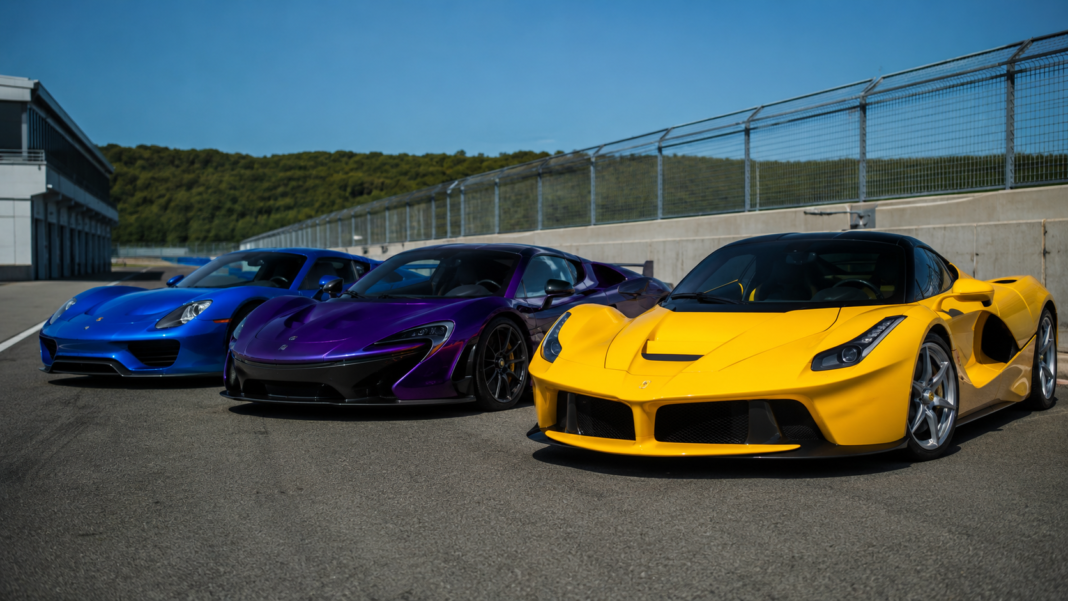
The sun is just beginning to warm the asphalt at the Pittsburgh International Race Complex in Wampum, Pennsylvania. Three cars are lined up in the paddock: a Ferrari LaFerrari, a McLaren P1, and a Porsche 918 Spyder. They are the “Holy Trinity” of hybrid hypercars. They are also the proof that hybrid powertrains make supercars faster, not slower.
A decade ago, the idea of a hybrid supercar seemed contradictory. Hybrids were associated with fuel economy, not performance. The Toyota Prius was the symbol of the segment, and it was the antithesis of everything a supercar stood for. Then, around 2013, three of the world’s greatest sports car brands released new range-topping models, all of which were hybrids. The Porsche 918 Spyder, Ferrari LaFerrari, and McLaren P1 each used electric power to augment their gas engines, with shocking results. They crushed quarter mile runs and broke lap records at racetracks worldwide.
This article explains how electric motors make a combustion supercar dramatically quicker, using the engineering principles that have become the foundation of modern hypercar performance.
The Problem: The Internal Combustion Engine’s Weakness
The internal combustion engine has a fundamental weakness. It produces peak power high in the rev range, near its redline. This means that acceleration is not linear. The engine must be revved to produce its best output. On a racetrack, this is manageable. In everyday driving, it is not.
The power band of a combustion engine is also narrow. There is a sweet spot where the engine produces maximum torque. Below that spot, the engine is sluggish. Above that spot, the engine is past its peak. The driver must manage the revs to stay in the power band.
The Solution: Torque Fill
The solution is torque fill. Electric motors produce peak torque from zero RPM. This is the opposite of a combustion engine, which produces peak torque at higher revs. By combining the two power sources, engineers can create a system that delivers linear power across the entire rev range.
The electric motor fills the gap before the gas engine produces peak power. The result is immediate throttle response from a standstill, strong mid-range power, and sustained pull to the redline. The driver does not have to wait for the engine to spool up. The power is always there.
The “Holy Trinity”: Proof of Concept
The Porsche 918 Spyder was the first road-approved vehicle to break the seven-minute mark on the Nürburgring’s Nordschleife. It did this not despite its hybrid drive, but because of it. The 918 Spyder combined a 4.6 liter V8 with two electric motors to produce 887 horsepower. The electric motors provided instant torque, filling the gaps in the V8’s power delivery.
The Ferrari LaFerrari used a HY-KERS system derived from Formula 1. The system provided instant torque and filled the gaps during gear changes. The result was a car that could accelerate from 0 to 100 km/h in 2.6 seconds and reach a top speed of 352 km/h. The electric motor did not make the car slower. It made it faster.
The McLaren P1 used a 3.8 liter twin-turbo V8 combined with an electric motor to produce 916 horsepower. The electric motor provided torque fill, plugging the gaps in the V8’s power delivery. The result was a car that was fast, responsive, and engaging.
The Evolution: Beyond Torque Fill
The hybrid systems of today have evolved beyond simple torque fill. The McLaren W1, for example, can drive in two gears at once. The electric motor is positioned after the transmission’s clutches, allowing the engine and electric motor to operate in different forward gear ratios at the same time. The result is constant power delivery, not just torque fill.
The Ferrari F80 uses electrically assisted turbochargers. An electric motor between the turbine and compressor can spin the blades almost instantly, negating turbo lag. The F80 also uses three electric motors, one at each front wheel and one at the rear, effectively making it all-wheel drive. The system provides instant torque, torque vectoring, and regenerative braking.
The Lamborghini Revuelto uses three electric motors to complement its V12 engine. The system provides instant torque and allows for all-wheel drive.
The Audi Nuvolari uses a 4.0 liter V8 with three axial flux electric motors to produce 1,001 horsepower. The system is inspired by Formula 1, with active aerodynamics and a new generation of all-wheel drive. The electric motors provide instant torque and variable torque distribution.
The Pittsburgh Morning: A Track Session
The LaFerrari, P1, and 918 Spyder are on track now. They are not racing. They are demonstrating. The electric motors fill the gaps in the combustion engines’ power delivery. The cars accelerate smoothly, predictably, and quickly.
A group of enthusiasts is watching from the paddock. They are discussing the technology. They are impressed.
“Look at how smooth it is,” one says. “No lag. No delay. Just power.”
“That is the hybrid system,” another replies. “Instant torque. Always there.”

The Benefits: Beyond Speed
The benefits of hybrid supercar powertrains extend beyond raw speed.
All-Wheel Drive Capability
The electric motors can drive the front axle, providing all-wheel drive without a heavy mechanical link. The Ferrari F80 uses two front motors for torque vectoring, while the Lamborghini Revuelto uses electric motors to provide all-wheel drive capability.
Torque Vectoring
Electric motors at each wheel can provide independent torque control, allowing for precise handling and cornering. The Ferrari F80 and Lamborghini Revuelto both use this technology.
Regenerative Braking
The electric motors can recover energy during braking, improving efficiency and reducing brake wear. The Porsche 918 Spyder’s electric motors could decelerate the car with significant braking force.
Electric-Only Operation
Some hybrid supercars can operate in pure electric mode for short distances. The Porsche 918 Spyder could travel up to 30 kilometers on electric power alone.
Quiet Operation
The electric motors allow the car to operate quietly in urban environments. This is a benefit for early morning starts and late night arrivals.
The Verdict
Hybrid supercars are faster than their internal combustion-only predecessors. The electric motors fill the gaps in the combustion engine’s power delivery, providing instant torque and linear acceleration. The result is a car that is more responsive, more predictable, and quicker.
The technology has evolved. Torque fill has given way to constant power delivery. Electric motors have given way to sophisticated hybrid systems that manage power distribution across multiple axles and multiple gears.
The LaFerrari, P1, and 918 Spyder proved that hybrids could be fast. The Ferrari F80, McLaren W1, and Audi Nuvolari are proving that hybrids can be even faster.
Key Takeaways
- Electric motors produce peak torque from zero RPM, filling the gap before the gas engine produces peak power.
- The Porsche 918 Spyder was the first road-approved vehicle to break the seven-minute mark on the Nürburgring.
- Modern hybrid systems can drive in two gears at once, providing constant power delivery.
- Electrically assisted turbochargers negate turbo lag, improving throttle response.
- Electric motors provide all-wheel drive capability and torque vectoring without heavy mechanical links.
Conclusion
The sun is higher now. The track session is over. The supercars are parked in the paddock, their batteries charging, their engines cooling.
The enthusiasts are still talking. They are convinced.
Hybrid supercars are faster. The data is clear. The experience is undeniable.
The LaFerrari, P1, and 918 Spyder proved that hybrids could be fast. The Ferrari F80, McLaren W1, and Audi Nuvolari are proving that hybrids can be even faster.
The electric motor is not a compromise. It is an enhancement. It is the future of performance. And the future is faster.

