
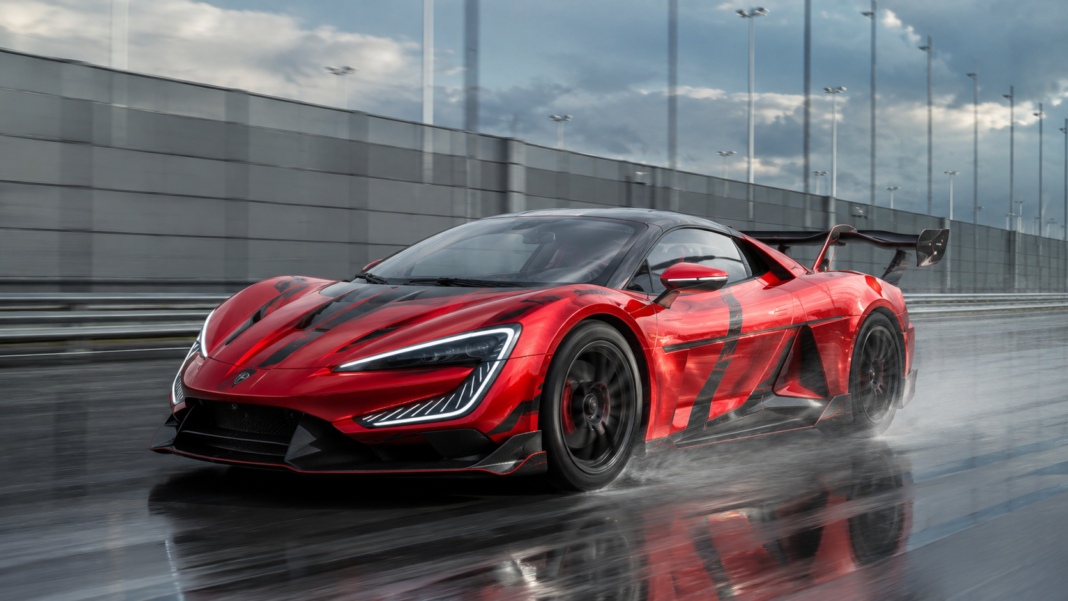
The lights of the ATP Automotive Testing Papenburg facility glow in the distance as a low, aggressive silhouette sits on the high-speed oval in Germany. The air is cool, the track is empty, and the car is about to make history. This is the Yangwang U9 Xtreme, China’s most extreme hypercar, and it represents a fundamental shift in the global automotive hierarchy.
Built by BYD’s ultra-luxury Yangwang brand, the U9 Xtreme is a limited edition of just 30 units that has already claimed the title of the world’s fastest production car. In September 2025, it reached 496.22 km/h (308.3 mph) at the ATP test track, eclipsing the previous benchmark of 304.8 mph set by the Bugatti Chiron Super Sport 300+. It also lapped the Nürburgring Nordschleife in 6 minutes and 59.157 seconds, making it the first production electric vehicle to break the seven-minute barrier.
The Powertrain: A 1,200V Revolution
The heart of the U9 Xtreme is a 1,200-volt electrical architecture, a first for any production car. This ultra-high-voltage platform allows the four electric motors, each capable of spinning at 30,000 rpm, to deliver a combined output of 3,000 PS (2,977 horsepower). The system produces more than 3,000 PS, equivalent to roughly 2,977 horsepower. Each wheel is driven independently, allowing the car’s control systems to continuously manage torque distribution.
The powertrain is supported by a specialized version of BYD’s lithium iron phosphate Blade Battery with a claimed discharge rate of up to 30C. This is up to 10 times the rate of a conventional EV battery and twice that of other electric hypercars. The peak energy-recuperation rate is more than 700 kW, helping to reduce load and stresses in the mechanical brakes.
The U9 Xtreme weighs 2,480 kilograms, making it heavier than many of its combustion rivals, but the power-to-weight ratio is exceptional at approximately 1.2 horsepower per kilogram. The standard Yangwang U9 has a top speed of 472.41 km/h (293.5 mph), but the Xtreme’s upgrades unlock over 20 km/h more.
Aerodynamics and Chassis: Mastery of Airflow
Producing enough power is only part of the equation when chasing 500 km/h. At those speeds, aerodynamic drag rises dramatically, meaning additional horsepower delivers increasingly small gains unless the body can move efficiently through the air. The U9 Xtreme incorporates extensive aerodynamic hardware designed for high-speed stability, including carbon-fiber components and a large rear diffuser.
The car uses Yangwang’s e⁴ plus DiSus X intelligent full-active body control technology, allowing four-wheel distributed motors to achieve vector torque distribution. Each wheel can adjust its suspension independently, and the system scans each damper to maximize grip and stability. The suspension is calibrated specifically for the enormous loads generated during extreme track driving.
The braking system features titanium calipers and optimized carbon-ceramic braking systems, with larger discs designed to dissipate heat more effectively when braking from stratospheric speeds.
The Records: 308 mph and a Sub-Seven-Minute Lap
The U9 Xtreme’s verified 308.3-mph run at Papenburg transformed the discussion from whether an electric production car could challenge combustion hypercars to how much further EV technology can realistically go. The car’s 496.22-km/h run eclipsed the previous benchmark associated with the fastest petrol-powered production model.
The Nürburgring lap time of 6:59.157 is a testament to the car’s balanced performance. The U9 Xtreme was driven by Moritz Kranz, a German driver with nearly 10,000 laps of experience at the Nürburgring, who noted that the success was possible thanks to the “perfect balance between a high-power electric platform and a very precise chassis configuration.”
The car’s performance is also enabled by semi-slick tires developed specifically for the U9 Xtreme, with compounds designed to handle speeds up to 500 km/h without compromising integrity. The GitiSport e·GTR2 PRO tires are the first of their kind to be developed for a Chinese production car at this performance level.
The Price: $3 Million and Only 30 Units
The Yangwang U9 Xtreme is limited to just 30 units globally, with all examples reportedly already reserved. At the 2026 Beijing Auto Show, the first production-spec model sold for over 20 million yuan (approximately $2.7 million to $3 million), making it the highest-priced vehicle ever sold at the event. The price places it in direct competition with the Bugatti Chiron Super Sport 300+ and the Koenigsegg Jesko Absolut.
BYD has confirmed that each example will feature a unique, fully customized design. Everything from exterior paint finishes and carbon-fiber patterns to the infotainment UI and door-closing chimes can be personalized to the owner’s specifications.
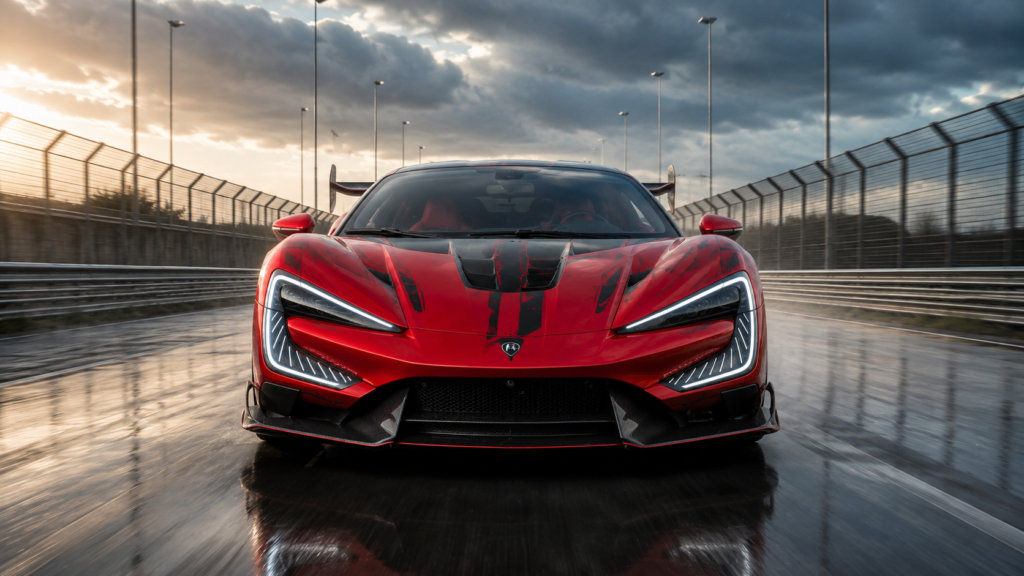
The ATP Evening
The U9 Xtreme has completed its demonstration run. Its quad-motor powertrain has delivered the 3,000 horsepower that makes it one of the most powerful production cars ever built. The 1,200-volt architecture and advanced aerodynamics have kept it stable at speeds that would have seemed impossible for an electric car just a few years ago. The driver has experienced a level of performance that is as exclusive as it is extraordinary.
The U9 Xtreme is not a car for everyone. It is limited to 30 units, priced at approximately $2.7 million. But it represents a significant moment in automotive history. It is the first Chinese production car to claim the title of the world’s fastest production car, and it proves that China can compete at the highest level of automotive engineering.
The U9 Xtreme is not just a car. It is a statement. It is a reminder that the hypercar world is no longer the exclusive domain of European manufacturers. The electric future has arrived. And it is faster than anyone expected.

