
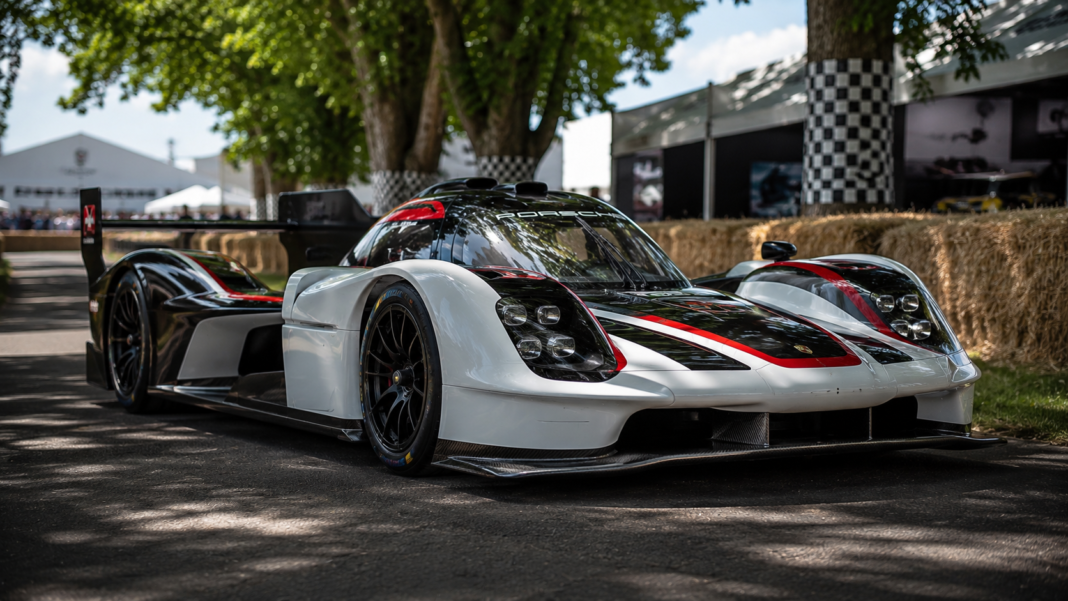
The sun is rising over the rolling hills of West Sussex as a low, aggressive silhouette sits on the lawn at the Goodwood Festival of Speed. The car is unmistakably a Le Mans prototype, yet it carries a license plate. It is the Porsche 963 RSP, the only example of its kind, and it represents the closest any private owner can come to owning a genuine endurance racing car that can be driven on public roads.
The 963 RSP is a one-off creation built for Roger Penske, the legendary team owner whose initials form the car’s name. It is inspired by the road-legal Porsche 917 built for Count Rossi in 1975, and it represents the same audacious spirit: a Le Mans-winning race car, adapted for the street. Porsche has built only one, and it is not for sale.
The Inspiration: A 50-Year-Old Legacy
The 963 RSP was inspired by a similar one-off, road-legal version of the two-time Le Mans-winning Porsche 917 race car, built in 1975 for Count Gregorio Rossi di Montelera, heir to the Martini fortune. That car was a full-on Le Mans-winning race car for the road, and it still appears at events like the Festival of Speed and Villa d’Este.
The idea for the 963 RSP was born during a conversation at the 2024 Petit Le Mans, where Porsche executives discussed how to commemorate the 50th anniversary of the Count Rossi 917. The project was developed in secret, involving only a small team of engineers and designers. Roger Penske was identified as the ideal owner early in the process.
The Engineering: A Race Car Tamed for the Road
The 963 RSP is not a replica or a tribute car. It is a genuine 963 LMDh chassis, built by Multimatic, and converted for road use by a team of experts at Porsche Motorsport headquarters in Germany and finished at the Porsche Classic Factory Restoration in Atlanta.
The heart of the car is a 4.6-liter twin-turbo V8 hybrid powertrain, derived from the Porsche 918 Spyder and sharing 80 percent of its components with that car. The race car’s output is 671 horsepower, and the RSP retains that figure, but the engine has been recalibrated to run on pump gas instead of racing fuel. The hybrid system, with its Bosch-spec electric motor and 800-volt battery, remains intact.
The suspension has been softened for road use, and the ride height has been raised to its highest setting to clear speed bumps and driveways. The car rides on Michelin wet-weather tires, fitted with 1970s-era Michelin stickers in honor of the Count Rossi 917. The Multimatic DSSV shock absorbers have been placed in their softest setting.
The aerodynamic package has also been modified. The large openings over the wheel arches, required for racing blow-over criteria, have been closed off. The bodywork has been sanded and painted in Martini Silver, the same color as the Count Rossi 917, with an enamel Porsche badge replacing the race car’s sticker.
The interior has been trimmed in Alcantara and leather, matching the tan of the 917, and features a removable 3D-printed cup holder. The race car’s FIA-approved racing seat, six-point harnesses, and driver-focused controls remain, but the car also has functional turn signals, brake lights, a horn, and license plate mounts.
The Exemption: Not Fully Road-Legal
The 963 RSP is not a fully homologated road car. It requires special dispensation to run on public roads, including an exemption from the EPA in the United States. Starting the car requires a laptop and trained technician. It is a race car for the road, not a road car that happens to be fast.
Porsche has no plans to build another example. The company has acknowledged that homologating a race car for road use is far more difficult now than it was in 1975, and any such effort would significantly change the character of the 963.
The Goodwood Morning
The 963 RSP has completed its demonstration run. Its V8 hybrid powertrain has delivered the 671 horsepower that makes it one of the most extraordinary road-legal cars ever built. The softened suspension and wet-weather tires have kept it composed on the grass. The driver, cocooned in the race-spec cockpit, has experienced a level of performance that is as exclusive as it is extraordinary.
The 963 RSP is not a car for everyone. It is a one-off, built for a single owner, and it will never be replicated. But it represents a significant moment in Porsche’s history. It is the closest any private owner can come to owning a genuine Le Mans prototype that can be driven on public roads.
The 963 RSP is not just a car. It is a statement. It is a reminder that even in an era of electrification and automation, Porsche remains committed to the raw, unfiltered joy of driving. The Le Mans prototype has a license plate. And it is unforgettable.

