
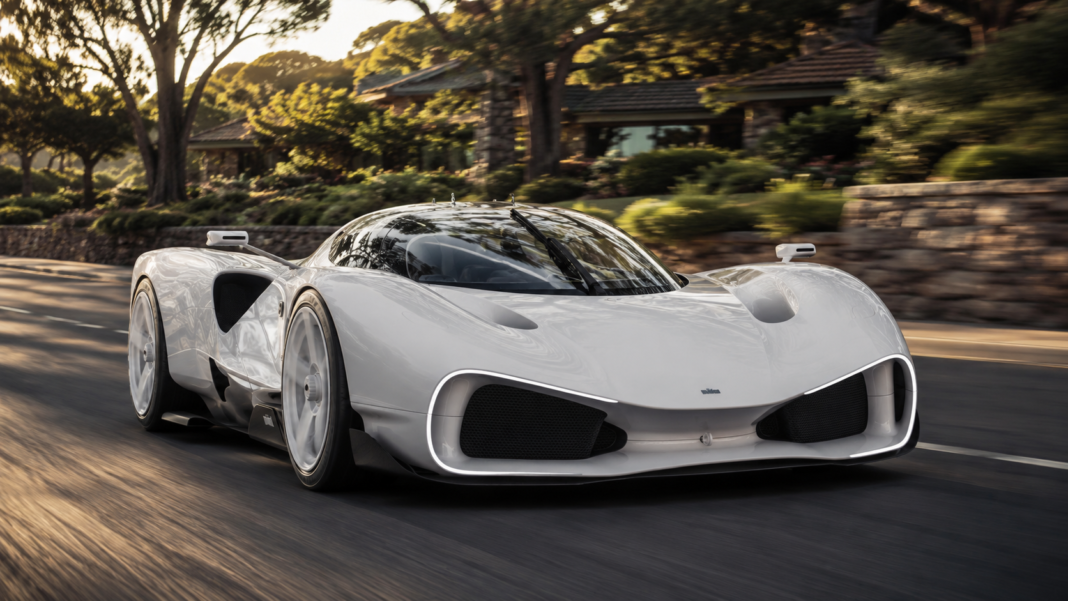
The sun is setting over the Monterey Peninsula as a low, sculpted silhouette sits on the lawn at the Quail Lodge in Carmel, California. The car has no screens, no steering wheel buttons, and no hybrid system. It is a pure, unfiltered expression of what happens when a designer who shaped the Bugatti Chiron, the Koenigsegg CC850, and the Lamborghini Huracán decides to build his own car. This is the Nilu27 NILU hypercar, and it represents a rebellion against everything the automotive industry is doing.
Sasha Selipanov, the founder of Nilu27, spent two decades designing cars for Volkswagen, Bugatti, Lamborghini, Genesis, and Koenigsegg. But he saw the industry’s pivot toward electrification and digitalization as a threat to the visceral, mechanical experience that defines a great driver’s car. So he left. He founded Nilu27 with his wife Inna, and he built the car he wanted to drive.
The Powertrain: A V12 That Defies the Trend
The heart of the NILU is a 6.5-liter naturally aspirated V12 engine developed by Hartley Engines of New Zealand. The engine features an 80-degree bank angle and a distinctive “Hot V” configuration that positions the exhaust headers between the cylinder banks. This allows heat to exit directly through the car’s fully exposed rear engine bay while contributing to a compact, performance-focused package.
The engine produces 1,070 horsepower at 11,000 rpm. It is a naturally aspirated masterpiece, with no turbochargers, no electric motors, and no hybrid assistance. The engine weighs just 200 kilograms and features 12 individual throttle bodies, a billet aluminum crankcase, forged connecting rods, and ultra-lightweight pistons. The sound is sharp and engaging, a high-revving wail that echoes off the cliffs of Carmel.
Power is sent to the rear wheels through a seven-speed manual transmission supplied by CIMA. The gearbox features a locking mechanism to prevent accidental reverse engagement, a nod to classic supercars like the Lamborghini Countach. The shift linkage is exposed, a mechanical centerpiece that connects the driver to the car.
The Chassis: Lightweight and Focused
The NILU is built around a carbon fiber monocoque with tubular aluminum subframes. The dry weight is 1,200 kilograms, giving it a power-to-weight ratio of nearly 1:1. The suspension uses double wishbones at all four corners with pushrod actuated dampers. The car rides on 20-inch front and 21-inch rear wheels wrapped in Michelin Pilot Sport Cup 2R tires, with Brembo carbon ceramic brakes providing immense stopping power.
The Interior: A Rebellion Against Screens
The NILU’s cabin is a deliberate rejection of modern supercar conventions. The seats are fixed, with only the pedal box, headrest, and mirrors adjustable. There are no buttons on the steering wheel. The only screen is the digital rearview mirror, required for the backup camera. The rest is analog: physical gauges, a gated shifter, and the sound of a V12 at 11,000 rpm.
Selipanov described the philosophy simply: “I made a 1,000 horsepower car with a manual gearbox because that’s how I wanted it.”
Production: Exclusive and Limited
Nilu27 plans to build 15 track-only examples first, followed by 54 street-legal versions. The Founder’s Edition Program allows customers to choose either configuration. Approximately 30 percent of the total production run of 69 units is already reserved. The price is approximately $3.7 million.
The Quail Evening
The NILU has completed its demonstration run. Its V12 has delivered the 1,070 horsepower that makes it one of the most powerful naturally aspirated cars ever built. The manual transmission has provided the direct mechanical engagement that purists crave. The driver, cocooned in the minimalist cabin, has experienced a level of performance that is both thrilling and raw.
The NILU is not a car for everyone. It is a car for those who value the pure, unfiltered experience of driving, who are willing to accept the compromises of a car built without compromise. But it represents a significant moment in automotive history. It is a car that proves the analog hypercar is not dead, that there is still a market for cars that prioritize engagement over technology.
The NILU is not just a car. It is a statement. It is a reminder that even in an era of electrification and automation, there is still room for a car that is built by hand, driven with intent, and cherished as art. The Koenigsegg designer has gone solo. And the result is unforgettable.

