
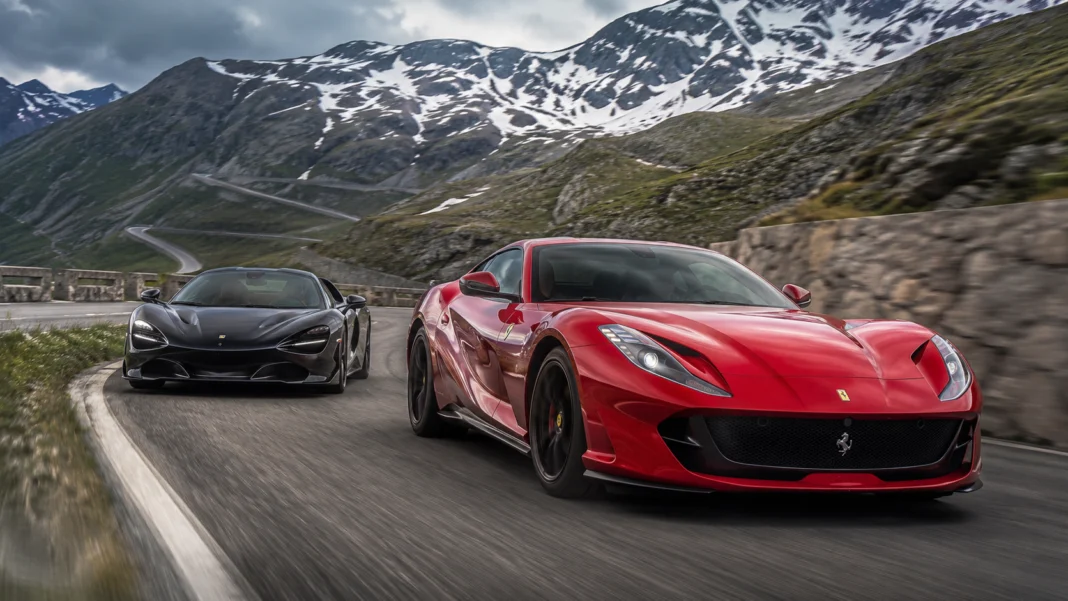
Imagine the sun just beginning to warm the peaks of the Rhaetian Alps as a Ferrari 812 Superfast, a Porsche 911 GT3 and a McLaren 765LT line up at the base of the Stelvio Pass, their owners adjusting tire pressures and checking brake temperatures. The air is cool and thin, the road ahead is a ribbon of asphalt climbing toward the sky, and the next 29 miles will test everything these cars are built for. Few roads test a car, or a driver, quite like it.
The Stelvio Pass, the Black Forest, and the Col de la Bonette are the roads every European supercar drive must include. This guide ranks the best driving roads in Europe for corner quality, scenery, and the total driving experience, and explains how to plan the trip around them.
The Stelvio Pass: The Ultimate Alpine Challenge
The Stelvio Pass is the second highest paved mountain pass in the Alps, surpassed only by the Col de l’Iseran in France. It is famous for being the highest car pass in Italy and one of the most dramatic driving roads in the world. The road was built by the Austrian Empire between 1820 and 1825 to connect the then Austrian province of Lombardy with the rest of the country.
The Stelvio has been regarded as an excellent driving road for over a century. It gained international attention when a British automotive show named it the greatest driving road in the world. The road has 48 hairpin bends on the Trafoi side and 40 on the Bormio side, making it a true paradise for drivers seeking a challenge.
For supercar owners, the Stelvio is a test of chassis balance, brake endurance, and driver skill. The constant hairpin bends demand precise steering inputs and smooth throttle application. The elevation changes test the cooling systems of even the most capable machines. The views of nearby glaciers provide a stunning backdrop to the driving experience.

The pass is usually open from June to October, but conditions can change quickly. It can become crowded, especially on weekends during July and August. The best time to drive is just outside those months, during the middle of the week, and getting there early in the morning.
The Black Forest: Germany’s Driving Playground
The Black Forest is a large forested mountain range in southwestern Germany, bounded by the Rhine Valley to the west and south. The region is known for its dense forests, rolling hills, and winding roads that make it a favorite destination for driving enthusiasts.
The Black Forest is divided into two parts by the deep Kinzig valley, with the highest summits to the south. The region has a raw climate in the higher districts, but the valleys offer mild weather and good pastureland. Oak and beech woods clothe the lower slopes, while extensive fir forests, which gave the range its name, climb to higher elevations.
For supercar owners, the Black Forest offers a mix of fast sweeping curves, technical sections, and long straights that allow for brief bursts of speed. The road surfaces are well maintained, and the scenery is spectacular. The region is also home to several mineral springs and spas, making it an excellent destination for a multi-day trip.
The B500, running from Baden-Baden to Freudenstadt, is one of the most famous driving roads in Germany. It winds through the northern Black Forest with a series of fast, sweeping corners and dramatic elevation changes.
The Col de la Bonette: The Highest Through Road in Europe
The Col de la Bonette is a high mountain pass in the French Alps, situated within the Mercantour National Park on the border of the departments of Alpes-Maritimes and Alpes-de-Haute-Provence. The actual pass rises to 2,715 meters, but the two kilometer long loop around the Cime de la Bonette peak reaches 2,802 meters, making it the highest through road in the Alps.

The road was completed in 1964, although a mule track had existed since 1832. The pass has featured in the Tour de France multiple times, with the loop around the Cime de la Bonette representing the highest point ever reached by the race.
For supercar owners, the Col de la Bonette offers a different experience from the Stelvio. The road is less technical, with longer straights and more sweeping curves. The average grade is 6.2 percent, with a maximum of 8.1 percent. The climb from Jausiers is 24.1 kilometers, while the ascent from Saint-Étienne-de-Tinée is 26.0 kilometers.
The D918: A Riviera Alternative
For those seeking a less demanding but equally scenic route, the D918 from Nice to the Col de Turini offers a classic Mediterranean driving experience. The road winds through the hills above Nice, with dramatic views of the coast and the mountains. The Col de Turini itself is a legendary section of the Monte Carlo Rally, with tight corners and dramatic elevation changes.
The D918 is accessible year-round and offers a mix of technical sections and sweeping curves. For supercar owners, it is a chance to experience the roads that rally drivers have conquered for decades.
Route Planning: Practical Considerations
The best European supercar road trips are planned around the season, the weather, and the condition of the roads.
Seasonality: The Stelvio Pass is usually open from June to October, but the exact dates depend on snow conditions. The Col de la Bonette is also closed during winter months. The Black Forest is accessible year round, but the best driving conditions are in late spring and early autumn.
Timing: Weekends in July and August are the busiest times at the Stelvio Pass. To avoid traffic, plan for a weekday visit in June or September.
Accommodation: Book hotels in advance, especially in popular areas like the Stelvio region and the Black Forest.

Vehicle Preparation: The Stelvio and the Col de la Bonette are high mountain passes. The thin air can affect engine performance. The constant braking on the Stelvio can cause brake fade. Ensure your car is in excellent mechanical condition before attempting these roads.
Respect the Road: The Stelvio Pass is a popular destination for cyclists, motorcyclists, and hikers. Watch for cyclists on the hairpin bends. Be aware of special events during which the pass is closed to traffic.
The Stelvio Morning
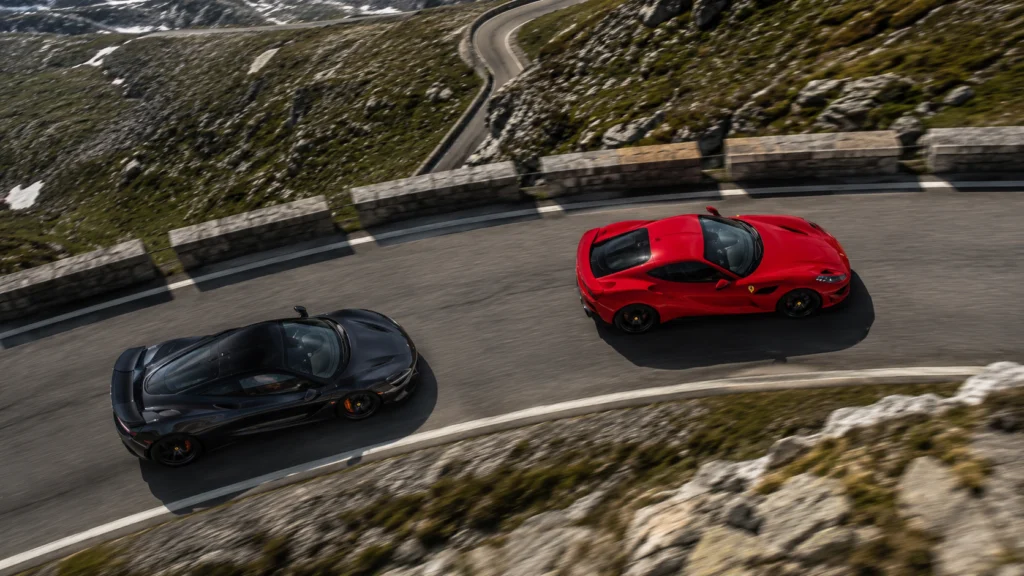
The fog has lifted. The supercars are heading out. The first few hairpin bends are tight, the pavement is smooth, and the rhythm begins to build. The drivers are focused, the cars are responding, and the road is delivering.
The Stelvio Pass is not the only answer. But it is a good start.
Key Takeaways
- The Stelvio Pass has 88 hairpin bends and is the second highest paved mountain pass in the Alps.
- The Black Forest offers a mix of fast sweeping curves, technical sections, and scenic views.
- The Col de la Bonette is the highest through road in the Alps, with a loop reaching 2,802 meters.
- The D918 from Nice to the Col de Turini offers a classic Mediterranean driving experience.
- Plan your trip around the season, the weather, and the condition of the roads.
- Book accommodations in advance and prepare your vehicle for the challenges of mountain driving.
Conclusion
The best driving roads in Europe for supercar owners are not limited to a single country or region. The Stelvio Pass in Italy, the Black Forest in Germany, the Col de la Bonette in France, and the D918 in France all offer exceptional driving experiences. Each road has its own character, its own challenges, and its own rewards.
The morning at the Stelvio Pass is over. The supercars have disappeared into the hairpin bends. The drivers will return with stories, smiles, and a deeper appreciation for the roads that make owning a supercar worthwhile.
The best driving road is not a single road. It is the one you drive.
Gear Picks for This Story
 PerformanceGrimmspeed 038006 Stainless Steel Shift KnobSee What It Does →
 Tech UpgradeBlueDriver Pro OBD2 Bluetooth ScannerExplore the Specs →
 Stay SafeSanDisk 1TB Extreme Pro microSDSee the Specs →
 Detail Like a ProAdam's Interior Detailer SpraySee How It Works →
As an Amazon Associate, VeloxTrend earns from qualifying purchases.

