
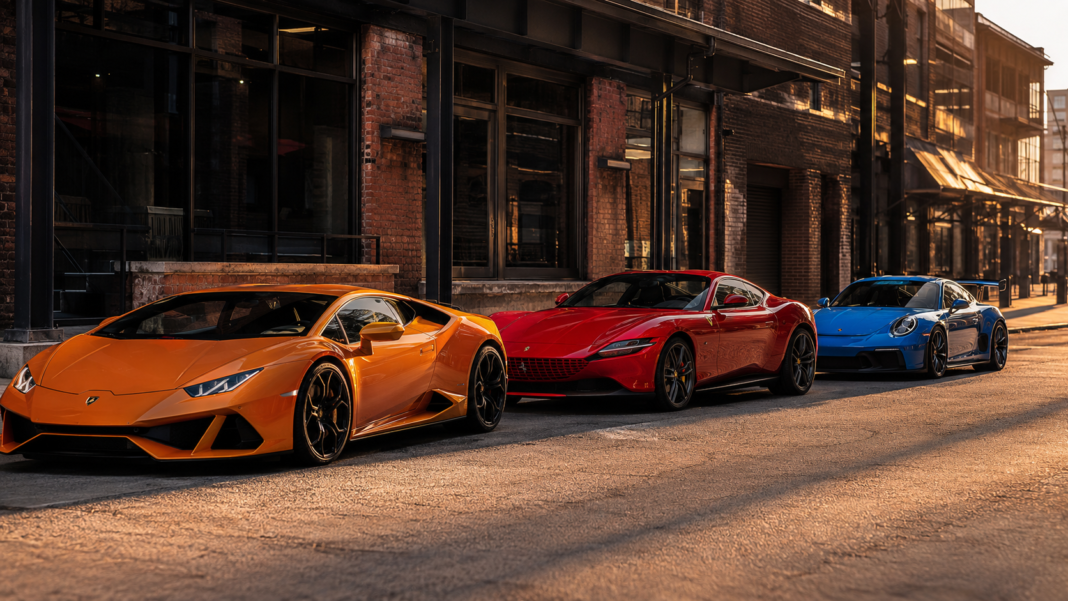
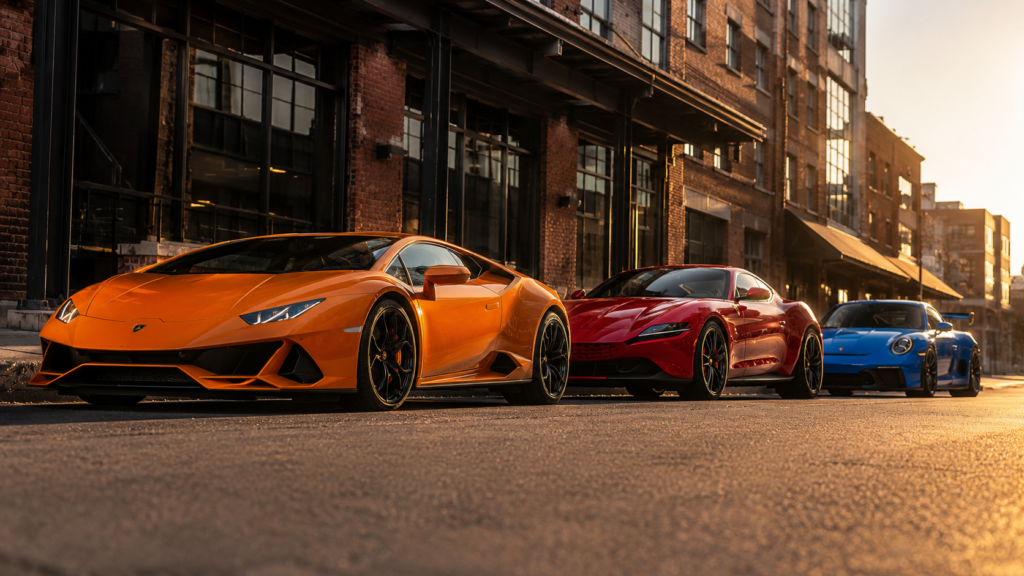
The morning sun is just beginning to warm the cobblestones of the Strip District in Pittsburgh, Pennsylvania. The smell of espresso and fresh bread drifts from outdoor cafes. But the real attraction is parked along Smallman Street. A row of supercars has gathered for an unofficial meet. There is a Lamborghini Huracán in Arancio Borealis, a vivid orange that seems to glow. A Ferrari Roma in Rosso Corsa, the classic red of Maranello. A Porsche 911 GT3 in Shark Blue, a color that looks flat in the shade but electric in the sun. An Audi R8 in a matte silver that absorbs light rather than reflecting it.
These are not accidental choices. The owners have spent hours, and in some cases thousands of dollars, selecting these colors. In the exotic car world, paint has become a language. Blu Nethuns, Arancio Borealis, Rosso Corsa these names carry meaning. They signal status, taste, and belonging.
This article tells the story of how supercar colors became a status signal, from the early days of red Ferraris to the explosion of personalization in the modern era.
The Location: The Strip District, Pittsburgh
The Strip District is a neighborhood of contrasts. By day, it is a bustling market district with Italian grocers, fish markets, and coffee shops. By early morning on a weekend, it is an unofficial gathering spot for car enthusiasts. The supercars park alongside pickup trucks and delivery vans. The owners talk engines, suspension, and of course, color.
Pittsburgh is not Monaco. It is a working city of steel and bridges. But the passion for cars is the same. The colors on display are a language that transcends geography.
The Early Days: Red for Ferrari, Yellow for Lamborghini
In the early days of the supercar, color choices were limited. Ferrari race cars were red because that was the international color assigned to Italy. Lamborghini chose yellow as its signature, a bright, sunny hue that contrasted with Ferrari’s deep red.
These colors became brands. A red Ferrari was immediately recognizable. A yellow Lamborghini was unmistakable. Owners who chose these colors were signaling their allegiance to the brand and its heritage.
The colors were not just aesthetic. They were historical. They connected the owner to the racing glory of the past.
The Rise of Personalization
In the 1990s and 2000s, manufacturers began offering more color options. Ferrari introduced the Tailor Made program. Lamborghini launched Ad Personam. Porsche created Paint to Sample.
These programs allowed buyers to choose from hundreds of colors, including historic shades and custom mixes. The options were expensive. A Paint to Sample Porsche could cost an additional $10,000 or more.
The rise of personalization changed the meaning of color. A standard Rosso Corsa Ferrari was now seen as conservative. A Blu Nethuns Ferrari, a deep, metallic blue, signaled that the owner had taken the time to spec the car themselves. It signaled sophistication and taste.
The Naming of Colors
The names of supercar colors are as important as the colors themselves. They are poetic, evocative, and sometimes absurd.
Blu Nethuns is named after the Etruscan god of water. Arancio Borealis is named for the northern lights. Rosso Corsa means racing red. Verde Draco is dragon green.
These names add to the mystique. They transform a simple paint job into a story. The owner who chooses Verde Draco is not just choosing green. They are choosing dragons, mythology, and Italian heritage.
The names also serve as a barrier to entry. A person who does not know the difference between Blu Nethuns and Blu Mirabeau is not part of the club. The language separates the initiated from the uninitiated.
The Pittsburgh Conversation: A Local Owner’s Perspective
A man in his 40s is standing next to his Lamborghini Huracán in Arancio Borealis. He is a surgeon. He has owned the car for two years.
“I wanted something that stood out,” he says. “Black, white, gray those are safe colors. They blend in. I did not want to blend in.”
He considered other colors. He thought about Verde Mantis, a bright green. He thought about Blu Cepheus, a metallic blue.
“In the end, I chose Arancio Borealis because it is loud. It is happy. It makes me smile.”
He points to a gray Audi R8 across the street. “That owner made a different choice. His car is subtle. It is elegant. It is a different statement.”
The Resale Value Factor
Color affects resale value. Some colors are more desirable than others.
Resale value varies by brand and market. In general, safe colors like black, white, and gray are easier to sell. They appeal to a broader audience.
But limited edition colors can also command a premium. A Porsche 911 GT3 in Paint to Sample Mexico Blue might sell for more than an identical car in standard white. The rarity of the color adds value.
Owners who spec their cars are balancing personal preference against future resale. Some accept the depreciation. Others choose safe colors to protect their investment.
The Social Media Effect
Social media has amplified the importance of color. A car that photographs well is more likely to be featured on Instagram, YouTube, and TikTok.
Bright, saturated colors look good in photos. They pop against a gray sky or a green backdrop. Matte finishes look dramatic. Metallics catch the light.
Creators have become color influencers. A car that appears in a popular video can spark a trend. Demand for a specific color can increase overnight.
The cycle feeds itself. Owners choose photogenic colors. Their cars get featured. Other owners see the videos and choose similar colors.
The Pittsburgh Morning: A Walk Down Smallman Street
The meet is winding down. The cars are leaving. The orange Lamborghini is the last to go. The driver starts the engine. The V10 growls. He pulls onto Smallman Street and disappears toward the Liberty Bridge.
A young woman is standing on the sidewalk, taking photos with her phone. She is not a car enthusiast. She is a tourist.
“I just liked the color,” she says. “It was so bright.”
She does not know the name Arancio Borealis. She does not know the history of Lamborghini. But she knows the car is special.
That is the power of color. It communicates without words.
The Future of Supercar Colors
The future of supercar colors is uncertain. Electric vehicles are changing the palette. Some manufacturers are experimenting with new materials and finishes.
Audi has shown concepts with color changing panels. BMW has unveiled color changing paint. The technology is not yet ready for production, but it is coming.
The basic psychology will remain. Color will continue to signal status, taste, and identity. The names will continue to be poetic. The choices will continue to be personal.
The Strip District Verdict
The Strip District is quiet now. The supercars are gone. The delivery trucks have returned. The produce vendors are packing up.
The language of color is still being spoken. The orange Lamborghini is on its way to a garage in Sewickley. The gray Audi is parked in a condo in the Cultural District. The red Ferrari is heading to a country club north of the city.
Each owner made a choice. Each choice said something about who they are and who they want to be.
That is the story of supercar colors. It is not about paint. It is about identity.
Key Takeaways
- Early supercar colors like Ferrari red and Lamborghini yellow were tied to brand heritage and racing identity.
- Personalization programs like Tailor Made, Ad Personam, and Paint to Sample expanded color options and added cost.
- The names of colors are poetic and serve as a cultural barrier, separating enthusiasts from casual observers.
- Color affects resale value, with safe colors like black and white appealing to a broader audience.
- Social media has increased the importance of photogenic colors, driving trends and demand.
Conclusion
The Pittsburgh morning has turned to afternoon. The cars are home. The owners are inside, perhaps checking their phones for photos of the meet.
They did not talk about horsepower or lap times. They talked about color. They talked about the emotional response to a particular shade of orange, blue, or red.
Supercar colors have become a status signal because they are a visible, immediate expression of taste and identity. A person who chooses Blu Nethuns is not just choosing blue. They are choosing a story, a heritage, and a community.
The language is subtle. It is complex. It is exclusive. But it is also beautiful.
That is the power of color. It speaks without words. It connects without explanation.
The cars are gone. The colors remain in memory. The language endures.

