
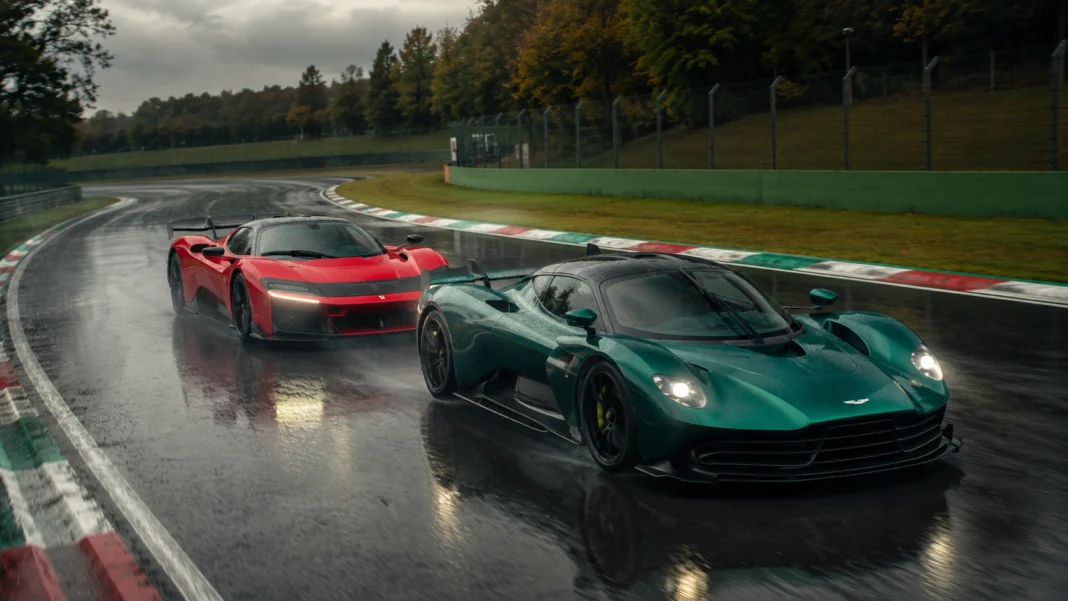
Imagine the lights of the Autodromo Enzo e Dino Ferrari at Imola glowing in the distance as two cars sit side by side in the pit lane, engines idling. On one side, the Aston Martin Valhalla, a 1,064-horsepower V8 hybrid that represents the British brand’s first series production mid-engine supercar. On the other, the Ferrari F80, a 1,200-horsepower V6 hybrid that joins the pantheon of icons including the GTO, F40, and LaFerrari. Both cars use hybrid powertrains to cross the 1,000-horsepower threshold. Both are limited to around 800 to 999 units. But the similarities end there.
The Powertrains: V8 vs V6
The Aston Martin Valhalla uses a bespoke 4.0-liter twin-turbo V8 with a flat-plane crankshaft, producing 817 horsepower on its own. Three electric motors, two on the front axle and one integrated into the eight-speed dual-clutch transmission, add another 248 horsepower, bringing the total system output to 1,064 horsepower and 811 lb-ft of torque.
The Ferrari F80 uses a 3.0-liter twin-turbo V6 with a 120-degree angle, producing 900 horsepower on its own. Three electric motors, two on the front axle and one MGU-K integrated into the transmission, add another 300 horsepower, bringing the total system output to 1,200 horsepower. The engine is derived from the 499P that won the 24 Hours of Le Mans in 2023 and 2024, and it features electric turbo technology that eliminates lag.
The Hybrid Systems: Different Approaches
The Valhalla’s hybrid system is designed for both performance and usability. In pure EV mode, the car can travel up to 14 kilometers (approximately 9 miles) with a top speed limited to 80 mph. The car has four drive modes: Pure EV, Sport, Sport+, and Race, each with its own combination of settings for powertrain, suspension, active aero, and steering calibration.

The F80’s hybrid system is designed solely for performance enhancement. The car cannot be driven in electric-only mode. The hybrid system is closed-loop, designed to deliver instantaneous response and maximum performance on track.
The Aerodynamics: Different Philosophies
The Valhalla’s aerodynamic package is a combination of active elements that work together to generate more than 600 kilograms of downforce at 149 mph, which is then maintained all the way to the car’s 217 mph maximum speed. The active rear wing raises by 255 mm in Race mode, and the active front wing shifts to maximum downforce mode, with an automated DRS function that reduces drag on straights. Under braking, the rear wing deploys as an air brake.
The F80’s aerodynamic package is among the most extreme ever fitted to a road car. It generates 1,000 kilograms of downforce at 250 km/h, achieved through an active rear wing, an S-Duct with a triple-wing configuration, a flat underbody with a 1.8-meter diffuser, and an active suspension system that contributes directly to ground effect by minimizing body roll during cornering.
The Driving Experience: Different Characters
The Valhalla is a car that rewards a skilled driver with a playful, approachable character. The chassis is allowed to breathe, and the rear end can be provoked into a slide on corner exit. The steering is light and accurate, and the ride is surprisingly compliant. The flat-plane crank V8 is hard-edged and responsive, though some reviewers note the sound is more McLaren than Ferrari. The Valhalla is a car that feels special and exotic, yet usable on the road.
The F80 is a car that demands respect. The power is immense, and the active aerodynamics and hybrid system work in harmony to deliver a driving experience that is both brutal and precise. It is more intense, more focused, and more demanding than the Valhalla. The F80 is a track weapon that happens to be road legal.

The Price: A Significant Difference
The Valhalla is priced at approximately £850,000 ($1.05 million), making it significantly more affordable than the F80, which starts at $3.7 million. The Valhalla is positioned as a step between traditional supercars and the more radical hypercars. The F80 is positioned as a halo car, a successor to the LaFerrari.
The Imola Evening
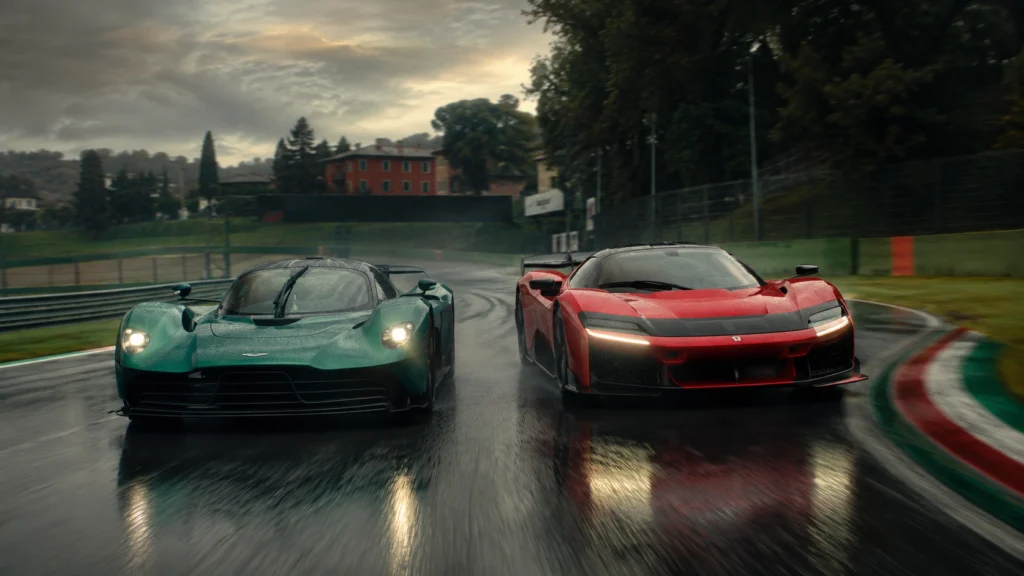
The two cars have completed their demonstration laps. The Aston Martin Valhalla has delivered the 1,064 horsepower that makes it the most powerful Aston Martin ever built. The Ferrari F80 has delivered the 1,200 horsepower that makes it the most powerful Ferrari road car ever built. The lap times are close, but the experience is different.
The Valhalla is a car that combines performance with usability. The hybrid system allows for electric-only driving, the active aerodynamics adapt to the situation, and the cabin is a comfortable place to be. It is a car that can be driven to the track, set competitive lap times, and drive home.
The F80 is a car that demands respect. The power is immense, and the car requires a skilled driver to extract its full potential. The active aerodynamics and hybrid system work in harmony to deliver a driving experience that is both brutal and precise. It is a car that is designed for the track, and it shows.
The Verdict
The Aston Martin Valhalla and Ferrari F80 are two of the most impressive hypercars ever built. The Valhalla is a technological showcase that combines performance with usability. The F80 is a track-focused weapon that pushes the boundaries of what is possible with a V6 hybrid powertrain.
The choice between them depends on what you value most. The Valhalla is more usable, with electric-only driving and a more comfortable cabin. It is also significantly more affordable. The F80 is more focused, with a more extreme aerodynamic package and a more demanding driving experience. Both are extraordinary. Both are legends. The rematch is a draw.
Gear Picks for This Story
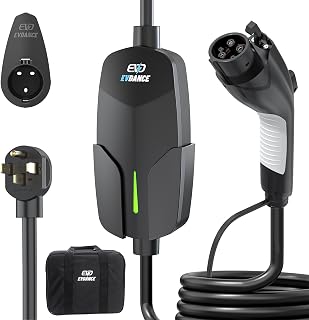 EV LifeEVDANCE Portable EV Charger 32ACheck Compatibility →
 Essential ToolMilwaukee M12 FUEL 3/8 RatchetExplore the Specs →
 Creator GearDJI Avata 2 FPV DroneSee the Specs →
 Tech UpgradeAutel MaxiSYS MS906 Pro ScannerExplore the Specs →
As an Amazon Associate, VeloxTrend earns from qualifying purchases.

