
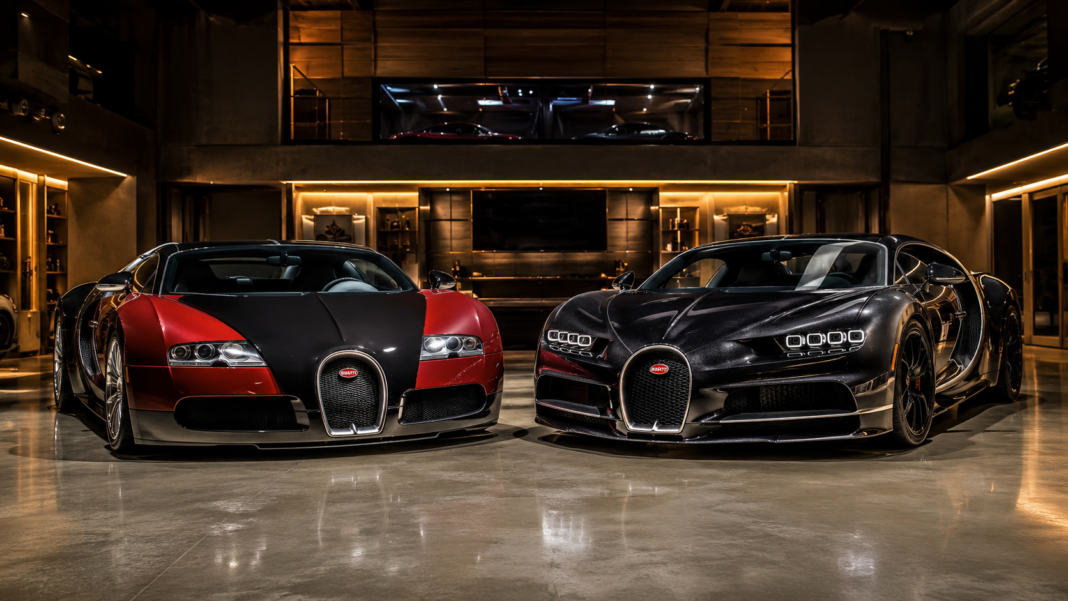
How does the car that defined the modern hypercar era compare to its successor? A generational comparison of two W16 legends on the open roads of Germany.
The sun was just beginning to warm the tarmac of the A2 autobahn, a stretch of unrestricted highway that cuts through the flat farmland of Lower Saxony near the town of Lehrte. To the north, the silhouette of the Volkswagen test track at Ehra Lessien was barely visible on the horizon, a place that had witnessed history twice, once in 2005 and again in 2019.
On the shoulder of the road, two cars sat side by side. On the left, a Bugatti Veyron 16.4 in a deep shade of ebony. On the right, a Bugatti Chiron Super Sport in a striking blue carbon fiber weave. Between them, 15 years of engineering evolution.
This was not a drag race. It was a journey. A chance to understand how the car that defined the modern hypercar era compared to its successor. Two W16 legends, separated by time but connected by an engine that had become the most iconic of the 21st century.
The story of the Veyron began in a small room in Wolfsburg, Germany, in the late 1990s. The story of the Chiron began on the same Ehra Lessien track where the Veyron had claimed its fame. Together, they represent a continuous pursuit of a single goal: to build the fastest, most powerful, and most technologically advanced production car in the world.
Bugatti Veyron vs Bugatti Chiron: Key Specifications Compared
| Specification | Bugatti Veyron 16.4 (2005) | Bugatti Chiron Super Sport (2019) |
|---|---|---|
| Engine | 8.0L quad-turbo W16 | 8.0L quad-turbo W16 |
| Horsepower | 987 hp (1,001 PS) | 1,578 hp |
| Torque | 922 lb-ft | 1,180 lb-ft |
| Transmission | 7-speed dual-clutch | 7-speed dual-clutch |
| Drive | All-wheel drive | All-wheel drive |
| 0-60 mph | 2.5 seconds | 2.3 seconds |
| Top Speed | 253 mph | 273 mph (limited) |
| Weight | 4,162 lb | 4,400 lb |
| Production | 450 units | 500 units (Super Sport) |
| Original Price | $1.7 million | $3.9 million |
The Birth of a Legend: The Veyron’s Impossible Promise
The early morning light caught the Veyron’s aluminum body panels, casting reflections that danced across the hood. The car was nearly two decades old, but it did not look dated. It looked purposeful, a machine designed by engineers, not stylists.
The Veyron was conceived in 1999 when Ferdinand Piëch, the chairman of Volkswagen Group, challenged his engineers to build the most powerful and fastest production car in the world. The targets were staggering. One thousand horsepower. Two hundred and fifty miles per hour. The ability to drive at top speed for an extended period without overheating or running out of fuel.
At the time, no production car had exceeded 240 miles per hour. No road car engine had ever produced 1,000 horsepower reliably. The engineering challenges seemed insurmountable. The project was canceled and restarted multiple times. Eighteen prototype engines failed before the first reliable unit was produced.
The car that finally emerged in 2005 was a masterpiece. The W16 engine, an 8.0 liter quad turbocharged unit, occupied the space between the driver and the rear axle. The transmission, a seven speed dual clutch unit, was one of the first of its kind. The all wheel drive system was designed to handle the immense power without overwhelming the tires.
The Veyron was not a car. It was a statement. It proved that the impossible was possible.
The Evolution: How the Chiron Built on a Legacy
The driver of the Chiron pressed the start button. The W16 engine came to life with a deep, mechanical rumble that was more refined than the Veyron’s. The car’s interior was a different world. The leather was softer, the carbon fiber trim was more intricate, and the digital instrument cluster was a work of art.
The Chiron was not a revolution. It was an evolution. The engineers had taken everything they learned from the Veyron and refined it. The engine produced 1,578 horsepower, nearly 600 more than the original Veyron. The torque figure of 1,180 lb-ft was available across a broader range of the rev band. The transmission was stronger, the cooling system was more efficient, and the aerodynamics were more sophisticated.
But the fundamental architecture remained the same. The W16 engine, the dual clutch transmission, the all wheel drive layout, the two seat configuration all of these elements were carried over from the Veyron. The Chiron was not a different car. It was a better version of the same car.
Performance Evolution: How the Numbers Changed in 15 Years
| Performance Metric | Veyron 16.4 (2005) | Chiron Super Sport (2019) | Improvement |
|---|---|---|---|
| 0-60 mph | 2.5 seconds | 2.3 seconds | 0.2 seconds |
| 0-100 mph | 5.5 seconds | 4.8 seconds | 0.7 seconds |
| 0-200 mph | 22.0 seconds | 15.8 seconds | 6.2 seconds |
| Top speed | 253 mph | 273 mph | 20 mph |
| Horsepower | 987 hp | 1,578 hp | 591 hp |
| Torque | 922 lb-ft | 1,180 lb-ft | 258 lb-ft |
The Drive: Experiencing the Veyron on the Autobahn
The driver slid into the Veyron’s cockpit. The seats were comfortable but not heavily bolstered. The dashboard was filled with physical buttons and a small screen. The steering wheel was thick and wrapped in leather. The car felt expensive, but it did not feel modern.
The Veyron pulled onto the autobahn. The engine was quiet at low speeds, and the ride was surprisingly compliant. The car felt heavy, which it was, but it also felt planted, secure, and stable.
The driver pressed the throttle. The turbos spooled, the transmission downshifted, and the Veyron surged forward. The acceleration was immense, but it was not violent. It was a wave of force that built steadily, pushing the driver into the seat. The car reached 120 miles per hour without drama. It reached 150 miles per hour with the same composure.
At 180 miles per hour, the Veyron began to feel different. The steering weighted up, the suspension firmed, and the car felt as if it were glued to the road. The driver could feel the downforce pressing the car onto the tarmac. The engine was roaring now, a mechanical symphony of 16 cylinders and 4 turbochargers.
The Veyron reached 200 miles per hour. The world outside became a tunnel of color. The driver’s focus narrowed to the road ahead, the gauges, the mirrors. The car was stable, predictable, and utterly confidence inspiring.
The Veyron was not a car that demanded skill to drive fast. It was a car that made speed feel effortless.
The Successor: Driving the Chiron on the Same Roads
The driver switched to the Chiron. The difference was immediate. The seats were more supportive. The digital instrument cluster was clearer. The sound of the engine was more refined, a deeper, more cultured note.
The Chiron pulled onto the autobahn. The ride was firmer than the Veyron’s, but it was still comfortable. The car felt smaller than its weight suggested. The steering was quicker, and the car responded more eagerly to inputs.
The driver pressed the throttle. The Chiron launched forward with a ferocity that the Veyron could not match. The 0 to 60 time of 2.3 seconds was not dramatically different from the Veyron’s 2.5 seconds, but the 0 to 200 time of 15.8 seconds was a revelation. The Chiron reached 200 miles per hour more than 6 seconds faster than the Veyron.
At high speed, the Chiron was even more stable. The aerodynamics were more advanced, generating downforce without excessive drag. The car felt planted, secure, and unstoppable.
The Chiron reached its limited top speed of 273 miles per hour. The world outside became a blur. The driver felt the immense forces at work, the engineering effort required to keep the car stable at speeds that were previously the domain of fighter jets.
The Chiron was not a different car. It was a better version of the same car. A car that had evolved over 15 years of continuous development.
The Interior: From 2005 Luxury to 2019 Opulence
The Veyron’s interior was a product of its time. The dashboard was filled with buttons and switches, each with a satisfying click. The materials were high quality, with leather covering every surface. The seats were heated and power adjustable. The sound system was premium.
But the technology felt dated. The navigation screen was small and low resolution. The interface was slow. There were no smartphone integration features, no advanced driver assistance systems. The Veyron was a car designed to be driven, not to be connected.
The Chiron’s interior was a different experience. The dashboard was dominated by a large digital instrument cluster that could be configured to show different information. The center console featured a small screen for infotainment functions. The materials were exceptional, with leather, carbon fiber, and machined aluminum throughout.
The seats were more supportive, with heating and cooling functions. The sound system was world class. The car featured Apple CarPlay, a premium audio system, and advanced climate control.
The Chiron was a car that you could live with. The Veyron was a car that you drove.
The Engineering: What Changed in 15 Years
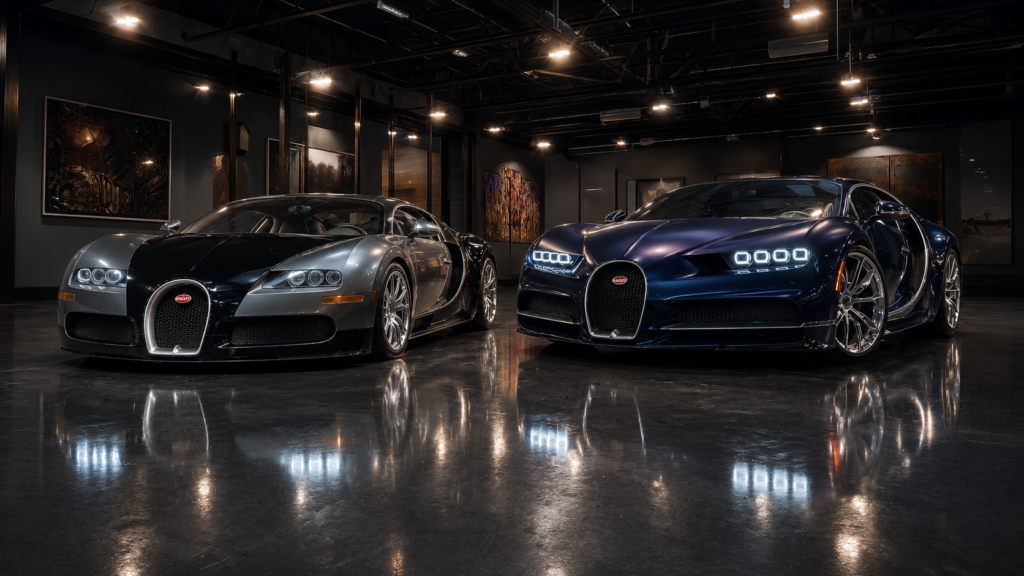
Under the skin, the Chiron represented a significant evolution from the Veyron. The engine block was redesigned, with larger turbochargers and improved cooling. The transmission was strengthened to handle the additional torque. The chassis was stiffened, and the suspension was revised.
But the most significant changes were in the electronics. The Veyron’s systems were relatively simple. The Chiron’s systems were complex, with advanced traction control, torque vectoring, and active aerodynamics that adjusted continuously based on driving conditions.
The Chiron also benefited from advances in materials science. The use of carbon fiber was more extensive, reducing weight while increasing rigidity. The tires were developed specifically for the car, with compounds that could withstand speeds exceeding 270 miles per hour.
The result was a car that was more powerful, more capable, and more refined than its predecessor. But it was also heavier, more complex, and more expensive.
The Cost of Hypercar Ownership
| Cost Consideration | Veyron (2005) | Chiron (2019) |
|---|---|---|
| Original price | $1.7 million | $3.9 million |
| Current value (used) | $1.5 to $2.5 million | $4 to $6 million |
| Tire replacement | $38,000 per set | $50,000 per set |
| Oil change | $21,000 | $30,000 |
| Annual service | $30,000 to $50,000 | $50,000 to $80,000 |
The Verdict: Evolution, Not Revolution
The Veyron and the Chiron were parked side by side at a rest stop near the town of Brunswick. The sun was higher now, and the day was warming. A few other cars had pulled in, their drivers stopping to photograph the two hypercars.
The Veyron was a landmark. It had defined the modern hypercar era. It had proven that 1,000 horsepower and 250 miles per hour were possible in a production car that could be driven on public roads. It was a car that had changed the industry.
The Chiron was the successor. It had taken the Veyron’s formula and refined it. More power, more speed, more luxury, more technology. It was a better car in every measurable way.
But the Veyron had something that the Chiron could not replicate. It had the aura of a pioneer. It was the car that had done it first. The car that had faced the impossible and had won.
The Chiron was the better car. The Veyron was the more significant car.
As the drivers prepared to leave, the owner of the Veyron looked at his car and then at the Chiron. “The Chiron is faster,” he said. “It’s more comfortable. It’s more advanced. But when I drive the Veyron, I feel like I’m driving a piece of history.”
The owner of the Chiron nodded. “The Veyron is the legend,” he said. “The Chiron is the legend perfected.”
They started their engines, pulled onto the autobahn, and disappeared into the distance. Two W16 legends, separated by 15 years but united by a common purpose. To push the boundaries of what was possible.
Conclusion: The Evolution of an Icon
The Bugatti Veyron and Bugatti Chiron represent two chapters in the same story. The Veyron was the bold beginning, a car that faced impossible engineering challenges and emerged victorious. The Chiron was the mature evolution, a car that took a brilliant formula and made it better in every way.
For the collector who values significance, the Veyron is the car to own. It is the car that changed the game, the car that defined the modern hypercar era. For the driver who values performance and luxury, the Chiron is the superior car. It is faster, more comfortable, and more capable.
Both are extraordinary. Both are legends. Both will be remembered as defining the era of the W16 hypercar.
And on a stretch of autobahn in Lower Saxony, the two cars drove on, each pushing toward the horizon, each carrying the weight of the Bugatti legacy on their shoulders. The Veyron had written the first chapter. The Chiron had written the second. Whatever came next would have to be very special indeed to surpass either.

