
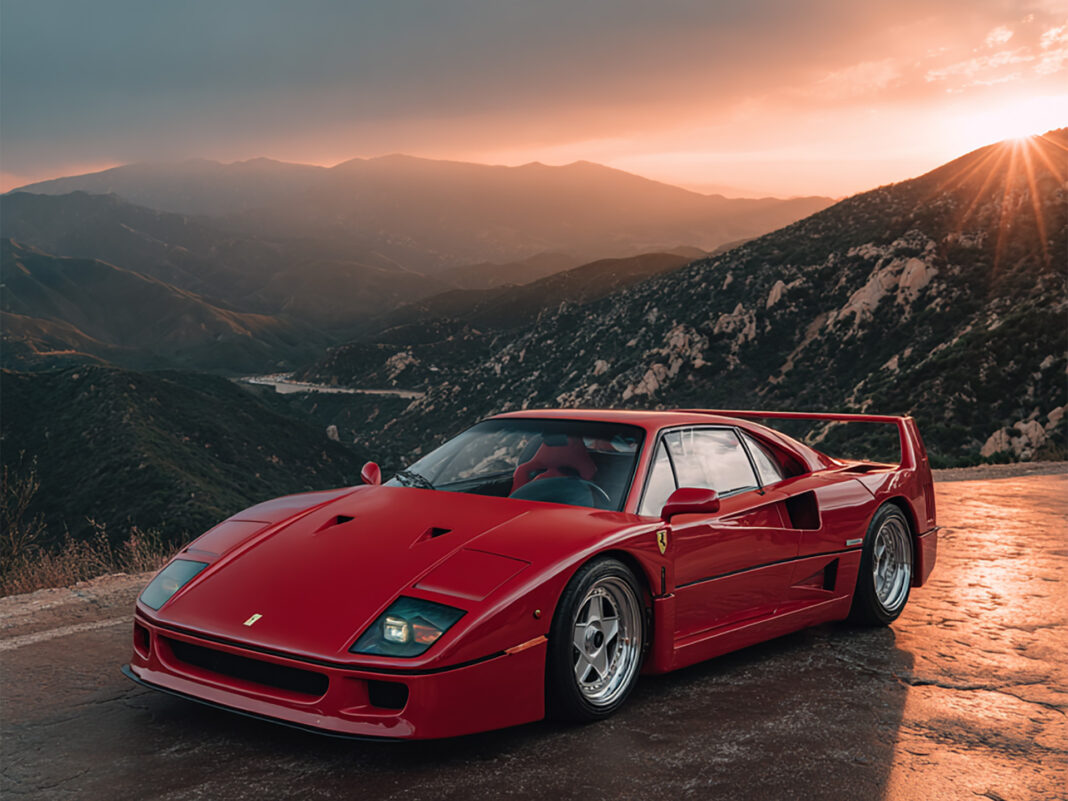
Few automobiles carry the weight of history quite like the Ferrari F40. It stands as a monument to a pivotal moment in automotive history, a machine born from competition and stamped with the final personal approval of the company’s founder. The F40 is not merely a classic car. It is a raw, unfiltered expression of Ferrari’s racing soul, created at a time of transition and unveiled to the world as a statement of enduring dominance.
This article explores the Ferrari F40 in detail, examining the context of its creation, its design and engineering philosophy, the driving experience it offers, and the legacy that has cemented its place as one of the most significant supercars ever built.
The Historical Context: A Legacy on the Line
To understand the F40, one must first understand the circumstances surrounding its birth. The 1980s were a decade of immense change for Ferrari. The company was navigating the complexities of the modern automotive industry while simultaneously competing at the highest levels of motorsport. Enzo Ferrari, Il Commendatore, was in his late eighties. The man who had built the Scuderia Ferrari racing team and later the road car division was nearing the end of his life.
There was a palpable sense within the company that a landmark car was needed. The Ferrari 288 GTO, released in 1984, had been a spectacular success, reestablishing Ferrari’s credentials as a builder of extreme, limited production performance cars. It was a homologation special, built to satisfy racing regulations for Group B. However, by 1986, Group B rallying had been canceled following a series of tragic accidents. Ferrari had already developed an evolution of the 288 GTO, known as the GTO Evoluzione, which never saw its intended track use.
With these purpose built race cars sitting unused, Enzo Ferrari made a decision. He directed his engineers to take the lessons learned from the Evoluzione program and create a new road car. It would be the ultimate expression of Ferrari engineering. It would be fast, uncompromising, and devoid of luxuries. Most importantly, it would be the last car he would personally approve before his death in 1988. This singular fact imbues the F40 with a significance that no other Ferrari can claim.
Design and Engineering: Form Follows Function
The Ferrari F40 was designed with a single objective: performance. There was no committee dictating styling cues for market appeal. The body was shaped by the wind tunnel and the demands of the car’s mechanical components.
Aerodynamics and Construction
Pininfarina, Ferrari’s long standing design partner, penned the body, but the final shape was heavily influenced by the need for aerodynamic efficiency. The low nose, the flush headlamps, and the prominent rear wing were all functional elements designed to manage airflow and generate downforce. The car’s silhouette is unmistakable, a wedge of purposeful aggression.
The construction of the F40 was revolutionary for a road car at the time. To save weight, the body panels were made from a variety of composite materials, including Kevlar, carbon fiber, and aluminum. The chassis itself was a tubular steel space frame, a proven racing solution. This focus on lightweight construction was relentless. The windows were made of lightweight plastic, and there was no sound deadening, no carpeting, and no door handles on the inside. Pull straps sufficed. The result was a curb weight of approximately 2,400 pounds, exceptionally light for a car with such a powerful engine.
The Powertrain
At the heart of the F40 lies its engine. It is a 2.9 liter twin turbocharged V8, a direct descendant of the unit used in the 288 GTO. For the F40, Ferrari’s engineers enlarged the displacement slightly and fitted larger IHI turbochargers with air to air intercoolers. The result was an official output of 471 horsepower, though many enthusiasts believe the actual figure was higher.
The engine was a masterpiece of turbocharging technology for its era. It provided immense thrust, but it also required skill to manage. Turbo lag was significant. The driver had to keep the engine on boost to access its full potential. This characteristic was part of the car’s challenge and part of its reward. Power was sent to the rear wheels through a five speed manual gearbox, a transmission that required a firm hand and offered a direct, mechanical connection to the powertrain.
The Driving Experience: Raw and Unfiltered
To drive a Ferrari F40 is to have a conversation with a machine that offers no pleasantries. It is a demanding and immersive experience that is vastly different from modern supercars with their electronic aids and sophisticated suspensions.
Stepping into the cabin requires a degree of athleticism. The wide carbon fiber sill must be navigated, and once inside, the driver is greeted by a sparse environment. The view forward is dominated by the steeply raked windshield and the large rear view mirror, which offers a glimpse of the engine cover through the slatted rear window. The seats are fixed, with adjustable pedals to accommodate drivers of different sizes.
Starting the engine is an event. The twin turbos spool with a distinctive whistle, and the exhaust note is a raw, mechanical symphony. On the road, the F40 demands respect. The steering is heavy and communicative, transmitting every nuance of the road surface to the driver’s hands. The ride is firm, and the car reacts instantly to inputs. It is not a car for casual cruising. It is a car that requires focus and intent.
The performance, even by modern standards, is startling. When the turbochargers reach full boost, the acceleration is ferocious. The car hunkers down and surges forward with a urgency that pins the driver to the seat. It is this combination of challenge, sensory feedback, and raw speed that defines the F40 experience. It is a pure, analog driving machine.
The Legacy of the Last Approved
The Ferrari F40 was launched in 1987 to celebrate Ferrari’s 40th anniversary. The automotive press and enthusiasts were stunned. It was faster, more extreme, and more focused than anything else available. It immediately set a new benchmark for what a supercar could be. Planned for a production run of 400 units, demand was so overwhelming that Ferrari ultimately built over 1,300 cars.
The death of Enzo Ferrari in August 1988, just as the first F40s were being delivered, added a profound layer of meaning to the car. It became a memorial, a tangible connection to the founder’s vision. Collectors and enthusiasts recognized immediately that this was the end of an era. Every subsequent Ferrari would be developed under the leadership of a new management structure, with different priorities.
In the decades since, the F40’s legend has only grown. It has consistently been ranked among the greatest supercars of all time by automotive publications worldwide. Its value has skyrocketed, making it one of the most coveted collector cars in existence. This appreciation is not merely due to its scarcity or its historical significance. It is because the car itself is so compelling. It represents a philosophical purity that is rare in any field.
F40 vs. Its Contemporaries
The late 1980s and early 1990s were a golden age for supercars, and the F40 did not exist in a vacuum. It had two primary rivals that are often discussed alongside it.
The Porsche 959 was developed alongside the F40 and offered a different philosophy. Where the F40 was raw and track focused, the 959 was technologically advanced, featuring sophisticated all wheel drive, adjustable suspension, and a more luxurious interior. It was a marvel of engineering, but it lacked the F40’s visceral intensity.
Later, the Jaguar XJ220 and the McLaren F1 would arrive, pushing performance even further. The McLaren F1, in particular, would eventually dethrone the F40 as the world’s fastest production car. However, even the McLaren, with its three seat configuration and gold lined engine bay, could not replicate the F40’s connection to Enzo Ferrari’s personal vision. The F40 remained the last word from the founder.
The F40 in Popular Culture and Collecting
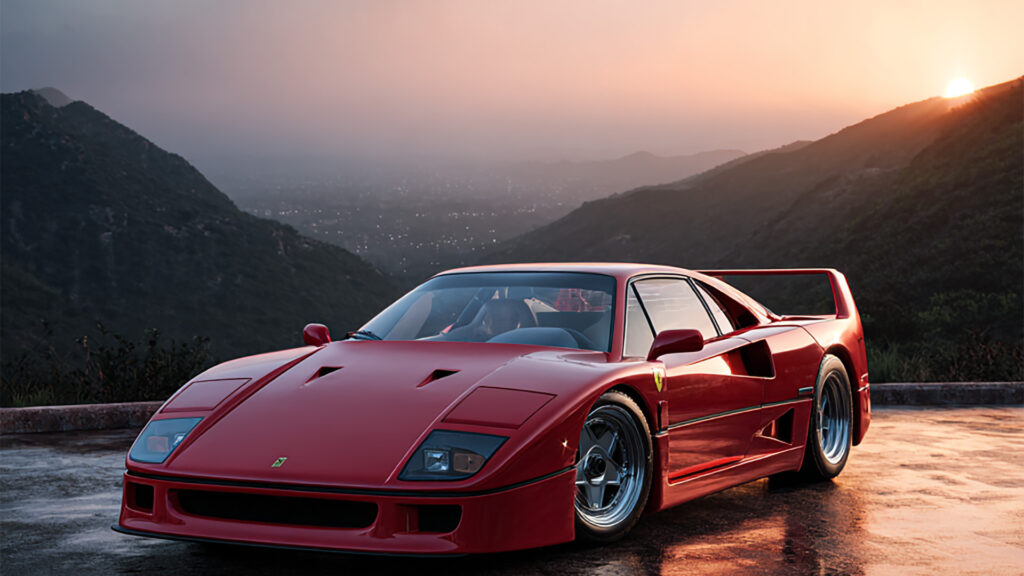
The Ferrari F40 has transcended its role as an automobile to become a cultural icon. It has appeared in countless video games, films, and magazine covers, instantly recognizable even to those with only a passing interest in cars. Its shape and its reputation have made it a symbol of 1980s excess and automotive passion.
For collectors, owning an F40 is the culmination of a lifetime of dedication. The market for these cars is robust and global. Low mileage, original examples command prices in the millions of dollars. The car’s collectability is underpinned by its historical importance, its performance legacy, and its status as the last Ferrari approved by the founder. It is considered a blue chip investment in the collector car world, a tangible asset that also happens to provide one of the most intense driving experiences ever devised.
Conclusion: The Enduring Icon
The Ferrari F40 is far more than the sum of its specifications. It is a historical document, a piece of engineering art, and a monument to one man’s unwavering commitment to racing. As the last car personally approved by Enzo Ferrari, it carries a significance that no other Ferrari can claim. It represents the final transmission of the founder’s vision directly to the road.
Its design is timeless, its performance is still exhilarating, and its driving experience remains unmatched in its purity. The F40 is not a car that coddles its driver. It is a car that demands engagement, skill, and respect. In return, it offers a connection to the road and to automotive history that is increasingly difficult to find. For these reasons, the Ferrari F40 will forever stand as one of the greatest supercars ever built, the last true Ferrari from the man who started it all.

