
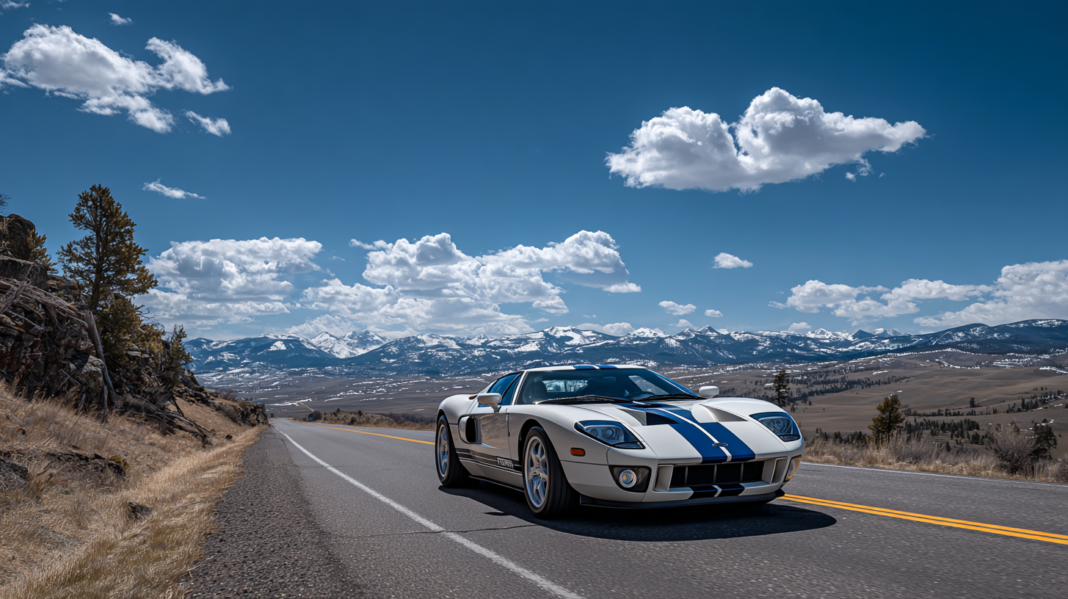
The Ford GT of 2005 occupies a unique place in automotive history. It was a car that looked backward and forward simultaneously. Its design was a direct homage to the legendary GT40 that won the 24 Hours of Le Mans four times in a row from 1966 to 1969. Yet its engineering was thoroughly modern, with a supercharged V8 engine, an aluminum chassis, and a carbon fiber and aluminum body. It was a car that proved an American manufacturer could build a supercar that competed with the best from Europe.
Produced from 2004 to 2006, the Ford GT was a limited edition model celebrating Ford’s 100th anniversary. Only 4,038 units were built, far more than the original GT40’s 105 units. Today, the GT has become a sought-after collector car, with values appreciating steadily. It is recognized as one of the most significant American performance cars of the modern era.
This article provides a comprehensive examination of the 2005 Ford GT, including its development, engineering, performance, design, and why it remains a modern American supercar icon.
The GT40 Legacy
The original Ford GT40 was born from a bitter rivalry. In the early 1960s, Henry Ford II attempted to buy Ferrari, but Enzo Ferrari backed out of the deal at the last minute. Ford responded by pouring resources into building a race car that would beat Ferrari at the 24 Hours of Le Mans, Ferrari’s home turf.
The result was the GT40, a mid-engine race car developed by Ford in partnership with Carroll Shelby and other specialists. After two years of development, the GT40 succeeded. In 1966, Ford GT40s finished first, second, and third at Le Mans. The GT40 went on to win Le Mans four times in a row from 1966 to 1969.
The Ford GT was a tribute to this legacy. It was designed to capture the spirit of the GT40 while adapting it for road use.
The Modern Revival
The Ford GT concept was unveiled at the 2002 North American International Auto Show in Detroit. The response was overwhelmingly positive, and Ford approved the car for production. The goal was to build a modern American supercar that would compete with the Ferrari 360 Modena and the Porsche 911 Turbo.
The production car was introduced in 2004 as a 2005 model. It was built at a dedicated facility in Wixom, Michigan, with a team of approximately 100 workers assembling each car by hand.
The development timeline was short. Ford engineers had just two years to take the concept from the show floor to production. The result was a car that was remarkably faithful to the concept.
Powertrain: The Supercharged V8
Engine Specifications
The Ford GT is powered by a 5.4 liter supercharged V8 engine, designated the Modular V8. This engine is a development of the unit used in the Ford Mustang SVT Cobra, with significant modifications for the GT application.
The engine produces 550 horsepower at 6,500 rpm and 500 lb-ft of torque at 3,750 rpm. The redline is 7,000 rpm.
The supercharger is a screw-type unit that provides immediate boost response. Unlike turbochargers, which can suffer from lag, the supercharger delivers power instantly, giving the GT linear, predictable power delivery.
Transmission
Power is transmitted to the rear wheels through a six-speed manual transmission, designated the Ricardo. The transmission is mounted at the rear of the car in a transaxle configuration, contributing to the car’s weight distribution.
The transmission features a traditional H-pattern gate and a clutch pedal with moderate weight. The shift action is mechanical and precise.
Performance
The Ford GT accelerates from 0 to 60 miles per hour in 3.8 seconds. The quarter mile is completed in approximately 11.8 seconds at 125 miles per hour. Top speed is 205 miles per hour.
These figures were competitive with the best supercars of the era.
Chassis and Construction
Aluminum Spaceframe
The Ford GT is built around an aluminum spaceframe chassis. The structure is lightweight and rigid, providing a solid foundation for the suspension. The body panels are also aluminum, with the exception of the carbon fiber hood and door sill plates.
The dry weight is approximately 1,450 kilograms (3,200 pounds).
Suspension
The GT features double-wishbone suspension at all four corners, with coil springs and adjustable dampers. The suspension is tuned for a balance of road comfort and track performance.
Brakes
The braking system uses four-wheel ventilated disc brakes with four-piston calipers. The brakes provide strong stopping power, with consistent pedal feel.
Wheels and Tires
The Ford GT rides on 18-inch front wheels and 19-inch rear wheels, wrapped in Goodyear Eagle F1 tires. The front tires are 235/45 ZR18, and the rear tires are 315/40 ZR19.
Aerodynamics
The Ford GT’s aerodynamic development focused on high-speed stability. The car features a prominent front splitter, a rear diffuser, and an integrated rear wing. The underbody is flat, improving airflow.
The GT generates downforce at speed, keeping the car planted on the road.
Design
Exterior Styling
The Ford GT’s exterior design is a modern interpretation of the GT40. The car features a low, wide stance, a long nose, and a fastback tail. The body is clean and muscular, with subtle curves and distinctive air intakes.
The front end features a prominent grille with a chrome surround and a Ford oval. The headlights are round, a reference to the GT40. The hood has large air outlets that extract hot air from the engine bay.
The side profile shows the low roofline, the large side air intakes, and the distinctive door cutouts. The doors open upward in a butterfly configuration.
The rear end features a prominent diffuser, a rear wing integrated into the decklid, and twin exhaust outlets. The round taillights are a reference to the GT40.
Interior Design
The interior of the Ford GT is focused on the driver. The seats are power-adjustable with leather upholstery. The dashboard features a digital instrument cluster with a central speedometer and tachometer.
The steering wheel is a three-spoke unit with a flat bottom. The shift lever is positioned high on the center console.
The interior is spartan compared to modern supercars, but it is functional and driver-focused.
Driving Experience
On Road Character
The Ford GT is a car that demands attention. The supercharged V8 produces a deep, guttural roar that fills the cabin. The ride is firm but not punishing. The steering is heavy at low speeds, but it provides excellent feedback at speed.
The clutch is heavy, and the shift action is mechanical. The car is not relaxing, but it is engaging.
On Track Behavior
When driven on a track, the Ford GT reveals its capabilities. The brakes provide strong stopping power, and the chassis remains composed through corners. The supercharged V8 pulls strongly to the redline.
The car’s rear-wheel-drive layout requires skill to manage. The GT rewards smooth inputs.
The Sound
The supercharged V8 engine’s sound is one of the Ford GT’s defining characteristics. The engine produces a deep, guttural rumble at low speeds and a sharp, aggressive roar at full throttle. The supercharger adds a whine that is characteristic of forced induction.
The Ford GT’s Legacy
A Modern Classic
The Ford GT is recognized as a modern classic. Its limited production numbers, its connection to the GT40, and its performance have made it a sought-after collector car. Values have appreciated steadily, with well-maintained examples trading for over $300,000.
Influence on Ford
The Ford GT influenced Ford’s performance strategy for years to come. It demonstrated that Ford could build a world-class supercar, and it paved the way for the 2017 Ford GT and the Mustang Shelby GT500.
The GT40 Connection
The Ford GT honors the GT40’s legacy while standing on its own. It is not a replica; it is a modern interpretation that captures the spirit of the original.

How the Ford GT Stacks Up Against Rivals
Against the Ferrari 360 Modena
The Ferrari 360 Modena is a mid-engine supercar with a 3.6 liter naturally aspirated V8 producing 400 horsepower.
The 360’s advantage is its power-to-weight ratio and its handling. The Ferrari is lighter and more agile.
The Ford GT’s advantage is its power and its torque. The GT produces 150 more horsepower than the Ferrari, and its supercharged V8 provides abundant torque.
Against the Porsche 911 Turbo
The Porsche 911 Turbo is a rear-engine, all-wheel-drive sports car with a 3.6 liter twin-turbocharged flat-six producing 415 horsepower.
The 911’s advantage is its all-weather capability and its daily usability. The Porsche is more practical and more refined.
The Ford GT’s advantage is its power and its drama. The GT produces 135 more horsepower than the Porsche, and its design is more dramatic.
Against the Lamborghini Gallardo
The Lamborghini Gallardo is a mid-engine supercar with a 5.0 liter naturally aspirated V10 producing 493 horsepower.
The Gallardo’s advantage is its engine character and its all-wheel-drive traction. The V10 produces a distinctive sound.
The Ford GT’s advantage is its power and its value. The GT produces 57 more horsepower than the Gallardo, and it is less expensive.
Against the Chevrolet Corvette Z06
The Chevrolet Corvette Z06 is a front-engine sports car with a 7.0 liter naturally aspirated V8 producing 505 horsepower.
The Z06’s advantage is its power and its value. The Corvette is less expensive than the GT, and it produces comparable power.
The Ford GT’s advantage is its design and its heritage. The GT is more exclusive and more dramatic.
Specifications Summary
| Specification | Value |
|---|---|
| Engine | 5.4L supercharged V8 |
| Horsepower | 550 hp at 6,500 rpm |
| Torque | 500 lb-ft at 3,750 rpm |
| Transmission | 6-speed manual |
| Drive | Rear wheel drive |
| 0-60 mph | 3.8 seconds |
| Top Speed | 205 mph |
| Weight | 1,450 kg |
| Production | 4,038 units |
| Original Price | $150,000 |
Conclusion
The 2005 Ford GT is a modern American supercar icon. It was a car that honored the legendary GT40 while establishing its own identity. Its supercharged V8 engine produced 550 horsepower, its aluminum spaceframe chassis provided a solid foundation, and its design was a masterful interpretation of a classic.
The Ford GT was not a car for everyone. Its production was limited to 4,038 units, its price was $150,000, and its focus on performance meant it lacked the luxury of grand tourers. But for the 4,038 owners who acquired a GT, the car offered something that no other American vehicle could provide: the experience of driving a modern interpretation of the GT40.
The Ford GT also represents a turning point in Ford’s history. It demonstrated that the company could build a world-class supercar, and it paved the way for future performance models. It is a car that will forever be remembered as a modern American classic.
The 2005 Ford GT is a testament to the power of heritage and engineering. It remains one of the most significant American performance cars ever built.

