
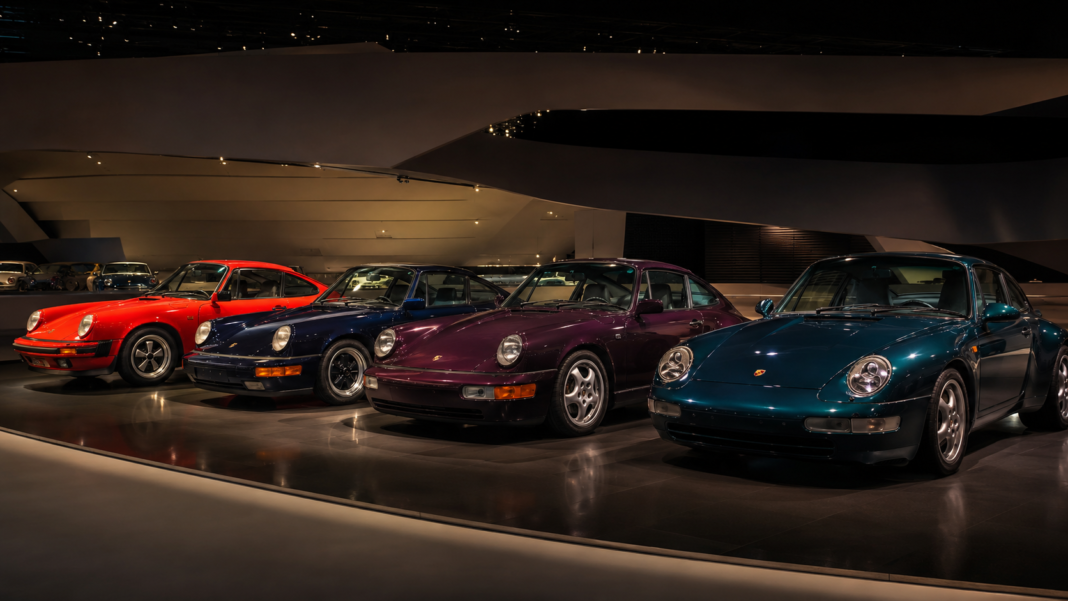
The sun is setting over Zuffenhausen, casting long shadows across the Porsche Museum in Stuttgart, Germany. The building itself is a statement, a futuristic glass and steel monolith that seems to float above the street. Inside, a row of 911s stretches from the original 901 to the latest 992 generation. They are all different. They are all the same.
The Porsche 911 is the most refined iteration of an original concept, not a reinvention. It has survived 60 years without a redesign because Porsche has continuously refined the car while preserving its essential character and distinctive silhouette. The rear-engine layout, the boxer engine, the iconic shape these are constants. But everything else has evolved. This article tells the story of how Porsche kept the same basic car relevant through eight generations of development.
The Location: Porsche Museum, Zuffenhausen, Germany
The Porsche Museum is a shrine to the brand’s history. The building contains over 80 vehicles, from the first 356 to the latest hypercars. The 911 section is the heart of the museum, a chronological display of the model’s evolution. It is the perfect place to understand how the 911 survived without a redesign.
The Original: The 901 (1963)
The 911 was introduced at the International Motor Show in Frankfurt in September 1963 as the 901. It was designed as the successor to the 356, and it retained the rear-engine layout and air-cooled engine that had become Porsche trademarks. The first 911 had a 2.0-liter flat-six engine producing 130 horsepower and a top speed of 210 km/h. It was a 2+2 seater with a large luggage compartment and a modern body.
The 901 was almost immediately renamed. Peugeot objected to the use of three-digit numbers with a zero in the middle, so Porsche changed the name to 911. The new name stuck.
The original 911 offered what its predecessor still lacked: two fold-down seats in the rear, a large luggage compartment, and a powerful boxer engine with six cylinders. The rear-engine layout and air-cooling would become defining features of the model line.
The Evolution: Eight Generations of Development
The 911 has evolved through eight generations, each building on the last. The changes have been evolutionary, not revolutionary. The silhouette, the engine layout, and the basic character have remained constant.
1963 to 1973: The First Generation
The first generation established the template. The car was available as a coupe, and later as a Targa with a roll-over bar. The engine grew from 2.0 to 2.7 liters, and power increased to 210 horsepower in the Carrera RS 2.7. The RS featured the iconic “ducktail” rear spoiler, the first of its kind.
1973 to 1989: The G-Series
The G-Series was longer and more comfortable, with plastic bumpers and improved safety features. The 911 Turbo (930) debuted in 1974, the first Porsche with an exhaust turbocharger. The Turbo initially developed 260 horsepower, later increasing to 300 horsepower. The G-Series also introduced the Cabriolet without a roll-over bar in 1983.
1989 to 1994: The 964
The 964 was a significant development, with 85 percent of the model newly developed. It introduced power steering, ABS, and a new 3.6-liter engine. The 964 also featured all-wheel drive for the first time in a 911, using a system adapted from the 959 super sports car.
1994 to 1998: The 993
The 993 was the last air-cooled 911. The multi-link rear axle improved driving dynamics and comfort. The Turbo featured twin-turbochargers for the first time. The 993 is widely considered one of the best-looking 911s.
1998 to 2005: The 996
The 996 was a watershed moment. It was the first water-cooled 911, a change driven by stricter emission standards. The switch was controversial, but it allowed for four-valve cylinder heads and increased power. The 996 also introduced the Porsche Ceramic Composite Brake (PCCB) on the GT2.
2004 to 2012: The 997
The 997 returned to the round headlights of the classic 911. The dual-clutch transmission (PDK) made its debut in the 997, combining the efficiency of a manual with the convenience of an automatic. Porsche also introduced turbochargers with variable turbine geometry (VTG) in the 911 Turbo, a world first for a gasoline engine.
2011 to 2019: The 991
The 991 was a major development step, with a significantly longer wheelbase and wider track. The aluminum-steel construction reduced weight compared to its predecessor. Porsche switched from naturally aspirated to turbocharged engines in the Carrera and GTS models.
2019 to Present: The 992
The 992 is the current generation, designed with a partially electric future in mind. The engine now produces up to 640 horsepower in the 911 Turbo S. The 992 also features innovations such as wet-road detection, Night Vision Assist, and a drag reduction system.
The Engineering Constants
Throughout the eight generations, three constants have remained.
The Rear Engine
The engine is mounted behind the rear axle. This layout provides exceptional traction, especially in low-traction conditions, because the weight rests on the driven axle. Braking performance is also improved, as the rear weight allows more braking force to be transferred to the rear wheels. The rear engine is so fundamental that altering it would fundamentally change the car’s character.
The Boxer Engine
The flat-six engine, also known as a boxer engine, has been the heart of the 911 since 1963. The engine has evolved from air-cooled to water-cooled, from naturally aspirated to turbocharged, but it has always been a flat-six. The engine is the soul of the car.
The Iconic Shape
The silhouette of the 911 is instantly recognizable. The flowing design line from the front over the roof to the rear, the distinctive window shape, and the four-point light signature have all remained consistent. The design has evolved, but the character has remained.
The Stuttgart Evening
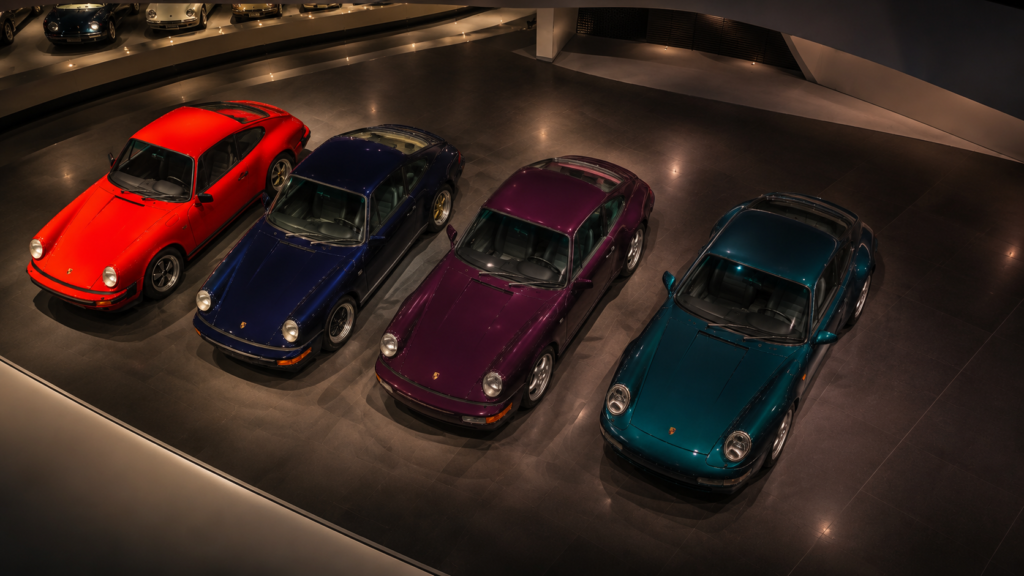
The sun has set over the Porsche Museum. The cars are parked in their final positions. The row of 911s tells a story of continuity and change.
The first-generation car is small and simple. The latest-generation car is larger, more powerful, and more complex. But they share a common DNA.
A guide is explaining the history to a group of visitors. “The 911 is not a new car,” he says. “It is a refined car. Each generation builds on the last. The engineers improve, but they do not reinvent.”
The Verdict
The Porsche 911 has survived 60 years without a redesign because Porsche has never redesigned it. The company has refined it, improved it, and optimized it, but it has always preserved the essential character. The rear-engine layout, the boxer engine, and the iconic shape have remained constant. The changes have been evolutionary, not revolutionary.
The 911 is a testament to the power of continuity. It is a car that has never been redesigned, yet it has never become irrelevant.
Key Takeaways
- The Porsche 911 was introduced in 1963 as the 901 and renamed in 1964.
- The rear-engine layout, boxer engine, and iconic silhouette have remained constant for 60 years.
- The 911 has evolved through eight generations, each building on the last.
- Key innovations include the ducktail spoiler, turbocharging, water-cooling, all-wheel drive, and the dual-clutch transmission.
- Porsche has refined the 911 without ever redesigning it.
Conclusion
The Porsche 911 has survived 60 years without a redesign. It is the most refined iteration of an original concept. The engineers have continuously improved the car, but they have never changed its essential character. The rear-engine, the boxer engine, the iconic shape these are constants.
The museum is quiet now. The cars are still. The 911s stand in a row, a testament to the power of evolution. They are different. They are the same. They are the 911.

