
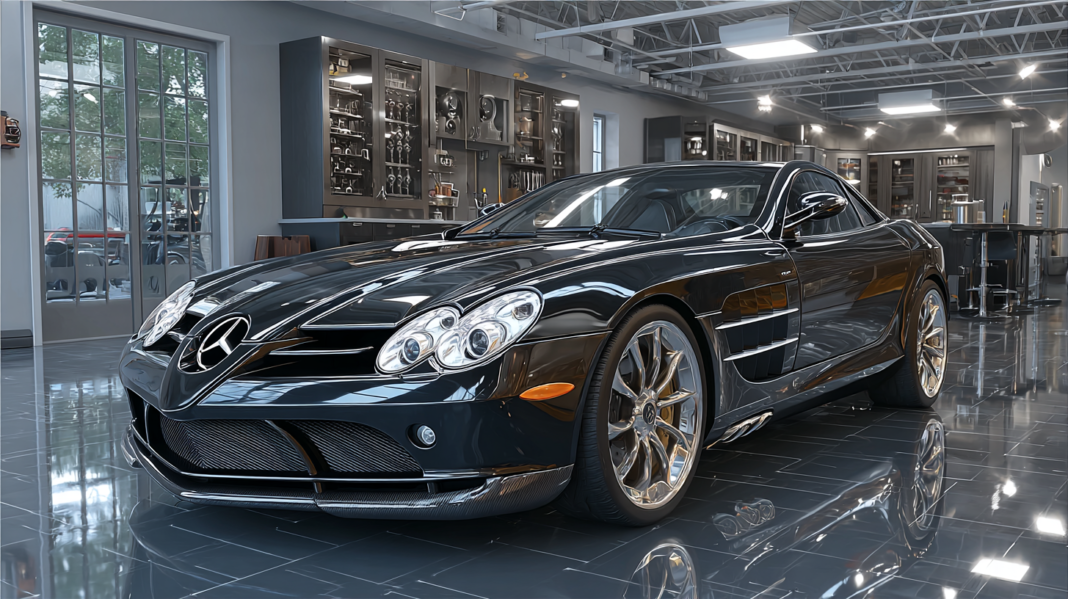
The Mercedes SLR McLaren occupies a unique place in automotive history. It was the result of a collaboration between Mercedes-Benz and McLaren, two companies with deep motorsport pedigrees. The SLR was designed to be a grand tourer, not a track-focused supercar. It prioritized high-speed comfort and long-distance capability over lap times. Yet its engineering, with a carbon fiber monocoque, a supercharged V8 engine producing 617 horsepower, and a distinctive long nose design, was ahead of its time.
Produced from 2003 to 2009, the SLR was controversial. Some critics found its handling too heavy and its automatic transmission too relaxed. Others praised its effortless performance, its stunning design, and its engineering ambition. Today, the SLR is recognized as a pioneer. It was one of the first production cars to use a carbon fiber monocoque. It was one of the first to use carbon ceramic brakes. It was a car that predicted the future of supercar engineering.
This article provides a comprehensive examination of the Mercedes SLR McLaren, including its development, engineering, performance, design, and why it remains unique today.
The Collaboration: Mercedes and McLaren
The Mercedes SLR McLaren was the product of a partnership between Mercedes-Benz and McLaren, which at the time was Mercedes’s Formula 1 team. The collaboration allowed Mercedes to access McLaren’s expertise in carbon fiber construction and aerodynamic development.
The SLR was unveiled in 2003 as a modern interpretation of the legendary 300 SLR race car from 1955. The 300 SLR, driven by Stirling Moss, was one of the most successful race cars of its era. The SLR name (Sport Leicht Rennen, or Sport Light Racing) and the design references were meant to honor this heritage.
The Carbon Fiber Revolution
Carbon Fiber Monocoque
The SLR was one of the first production cars to use a carbon fiber monocoque. The structure was a single-piece carbon fiber tub that provided exceptional rigidity and occupant protection while minimizing weight. The monocoque was manufactured using aerospace-grade materials and processes.
The carbon fiber construction was a significant engineering achievement. At the time, carbon fiber was primarily used in Formula 1 and other racing series. The SLR brought this technology to a production grand tourer.
Weight and Rigidity
The carbon fiber monocoque weighed only 110 kilograms, far less than a steel or aluminum structure would have weighed. It also provided exceptional torsional rigidity, which contributed to the car’s precise handling and stable high-speed behavior.
Crash Safety
The carbon fiber monocoque also provided excellent crash protection. The structure was designed to absorb impact energy while maintaining the integrity of the passenger cell.
Powertrain: The Supercharged V8
Engine Specifications
The SLR is powered by a 5.4 liter supercharged V8 engine, designated the M155. The engine produces 617 horsepower at 6,500 rpm and 575 lb-ft of torque from 3,250 to 5,000 rpm. The redline is 6,500 rpm.
The supercharger is a screw-type unit that provides immediate boost response. Unlike turbochargers, which can suffer from lag, the supercharger delivers power instantly, giving the SLR a linear, predictable power delivery.
Transmission
Power is transmitted to the rear wheels through a five-speed automatic transmission. The transmission is a traditional torque converter unit, not a dual-clutch. This was a controversial choice at the time, as many supercars were moving to automated manuals and dual-clutch transmissions.
The transmission is mounted at the rear of the car in a transaxle configuration, contributing to the car’s weight distribution. The gearbox can be operated in fully automatic mode or via paddle shifters.
Performance
The SLR accelerates from 0 to 60 miles per hour in 3.6 seconds. The quarter mile is completed in approximately 11.5 seconds at 126 miles per hour. Top speed is 208 miles per hour (334 kilometers per hour).
These figures were competitive with the best supercars of the era.
Chassis and Engineering
Suspension
The SLR features double-wishbone suspension at all four corners, with coil springs and adaptive dampers. The suspension is tuned for high-speed stability and long-distance comfort.
Brakes
The SLR was one of the first production cars to feature carbon ceramic brakes. The discs measure 14.8 inches at the front and 14.4 inches at the rear. The system provides exceptional stopping power, with consistent pedal feel and resistance to fade.
The carbon ceramic brakes were a significant advancement. They are lighter than steel brakes, they last longer, and they perform better under high temperatures.
Aerodynamics
The SLR’s aerodynamic package was developed using McLaren’s Formula 1 expertise. The car features a prominent front splitter, a rear diffuser, and an active rear wing that deploys at speed. The wing also functions as an air brake, raising to increase drag during heavy braking.
The aerodynamic system provides downforce for high-speed stability while reducing drag for efficiency.
The Long Nose
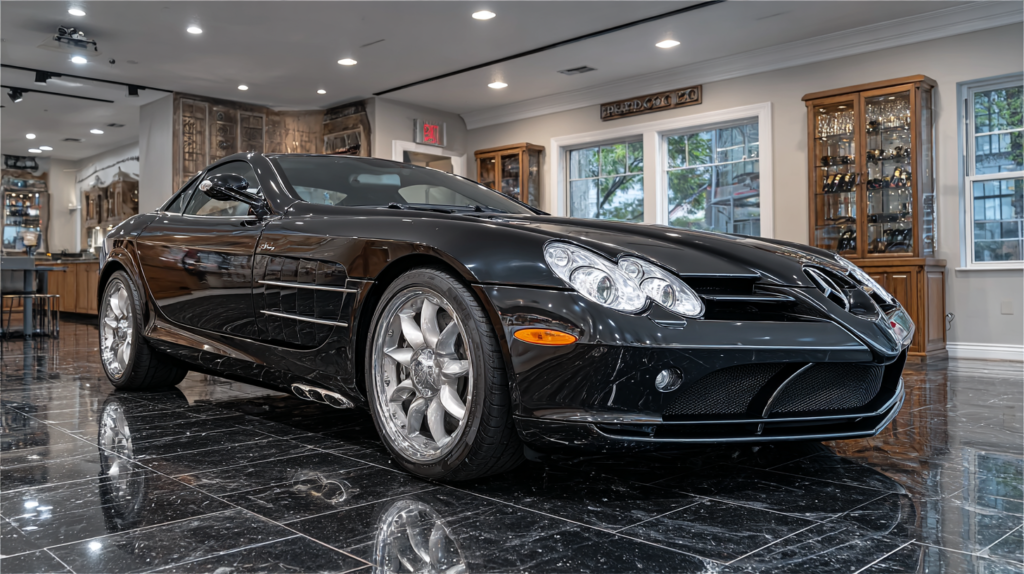
The SLR’s most distinctive design feature is its long nose. The hood extends far forward, giving the car a dramatic, aggressive profile. The long nose was a design reference to the 300 SLR race car, and it also provided aerodynamic benefits.
Design
Exterior Styling
The SLR’s exterior was designed by Mercedes-Benz’s design team, led by Gorden Wagener. The design is dramatic and distinctive, with a long nose, prominent grille, and side exhaust outlets.
The front end features a silver grille with chrome vertical slats, a reference to the 300 SLR. The headlights are slim and integrated into the bodywork. The hood has a central vent that extracts hot air from the engine bay.
The side profile shows the long nose, the side exhaust outlets, and the curved roofline. The side exhaust outlets are a distinctive feature, directing hot gases away from the body.
The rear end is characterized by the active rear wing, the quad exhaust outlets, and the diffuser.
Interior Design
The interior of the SLR is luxurious and driver-focused. The seats are power-adjustable with heating. The dashboard features a digital instrument cluster with a central speedometer. The central infotainment screen is small by modern standards.
The interior is finished in high-quality materials, including leather, Alcantara, and carbon fiber. The steering wheel is a three-spoke unit with paddle shifters.
The SLR Stirling Moss
Mercedes produced a limited edition variant of the SLR called the SLR Stirling Moss. Named for the legendary driver, the Stirling Moss was a roadster with no roof, no windshield, and no side windows. It was a pure, unfiltered driving machine.
Only 75 units of the Stirling Moss were built. It is the rarest and most valuable SLR variant.
Driving Experience
On Road Character
The SLR is a car that is best appreciated on long, high-speed journeys. The engine produces abundant torque from low rpm, making it effortless to accelerate. The ride is firm but compliant, and the cabin is quiet at highway speeds.
The automatic transmission is smooth in normal driving, but it can feel slow when using the paddle shifters. The car is heavy, and it does not change direction as quickly as lighter supercars.
On Track Behavior
The SLR is not a track car. Its weight and its automatic transmission make it less engaging on a circuit than dedicated track cars. However, it is stable and predictable at high speeds, and the brakes provide consistent stopping power.
The Sound
The supercharged V8 engine’s sound is distinctive. The engine produces a deep, muscular rumble at low speeds and a sharp, aggressive roar at full throttle. The supercharger adds a whine that is characteristic of forced induction engines.
Rarity and Exclusivity
Production Numbers
Mercedes built approximately 1,400 units of the SLR coupe, 600 units of the SLR roadster, and 75 units of the SLR Stirling Moss. Total production was approximately 2,075 units.
Pricing
The SLR carried a base price of approximately $450,000 when new. Today, well-maintained examples trade for $500,000 to $700,000, depending on the variant.
Collector Status
The SLR is a sought-after collector car. Its status as a collaboration between Mercedes and McLaren, its carbon fiber construction, and its distinctive design have made it a favorite among collectors.
How the SLR Stacks Up Against Modern Rivals
Against the Mercedes-AMG GT Black Series
The Mercedes-AMG GT Black Series is a track-focused sports car with a 4.0 liter twin-turbocharged V8 producing 720 horsepower.
The GT Black Series’s advantage is its performance and its handling. The modern car is faster, more agile, and more engaging to drive.
The SLR’s advantage is its heritage and its design. The SLR was a pioneer, and its long nose and side exhausts remain distinctive.
Against the McLaren GT
The McLaren GT is a grand tourer with a 4.0 liter twin-turbocharged V8 producing 612 horsepower.
The McLaren GT’s advantage is its weight and its handling. The modern McLaren is lighter and more agile than the SLR.
The SLR’s advantage is its supercharged V8 and its design. The SLR’s engine has a different character than the McLaren’s twin-turbo V8.
Against the Ferrari 812 Superfast
The Ferrari 812 Superfast is a front-engine V12 grand tourer with 789 horsepower.
The 812’s advantage is its power and its refinement. The Ferrari produces 172 more horsepower than the SLR, and its interior is more modern.
The SLR’s advantage is its carbon fiber monocoque and its supercharged V8. The SLR was a pioneer, and its construction was ahead of its time.
Against the Porsche 911 Turbo S
The Porsche 911 Turbo S is a rear-engine, all-wheel-drive sports car with 640 horsepower.
The 911’s advantage is its performance and its daily usability. The Porsche is faster, more agile, and more practical.
The SLR’s advantage is its grand touring character. The SLR is designed for long, high-speed journeys, and it excels at that mission.
The SLR’s Legacy
A Pioneer
The SLR was a pioneer. It was one of the first production cars to use a carbon fiber monocoque. It was one of the first to use carbon ceramic brakes. It predicted the future of supercar engineering.
A Grand Tourer
The SLR was designed as a grand tourer, not a track car. It prioritized high-speed comfort and long-distance capability over lap times. This mission sets it apart from many modern supercars, which are increasingly track-focused.
A Design Icon
The SLR’s design remains distinctive. The long nose, the side exhaust outlets, and the silver grille are instantly recognizable. The car has aged well, and it still looks modern today.
Specifications Summary
| Specification | Value |
|---|---|
| Engine | 5.4L supercharged V8 |
| Horsepower | 617 hp at 6,500 rpm |
| Torque | 575 lb-ft from 3,250 to 5,000 rpm |
| Transmission | 5-speed automatic |
| Drive | Rear wheel drive |
| 0-60 mph | 3.6 seconds |
| Top Speed | 208 mph |
| Weight | 1,570 kg |
| Production | Approximately 2,075 units |
| Base Price | $450,000 |
Conclusion
The Mercedes SLR McLaren was a supercar ahead of its time. It was one of the first production cars to use a carbon fiber monocoque, one of the first to use carbon ceramic brakes, and one of the first to combine grand touring comfort with supercar performance. Its supercharged V8 engine produced 617 horsepower, its design was dramatic and distinctive, and its engineering was ambitious.
The SLR was not a perfect car. Its automatic transmission was not as engaging as the dual-clutch transmissions that would follow. Its weight made it less agile than lighter supercars. But it was a pioneer, and it predicted the future of supercar engineering.
The SLR also represents a unique moment in automotive history. It was the result of a collaboration between Mercedes and McLaren, two companies with deep motorsport pedigrees. It honored the 300 SLR race car, and it established a template for modern grand tourers.
Today, the SLR is a sought-after collector car. Its carbon fiber construction, its supercharged V8, and its distinctive design have made it a favorite among enthusiasts. It remains unique, a car that was ahead of its time and that still stands out today.
The Mercedes SLR McLaren is a supercar that was ahead of its time, and it will forever be remembered as a pioneering machine.

