
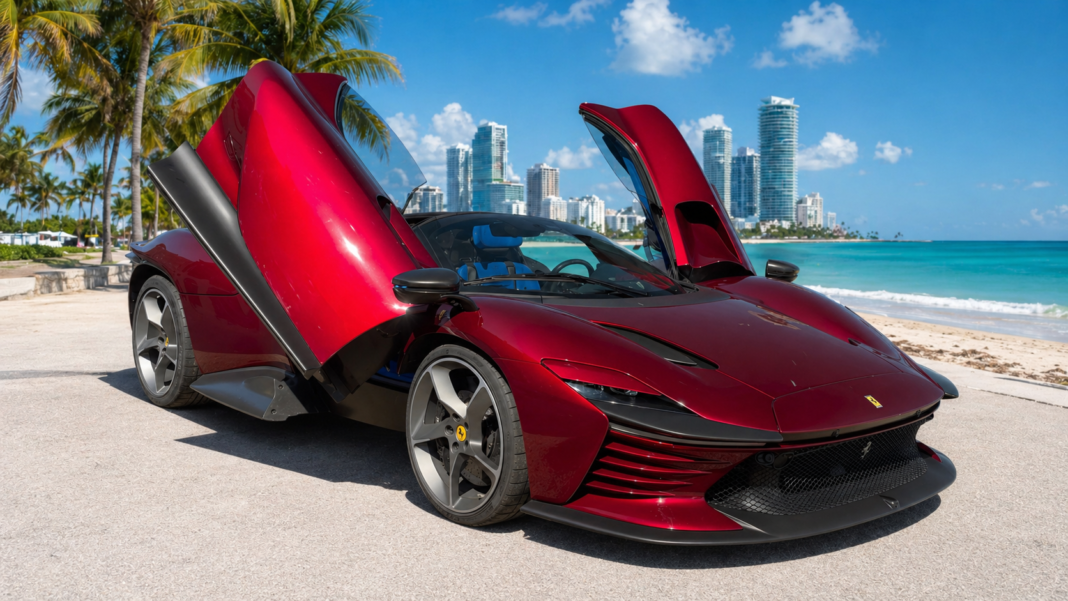
The Ferrari Daytona SP3 is a car that looks backward and forward simultaneously. It honors Ferrari’s racing heritage, specifically the legendary 1967 Daytona 24 Hours victory where a Ferrari 330 P4 finished first, second, and third. Yet it is a thoroughly modern machine, with a 6.5 liter naturally aspirated V12 engine producing 828 horsepower, a carbon fiber chassis, and advanced aerodynamics. It is one of the most beautiful cars Ferrari has ever built, and it represents the pinnacle of the brand’s internal combustion engineering.
Introduced in 2021 as the third model in Ferrari’s Icona series, following the Monza SP1 and SP2, the Daytona SP3 is a limited edition supercar that pays tribute to Ferrari’s sports racing prototypes of the 1960s. Only 599 units were built, and all were sold before the car was revealed.
This article provides a comprehensive examination of the Ferrari Daytona SP3, including its design inspiration, V12 engine, performance, engineering, and why it is a fitting tribute to Ferrari’s racing heritage.
The Icona Series
Ferrari’s Icona series is a line of limited edition cars that reinterpret classic Ferrari designs for the modern era. The first Icona models were the Monza SP1 and SP2, which paid tribute to the barchettas of the 1950s. The Daytona SP3 is the third Icona model, and it honors the sports racing prototypes of the 1960s.
The Icona series allows Ferrari’s designers to create cars that are not constrained by the requirements of volume production. The cars are more expressive, more dramatic, and more focused on aesthetics than Ferrari’s regular models.
The Daytona Name
The Daytona name refers to the 1967 Daytona 24 Hours race, where Ferrari scored one of its most significant victories. The Ferrari 330 P4, driven by Lorenzo Bandini and Chris Amon, finished first, with the 330 P3/4 of Mike Parkes and Ludovico Scarfiotti finishing second, and the 330 P4 of Peter Sutcliffe and David Piper finishing third. It was a clean sweep, and it cemented Ferrari’s dominance in sports car racing.
The Daytona SP3 is named after this victory. The number 3 in the name refers to the three cars that finished on the podium.
Design Inspiration
The 330 P4
The primary design inspiration for the Daytona SP3 is the Ferrari 330 P4, the car that won the 1967 Daytona 24 Hours. The 330 P4 was a stunningly beautiful car, with a low, wide body, a curved glass canopy over the cockpit, and a distinctive fastback tail.
The Daytona SP3’s design echoes these elements. The car has a low, wide stance, a curved glass canopy over the driver and passenger, and a fastback tail with a prominent rear wing.
The 350 Can Am
The Daytona SP3 also draws inspiration from the 350 Can Am, a Ferrari sports prototype that competed in the Can-Am series in the late 1960s. The 350 Can Am had a more aggressive, aerodynamic shape than the 330 P4, with large air intakes and a prominent rear wing.
The Daytona SP3’s side air intakes and rear wing are influenced by the 350 Can Am.
The 512 S
The 512 S, a Ferrari sports prototype from 1970, also influenced the Daytona SP3’s design. The 512 S had a long, low body and a distinctive front end with prominent fenders.
The Daytona SP3’s front end, with its prominent fenders and low nose, echoes the 512 S.
Exterior Design
Proportions
The Daytona SP3 has classic sports prototype proportions: a long, low body, a cockpit positioned far back, and a short rear deck. The car measures 4,700 mm in length, 1,985 mm in width, and 1,140 mm in height. The wheelbase is 2,650 mm.
The car’s most distinctive feature is the curved glass canopy over the cockpit. The canopy is made of a single piece of glass, sweeping from the windshield to the rear. It is a design element that directly references the 330 P4.
The Front End
The front end features prominent fenders that rise above the hood, a design element that references the 512 S. The headlights are slim and integrated into the fenders. The grille is a reinterpretation of the classic Ferrari grille, with a mesh pattern that references the 330 P4.
The front splitter is prominent, and there are large air intakes in the front bumper.
The Side Profile
The side profile shows the curved glass canopy, the large side air intakes, and the prominent rear haunches. The side intakes are shaped to feed cooling air to the engine and brakes.
The doors open upward in a butterfly configuration, providing access to the cabin.
The Rear End
The rear end is characterized by a prominent rear wing that spans the width of the car. The wing is fixed, and it is made of carbon fiber. The rear diffuser is large and complex, with multiple channels. The taillights are slim and integrated into the bodywork.
The quad exhaust outlets are positioned high, a design element that references the 330 P4.
The V12 Engine
Engine Specifications
The Daytona SP3 is powered by a 6.5 liter naturally aspirated V12 engine, designated the F140 HC. This engine is a development of the unit that powered the 812 Superfast and the 812 Competizione. It produces 828 horsepower at 9,250 rpm and 514 lb-ft of torque at 7,250 rpm. The redline is 9,500 rpm.
The specific output is 127 horsepower per liter, a figure that is remarkable for a naturally aspirated engine of this size.
The Sound
The V12 engine’s sound is one of the Daytona SP3’s defining characteristics. The engine produces a high-pitched wail as the revs climb toward the 9,500 rpm redline. The sound is sharp, urgent, and deeply satisfying, with a quality that distinguishes it from every other production engine.
Transmission
Power is transmitted to the rear wheels through a seven-speed dual-clutch transmission. The transmission is mounted at the rear of the car in a transaxle configuration, contributing to the car’s weight distribution.
Performance
Acceleration and Speed
The Daytona SP3 accelerates from 0 to 62 miles per hour in 2.85 seconds. The 0 to 124 miles per hour sprint takes approximately 7.4 seconds. Top speed is 211 miles per hour (340 kilometers per hour).
Weight and Balance
The Daytona SP3 has a dry weight of approximately 1,485 kilograms (3,274 pounds). The weight distribution is 44 percent front, 56 percent rear.
Chassis and Engineering
Carbon Fiber Monocoque
The Daytona SP3 is built around a carbon fiber monocoque, providing exceptional rigidity and occupant protection while minimizing weight. The monocoque is derived from the LaFerrari’s, but it has been modified for the SP3’s unique body.
The body panels are also carbon fiber. The dry weight is 1,485 kilograms.
Suspension
The Daytona SP3 features double-wishbone suspension at all four corners, with pushrod-actuated dampers. This configuration, derived from Formula 1, allows for precise control over wheel motion and reduces unsprung weight.
The suspension is adjustable, with settings for ride height and damping.
Brakes
The braking system uses carbon ceramic discs with six-piston calipers at the front and four-piston calipers at the rear. The system provides exceptional stopping power, with consistent pedal feel and resistance to fade.
Wheels and Tires
The Daytona SP3 rides on 20-inch front wheels and 21-inch rear wheels, wrapped in specially developed tires. The front tires are 265/30 ZR20, and the rear tires are 345/30 ZR21.
Interior Design
Driver Focus
The interior of the Daytona SP3 is focused on the driver. The seats are carbon fiber racing buckets with leather and Alcantara upholstery, providing lateral support during cornering. The seats are fixed in position, with the pedal box adjustable.
The dashboard features a digital instrument cluster with a central tachometer and auxiliary gauges. The steering wheel is a Formula 1-inspired unit with integrated controls for the car’s systems.
The passenger has a dedicated display that shows vehicle information.
Materials
The interior materials are of the highest quality. The leather is sourced from premium tanneries, and the Alcantara is applied with care. The carbon fiber trim is finished to show its weave. The metal accents are machined from solid aluminum.
Customization
The Daytona SP3 is highly customizable through Ferrari’s Tailor Made program. Buyers can specify unique colors, materials, and details. Each of the 599 cars is unique.
Rarity and Exclusivity
Production Numbers
Ferrari built 599 units of the Daytona SP3. All units were sold before the car was revealed.
Pricing
The Daytona SP3 carried a base price of approximately $2.3 million. This pricing placed it in the same tier as limited edition Ferraris like the Monza SP1 and SP2.
Collector Status
The Daytona SP3 is one of the most sought-after modern Ferraris. Its limited production numbers, its status as an Icona series model, and its stunning design have made it a prized collector car.
How the Daytona SP3 Stacks Up Against Rivals
Against the Ferrari 812 Competizione
The 812 Competizione is a front-engine V12 grand tourer with 819 horsepower.
The Competizione’s advantage is its power and its refinement. The Competizione produces 9 less horsepower than the SP3, but it is more practical for daily driving.
The SP3’s advantage is its design and its exclusivity. The SP3 is one of the most beautiful cars Ferrari has ever built, and it is significantly rarer than the Competizione.
Against the Lamborghini Countach LPI 800-4
The Lamborghini Countach LPI 800-4 is a limited edition hybrid supercar that pays tribute to the Countach, with a 6.5 liter V12 and a supercapacitor hybrid system producing 802 horsepower.
The Countach’s advantage is its hybrid technology and its name. The Countach name carries significant weight, and the hybrid system provides instant torque.
The SP3’s advantage is its naturally aspirated V12 and its design. The Ferrari’s engine revs higher and produces a more distinctive sound, and its design is more elegant.
Against the Porsche 911 GT3
The Porsche 911 GT3 is a track-focused sports car with a 4.0 liter naturally aspirated flat-six producing 502 horsepower.
The GT3’s advantage is its weight and its handling. The Porsche is lighter and more agile than the SP3.
The SP3’s advantage is its power and its exclusivity. The Ferrari produces 326 more horsepower than the Porsche, and it is one of the rarest cars on the market.
A Tribute to Racing Heritage
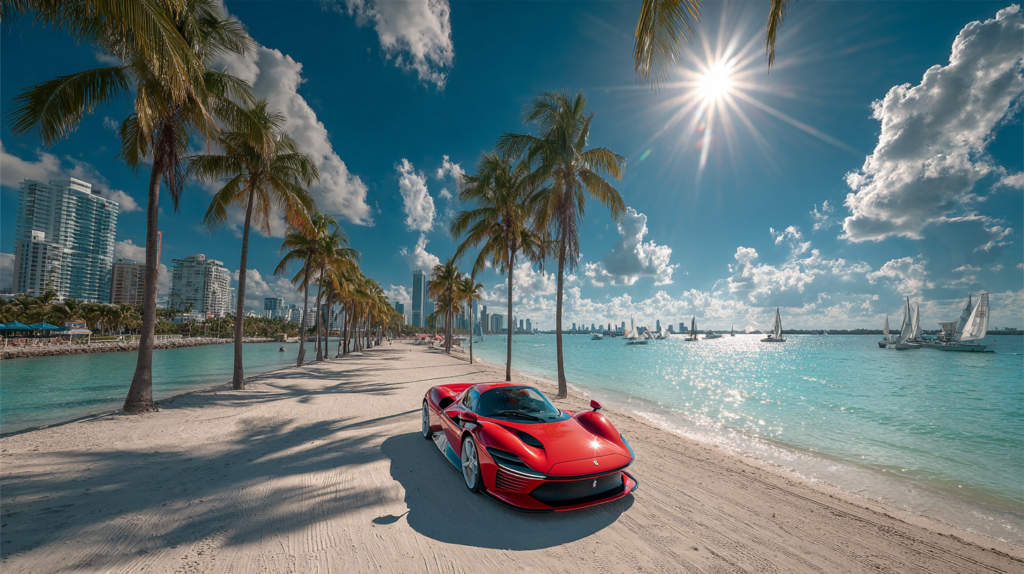
The Daytona SP3 is a tribute to Ferrari’s racing heritage. It honors the 1967 Daytona 24 Hours victory, but it also honors the era of sports prototype racing. The 1960s were a golden age for Ferrari, with victories at Le Mans, Daytona, and Sebring. The SP3 captures the spirit of that era.
The SP3 is also a tribute to the engineers and designers who created the 330 P4, the 350 Can Am, and the 512 S. These cars were among the most beautiful and successful racing cars ever built, and the SP3 is a fitting tribute.
Specifications Summary
| Specification | Value |
|---|---|
| Engine | 6.5L naturally aspirated V12 |
| Horsepower | 828 hp at 9,250 rpm |
| Torque | 514 lb-ft at 7,250 rpm |
| Redline | 9,500 rpm |
| Transmission | 7-speed dual-clutch |
| Drive | Rear wheel drive |
| 0-62 mph | 2.85 seconds |
| Top Speed | 211 mph |
| Weight | 1,485 kg dry |
| Production | 599 units |
| Base Price | $2.3 million |
Conclusion
The Ferrari Daytona SP3 is a car that honors the past while embracing the future. It is a tribute to the 1967 Daytona 24 Hours victory, and to the sports racing prototypes of the 1960s. Its design, with its curved glass canopy, prominent fenders, and fastback tail, is a modern interpretation of the 330 P4. Its 6.5 liter naturally aspirated V12, producing 828 horsepower and revving to 9,500 rpm, is one of the greatest engines ever built.
The Daytona SP3 is not a car for everyone. Its production is limited to 599 units, its price is $2.3 million, and its focus on aesthetics and performance means it lacks the practicality of other Ferraris. But for the 599 owners who acquired an SP3, the car offers something that no other vehicle can provide: the experience of driving a modern interpretation of a Ferrari racing legend.
The Daytona SP3 is a fitting tribute to Ferrari’s racing heritage. It is one of the most beautiful cars Ferrari has ever built, and it will forever be remembered as one of the greatest Ferraris of the modern era.

