
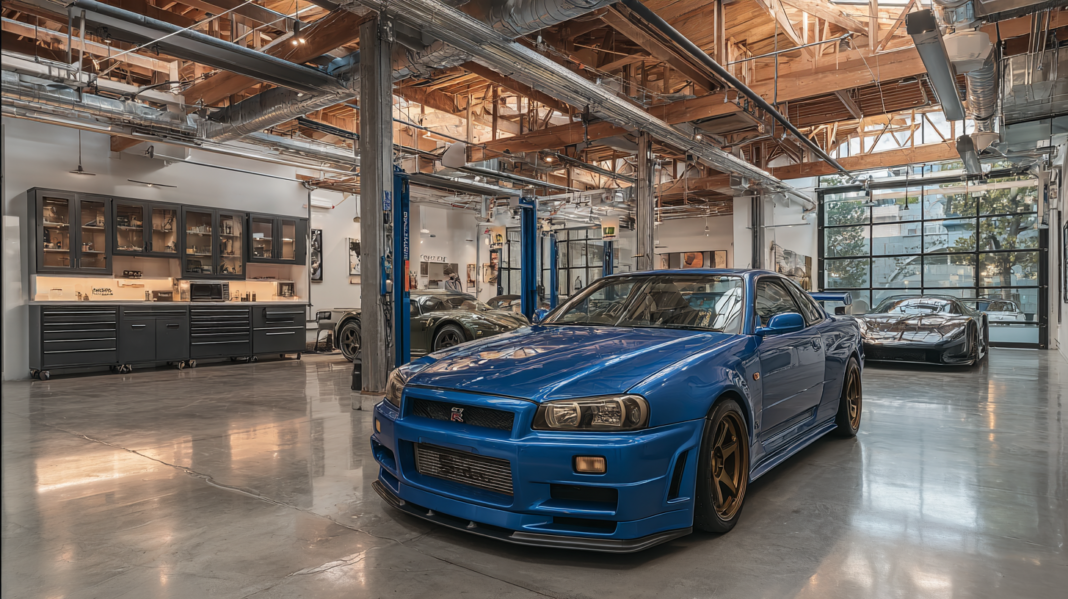
The Nissan Skyline GT-R R34 holds a unique position in automotive history. It is not merely a car; it is a cultural artifact, a technological benchmark, and a symbol of a golden era of Japanese performance engineering. Produced for only three years, from 1999 to 2002, the R34 was the final evolution of the Skyline GT-R lineage before the nameplate would be retired and later reborn as the standalone Nissan GT-R. It represents the peak of analog all-wheel-drive performance, combining raw mechanical engagement with sophisticated electronics.
Two decades after production ended, the R34 is more sought after than ever. Its starring role in the Fast and Furious franchise, its dominance in video games like Gran Turismo, and its reputation as a tuning legend have cemented its status as a global icon. This article explores the engineering, performance, cultural impact, and lasting legacy of the Nissan Skyline GT-R R34.
The Evolution of Godzilla
The GT-R legend began in 1969 with the PGC10 “Hakosuka.” After a long hiatus, the nameplate was resurrected in 1989 with the R32. The R32 earned the “Godzilla” nickname by dominating Australian touring car racing, winning 29 races from 29 starts. Its ATTESA E-TS all-wheel-drive system was revolutionary.
The R33, introduced in 1995, was larger and more refined. While some critics considered it softer than the R32, the R33 Nürburgring package proved its capability by setting a lap time at the Nürburgring that was faster than many exotics of the era, including the Ferrari F50.
When the R34 arrived in 1999, Nissan engineers addressed the criticisms of the R33. The result was a car that was shorter, stiffer, and more visually aggressive. It combined the raw edge of the R32 with the refined technology of the R33, creating the definitive modern Skyline.
The RB26DETT Engine
The heart of the R34 is the legendary RB26DETT engine. This 2.6 liter inline-six features twin turbochargers, individual throttle bodies, and a cast-iron block. Under the Japanese “gentleman’s agreement,” it was officially rated at 276 horsepower, but actual output was closer to 320 horsepower.
The engine’s true genius lies in its robustness. The cast-iron block can withstand immense power, and aftermarket support for the RB26 is massive. It is common to find R34s tuned to 600, 800, or even 1,000 horsepower with modifications to the turbos, fuel system, and engine management.
The individual throttle bodies are a rarity for turbocharged engines. Each cylinder has its own throttle butterfly, dramatically improving throttle response. This gives the R34 a sharp, immediate feel when the driver steps on the gas, a characteristic that distinguishes it from many modern turbocharged cars.
Sequential Turbocharging
The RB26 uses a sequential turbocharger system. A smaller primary turbo spools quickly to provide low-end torque, while a larger secondary turbo takes over in the mid-range. There is a distinct surge of power as the second turbo comes online, rewarding the driver who keeps the revs high.
ATTESA E-TS Pro All-Wheel Drive
The handling of the R34 is defined by the ATTESA E-TS Pro system. Unlike traditional all-wheel-drive systems that are always sending power to both axles, ATTESA E-TS is primarily rear-wheel drive. It uses electronic sensors to detect loss of traction at the rear wheels and instantly routes power to the front wheels via a computer-controlled clutch pack.
The “Pro” version in the R34 V-Spec added an Active Rear Differential. This mechanical limited-slip differential could actively vary torque between the left and right rear wheels, further enhancing cornering grip and reducing understeer.
The result is a car that launches hard from a standstill without wheelspin but rotates like a rear-wheel-drive car when the driver lifts off the throttle mid-corner. This duality is what makes the R34 so rewarding to drive quickly.
Transmission
The R34 was offered exclusively with a six-speed manual transmission. The previous R33 used a five-speed, so the extra gear was a welcome improvement for highway cruising and performance driving. The gearbox is robust, though it can feel notchy compared to modern units. The clutch is heavy, as expected from a performance car of this era.
Aerodynamics and Styling
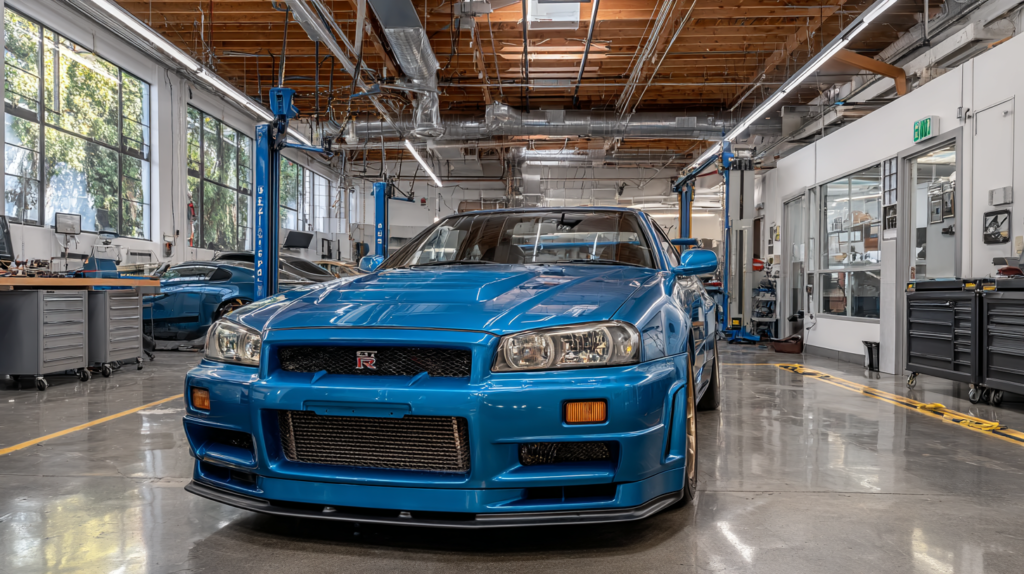
The R34 is widely regarded as the best-looking of all the Skyline GT-Rs. Its styling is boxy, aggressive, and purposeful. Unlike the softer curves of the R33, the R34 features sharp lines, a massive front grille, and a distinctive rear wing.
The V-Spec models included functional aerodynamic upgrades, including a rear diffuser under the bumper and NACA ducts on the hood. The signature round taillights, a fixture on Skylines, were set into a flat panel that stretched across the entire rear width, giving the car a planted, wide stance.
The front bumper is low and aggressive, housing large fog lights and intakes. The fenders bulge significantly to cover the wide track. The car looks like a race car homologated for the street.
Interior and the MFD Screen
The R34’s interior is utilitarian but distinctive. The seats are supportive but not overly aggressive. The pedals are drilled aluminum. The short-throw shifter sits high on the center console.
The defining feature of the interior is the Multi-Function Display (MFD). This small digital screen, mounted in the center of the dashboard, was groundbreaking for 1999. It provides real-time data on:
- Turbocharger boost pressure
- Oil and water temperature
- Front and rear torque distribution
- G-force meter
- Lap timer
This display gave the driver access to information usually reserved for race cars, reinforcing the R34’s image as a technology leader.
The R34 V-Spec Models
The standard GT-R was very capable, but the V-Spec (Victory Specification) models added key performance hardware.
V-Spec: Added the Active Rear Differential, stiffer suspension, and a lower ride height.
V-Spec II: Added a larger carbon fiber rear wing, a carbon fiber hood, and aluminum pedals.
V-Spec II Nür: A limited edition named after the Nürburgring. It featured a more aggressive camshaft profile, upgraded turbocharger system allowing for higher output, a unique exhaust, and a special two-tone interior.
The M-Spec (Midnight) model focused on comfort, with softer suspension and leather seats, appealing to the grand touring side of the R34.
Cultural Impact
The R34 is the most famous Japanese car in pop culture, largely due to the Fast and Furious franchise. The silver and blue R34 driven by Brian O’Conner in 2 Fast 2 Furious (2003) and later Fast & Furious (2009) became an icon. The aggressive body kit and the sound of the RB26 imprinted the R34 onto the consciousness of millions who had never seen a Japanese sports car before.
Beyond film, the R34 was a star of the Gran Turismo video game series. For many young enthusiasts, their first experience “driving” an R34 was on a PlayStation, mastering the complex corners of Trial Mountain.
Its role in Japanese drifting culture (via the Initial D manga and anime) and Australian touring car racing further cemented its legendary status.
Driving the R34 Today
Driving an R34 today is a visceral, analog experience. The hydraulic power steering is heavy. The ride is firm, transmitting road imperfections directly to the driver. The engine is noisy, the road noise is significant, and the transmission whines.
This lack of modern insulation and electronic nannies provides a level of feedback that is missing from modern sports cars. The driver feels everything.
The sequential turbochargers provide a unique power delivery. There is a distinct surge as the second turbo comes online, pulling hard to the redline. The R34 rewards drivers who keep the revs high.
The R34 is not a car for commuting. The clutch is tiring in stop-and-go conditions, and the turning circle is poor. But on a winding road or an open track, it is one of the most communicative and rewarding cars ever made.
Rarity and Collectability
The R34 GT-R was produced in limited numbers. Total production of the R34 generation is estimated at approximately 12,000 units, including all variants.
The 25-year import rule in the United States meant that R34s were largely unavailable to American enthusiasts until the 2020s. This pent-up demand, combined with the car’s iconic status, has driven prices to extraordinary heights.
V-Spec II and Nür models command the highest prices, often exceeding $300,000 for low-mileage examples. Even standard GT-Rs sell for well over $100,000.
Specifications Summary
| Specification | Value |
|---|---|
| Engine | 2.6L twin-turbo inline-six (RB26DETT) |
| Horsepower | 276 hp (factory rating) |
| Torque | 260 lb-ft |
| Transmission | 6-speed manual |
| Drive | ATTESA E-TS Pro all-wheel drive |
| 0-60 mph | Approximately 4.9 seconds |
| Top Speed | Approximately 156 mph |
| Weight | Approximately 1,540 kg |
| Production Years | 1999 to 2002 |
Conclusion
The Nissan Skyline GT-R R34 is more than a car. It is a cultural artifact, a technological marvel of its time, and a driver’s machine that analog enthusiasts revere. It arrived at the perfect moment, just before the automotive industry began its shift toward electronic power steering, dual-clutch transmissions, and hybrid powertrains.
Its RB26 engine is tunable to absurd levels. Its ATTESA all-wheel-drive system remains impressive today. Its styling is aggressive and timeless. Its role in film and video games ensured that a generation of car lovers would dream of owning one.
As the R34 becomes legal to import into more countries, its legend continues to grow. It is the final link to a golden era of Japanese performance cars, a time when Nissan, Toyota, Honda, Mitsubishi, and Subaru were locked in a horsepower war that produced some of the most beloved cars in history.
The Nissan Skyline GT-R R34 is the definitive Godzilla, a car that earned its legacy on the track and in the hearts of enthusiasts worldwide. It will forever be remembered as one of the greatest performance cars ever built.

