

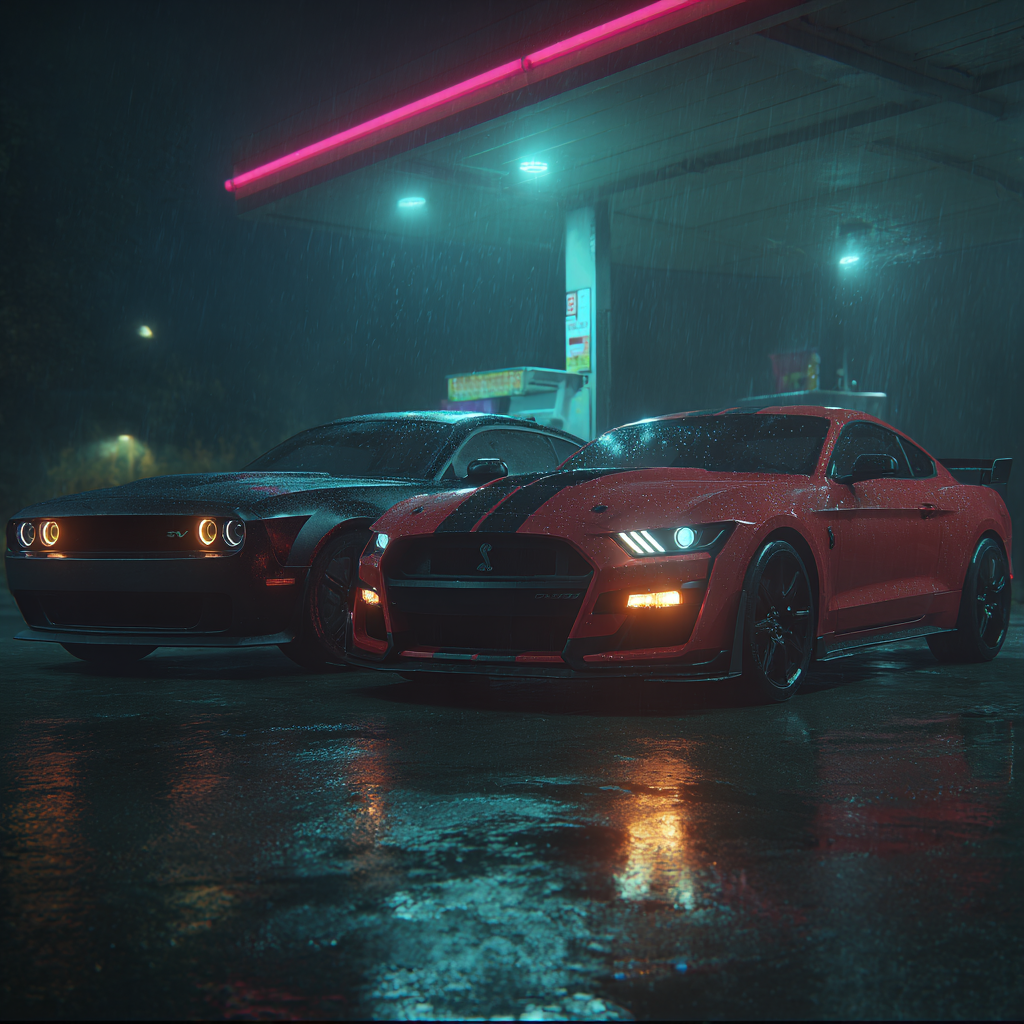
The argument between Dodge and Ford fans has lasted for decades. But the current generation of muscle cars has raised the stakes. The Dodge Challenger Hellcat and the Ford Mustang Shelby GT500 both produce more than 700 horsepower. Both are capable of running the quarter mile in the mid ten second range. Both are the final expressions of the traditional American muscle car before the industry shifts to electrification.
The Hellcat is a supercharged 6.2 liter V8 producing up to 807 horsepower in its most extreme form. The GT500 is a supercharged 5.2 liter V8 producing 760 horsepower. The Hellcat is a heavy, comfortable cruiser. The GT500 is a lighter, more track focused machine.
This article compares the Dodge Challenger Hellcat and the Ford Mustang Shelby GT500 across performance, design, daily usability, and value to determine which muscle car wins on paper and in your driveway.
The Contenders: Two American Icons
Dodge Challenger Hellcat Redeye
The Challenger Hellcat is the ultimate expression of Dodge’s muscle car philosophy. The Redeye variant produces 797 horsepower. The Super Stock produces 807 horsepower. The car is large, heavy, and comfortable. It is designed for drag strip dominance and highway cruising.
Ford Mustang Shelby GT500
The Shelby GT500 is Ford’s most powerful production car. The supercharged 5.2 liter V8 produces 760 horsepower. The car features a dual clutch transmission, adaptive suspension, and a track focused chassis. It is designed to be as capable on a road course as it is on the drag strip.
Powertrain and Performance
Dodge Challenger Hellcat Redeye
The Hellcat’s 6.2 liter supercharged V8 is a simple, effective engine. The supercharger provides massive low end torque, and the power delivery is linear and predictable.
- Displacement: 6.2 liters
- Configuration: Supercharged V8
- Horsepower: 797 hp (Redeye)
- Torque: 707 lb-ft (Redeye)
- Transmission: 8-speed automatic
- Drive: Rear wheel drive
- 0-60 mph: 3.5 seconds
- Quarter mile: 10.8 seconds at 131 mph
- Top Speed: 203 mph
- Curb Weight: 4,200 lb
Ford Mustang Shelby GT500
The GT500’s 5.2 liter supercharged V8 features a cross-plane crank and a high revving character. The dual clutch transmission provides rapid shifts and allows for launch control.
- Displacement: 5.2 liters
- Configuration: Supercharged V8
- Horsepower: 760 hp
- Torque: 625 lb-ft
- Transmission: 7-speed dual-clutch
- Drive: Rear wheel drive
- 0-60 mph: 3.3 seconds
- Quarter mile: 10.6 seconds at 133 mph
- Top Speed: 180 mph (limited)
- Curb Weight: 4,100 lb
Performance Verdict
The GT500 is slightly quicker to 60 miles per hour and through the quarter mile. The dual clutch transmission provides faster shifts, and the lighter weight gives it an advantage.
However, the Hellcat produces more torque, and its simpler automatic transmission is more consistent for drag racing. On a prepared drag strip, the two cars are closely matched.
Chassis and Handling
Dodge Challenger Hellcat
The Challenger is built on a large sedan platform. The suspension is tuned for comfort, not cornering. The car is heavy, and it does not hide its weight. Body roll is significant, and the steering is numb. The Hellcat is not a track car.
Ford Mustang Shelby GT500
The Mustang is lighter and more agile. The suspension is adaptive, with settings for comfort and track use. The car corners flat, and the steering provides good feedback. The GT500 is capable on a road course, with lap times that rival dedicated sports cars.
Handling Verdict
The GT500 is the clear winner for handling. It is more agile, more responsive, and more capable on a track. The Hellcat is a straight line specialist.
Design and Styling
Dodge Challenger Hellcat
The Challenger’s design is retro, referencing the 1970 Challenger. The body is wide and muscular, with a prominent grille and a long hood. The rear end features a full width taillight. The design has aged well, but it is not contemporary.
Ford Mustang Shelby GT500
The Mustang’s design is more aggressive and modern. The front end features a massive grille and prominent air intakes. The side profile shows the fastback roofline and the muscular haunches. The rear end features a prominent wing and quad exhaust outlets.
Design Verdict
The GT500 is the more aggressive and contemporary design. The Hellcat is more classic and retro. The choice depends on personal taste.
Interior and Daily Usability
Dodge Challenger Hellcat
The Challenger’s interior is spacious and comfortable. The seats are large and supportive, and there is ample headroom and legroom for four adults. The trunk is large enough for luggage and groceries. The infotainment system is simple and functional.
Ford Mustang Shelby GT500
The Mustang’s interior is smaller and more cramped. The rear seats are usable only for children. The trunk is smaller than the Challenger’s. The infotainment system is more advanced, with a larger screen and more features.
Usability Verdict
The Challenger is the more practical daily driver. It is more comfortable, more spacious, and easier to live with. The GT500 is less practical, but it is more engaging.
Driving Experience
On the Road
The Hellcat is a relaxed cruiser. The ride is smooth, the engine is quiet at low speeds, and the cabin is comfortable. The car is easy to drive slowly.
The GT500 is more intense. The ride is firm, the engine is louder, and the dual clutch transmission is more aggressive. The car demands attention even at low speeds.
On the Drag Strip
Both cars are exceptional. The Hellcat’s automatic transmission is consistent, and the car launches hard. The GT500’s dual clutch transmission provides rapid shifts, and the launch control system is effective.
On a Road Course
The GT500 is the clear winner. The Hellcat is heavy and unresponsive. The GT500 is lighter, more agile, and more capable.
The Sound
The Hellcat’s supercharged V8 produces a deep, guttural roar. The supercharger whine is distinctive and addictive.
The GT500’s V8 produces a higher pitched, more aggressive note. The flat-plane crank gives it a character that is closer to a European supercar.
Value and Ownership
Pricing
The Dodge Challenger Hellcat Redeye has a base price of approximately $80,000. The Ford Mustang Shelby GT500 has a base price of approximately $75,000. The GT500 is less expensive.
Depreciation
Both cars hold their value well. The Hellcat’s production numbers are higher, which may affect long term value. The GT500 is rarer, and it may appreciate in the future.
Ownership Costs
Both cars are expensive to maintain. Tires and brakes wear quickly, and fuel consumption is high. The GT500’s dual clutch transmission requires specialized service.
Which One Wins on Paper?
On paper, the Ford Mustang Shelby GT500 is the better car. It is quicker, faster, more agile, and less expensive. It is the more modern and capable machine.
The Dodge Challenger Hellcat is the older car, and it shows its age. It is heavy, inefficient, and less capable in corners.
Which One Wins in Your Driveway?
The answer depends on what you want from a muscle car.
Choose the Dodge Challenger Hellcat if:
- You want a comfortable cruiser for the highway. The Hellcat is relaxed and easy to drive.
- You need rear seat space and trunk space. The Challenger is the more practical car.
- You love the retro styling and the supercharger whine. The Hellcat is a classic.
- You plan to drag race. The Hellcat is consistent and capable.
Choose the Ford Mustang Shelby GT500 if:
- You want a car that can do it all. The GT500 is fast in a straight line and capable on a track.
- You value modern technology and performance. The GT500 is the more advanced car.
- You want a more aggressive and contemporary design.
- You plan to drive on road courses.
Specifications Summary
| Specification | Dodge Challenger Hellcat Redeye | Ford Mustang Shelby GT500 |
|---|---|---|
| Engine | 6.2L supercharged V8 | 5.2L supercharged V8 |
| Horsepower | 797 hp | 760 hp |
| Torque | 707 lb-ft | 625 lb-ft |
| Transmission | 8-speed automatic | 7-speed dual-clutch |
| 0-60 mph | 3.5 seconds | 3.3 seconds |
| Quarter mile | 10.8 seconds at 131 mph | 10.6 seconds at 133 mph |
| Top Speed | 203 mph | 180 mph |
| Weight | 4,200 lb | 4,100 lb |
| Base Price | $80,000 | $75,000 |
Conclusion
The Dodge Challenger Hellcat and the Ford Mustang Shelby GT500 are two of the greatest muscle cars ever built. They represent the peak of internal combustion performance before the industry shifts to electric power.
The GT500 is the better car on paper. It is quicker, faster, more agile, and less expensive. It is the more modern and capable machine.
The Hellcat is the better car for the driveway. It is more comfortable, more spacious, and easier to live with. It is the car that you can drive every day.
Which one wins the muscle wars? It depends on what you value most. If you want the fastest, most capable muscle car, choose the GT500. If you want the most comfortable, practical, and classic muscle car, choose the Hellcat.
Both produce enough tire smoke to block a freeway. Both are legends. And both prove that the muscle car is far from dead.

