
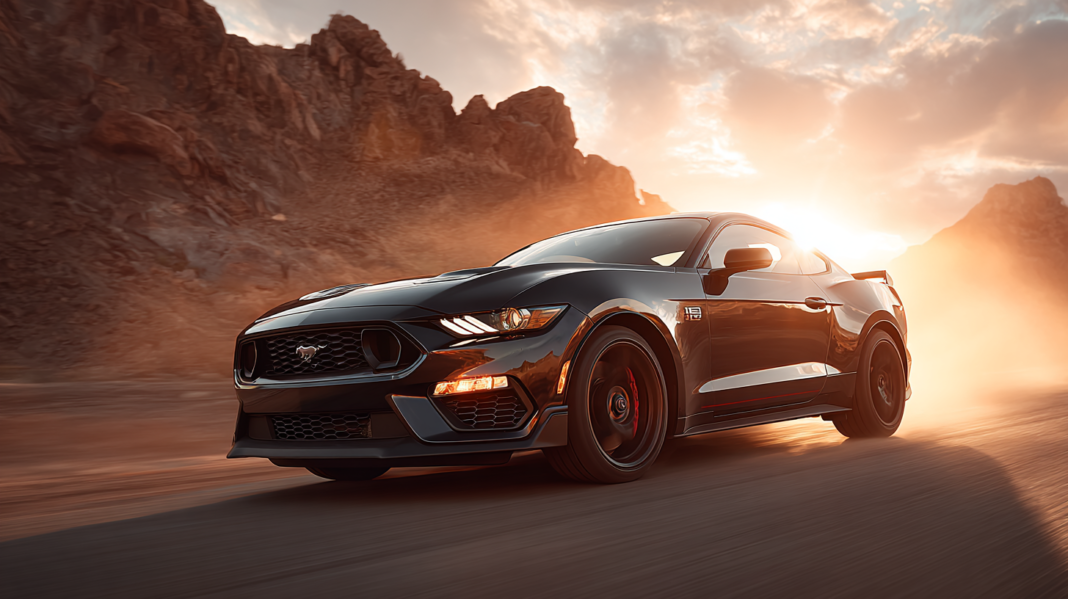
The Ford Mustang has been a fixture of the American automotive landscape for more than six decades. Through fuel crises, changing consumer preferences, and the rise of SUVs, the Mustang has endured. It has evolved from a sporty secretary’s car to a genuine performance machine, from a pony car to a global sports car. Throughout its history, one constant has remained: the V8 engine.
The Mustang Dark Horse represents the latest expression of this tradition. Introduced for the 2024 model year as a new performance tier above the GT, the Dark Horse is designed for enthusiasts who want a V8 powered, rear wheel drive sports car that prioritizes handling and track capability alongside straight line speed. It is the most track focused Mustang short of the Shelby GT500, and it arrives at a time when V8s are increasingly rare.
This article provides a comprehensive review of the Ford Mustang Dark Horse, examining its performance specifications, design philosophy, interior accommodations, and how it stacks up against rivals in performance, design, and value.
The Mustang Legacy: More Than Six Decades of V8 Power
The Ford Mustang debuted in April 1964, creating the pony car segment and capturing the imagination of a generation. The V8 engine was available from the beginning, with a 4.7 liter unit producing 210 horsepower. Over the following decades, the Mustang’s V8 evolved, gaining power, sophistication, and character.
The current generation Mustang, introduced for the 2024 model year, represents the seventh generation of the nameplate. It retains the front engine, rear wheel drive layout that has defined the Mustang from the beginning, while adding modern technology and refinement.
The Dark Horse is the new performance tier in the Mustang lineup, positioned between the GT and the Shelby GT500. It is designed for enthusiasts who want a car that can perform on track as well as on the street, with enhancements to the engine, chassis, aerodynamics, and cooling that make it capable of sustained high performance driving.
Powertrain and Performance
Engine Specifications
The Mustang Dark Horse is powered by a 5.0 liter naturally aspirated V8 engine, designated Coyote. This engine has been a mainstay of the Mustang lineup for years, but the Dark Horse receives a version with specific enhancements. The engine produces 500 horsepower at 7,250 rpm and 418 lb ft of torque at 4,900 rpm.
The enhancements for the Dark Horse include a revised intake manifold that improves airflow at high rpm, forged connecting rods and a forged crankshaft for increased durability, and upgraded oil and cooling systems that allow the engine to sustain performance during track use. The engine also features a dual throttle body intake system that improves throttle response.
Transmission Options
The Mustang Dark Horse is offered with two transmission choices: a six speed manual and a ten speed automatic. The manual transmission is the enthusiast’s choice, featuring a revised gearset and a short throw shifter that provides direct mechanical engagement. The transmission also includes rev matching capability, which can be enabled or disabled at the driver’s preference.
The ten speed automatic transmission is a conventional torque converter unit with paddle shifters. It is capable of rapid shifts and is tuned to keep the engine in its power band during spirited driving. For drivers who prioritize lap times or convenience, the automatic is the choice.
Acceleration and Speed
The Mustang Dark Horse accelerates from 0 to 60 miles per hour in 4.1 seconds with the manual transmission and 3.8 seconds with the automatic. The quarter mile is completed in approximately 12.2 seconds at 118 miles per hour with the manual and 11.9 seconds at 120 miles per hour with the automatic.
Top speed is 166 miles per hour for the manual and 168 miles per hour for the automatic. These figures place the Dark Horse among the quickest naturally aspirated V8 cars in its class.
Weight and Balance
The Mustang Dark Horse weighs approximately 3,800 pounds, a figure that reflects its size, V8 engine, and the structural reinforcements required for its performance. The weight distribution is approximately 53 percent front, 47 percent rear, reflecting the front engine layout.
The car’s curb weight is higher than some competitors, but the engine’s power and the chassis tuning compensate effectively.
Chassis and Dynamics
Suspension System
The Mustang Dark Horse features a double wishbone front suspension and a multi link rear suspension, both significantly revised for the Dark Horse model. The front suspension uses stiffer springs and revised damper tuning compared to the GT, while the rear suspension incorporates a unique toe link that improves cornering stability.
The car features MagneRide adaptive dampers as standard, a system that uses magnetorheological fluid to adjust damping characteristics in milliseconds. The system provides a range of behavior from compliant for daily driving to firm for track use.
Steering
The electric power steering is calibrated for the Dark Horse’s performance focus. The system provides appropriate weighting and feedback, with a level of communication that is good for an electric system. The steering ratio is quick, requiring minimal input to change direction.
Brakes
The braking system is one of the Dark Horse’s most significant upgrades over the GT. The car features 16.0 inch front discs with six piston Brembo calipers and 14.6 inch rear discs with four piston calipers. The front rotors are two piece units that reduce unsprung weight and improve heat dissipation.
This system provides exceptional stopping power, with consistent pedal feel and resistance to fade during track use. The brakes are capable of repeated hard stops without degradation, a critical feature for a car designed for track days.
Wheels and Tires
The Mustang Dark Horse rides on 19 inch forged aluminum wheels wrapped in high performance summer tires. The standard tires are Pirelli P Zero, with Michelin Pilot Sport Cup 2 tires available as part of the Handling Package. The tire sizes are 255/40 ZR19 front and 275/40 ZR19 rear, with the rear tires wider to manage the engine’s torque.
The Handling Package adds wider wheels and tires, with 305/30 ZR19 tires at all four corners, significantly increasing grip.
Aerodynamics
The Dark Horse features a specific aerodynamic package that distinguishes it from the GT. The front end incorporates a more aggressive splitter that directs air under the car, while the rear end features a large fixed wing that provides downforce at the rear axle. The side skirts are shaped to manage airflow along the flanks.
The car’s aerodynamic development focused on generating downforce without excessive drag. The result is a car that feels planted at high speeds and stable through corners.
Design
Exterior Styling
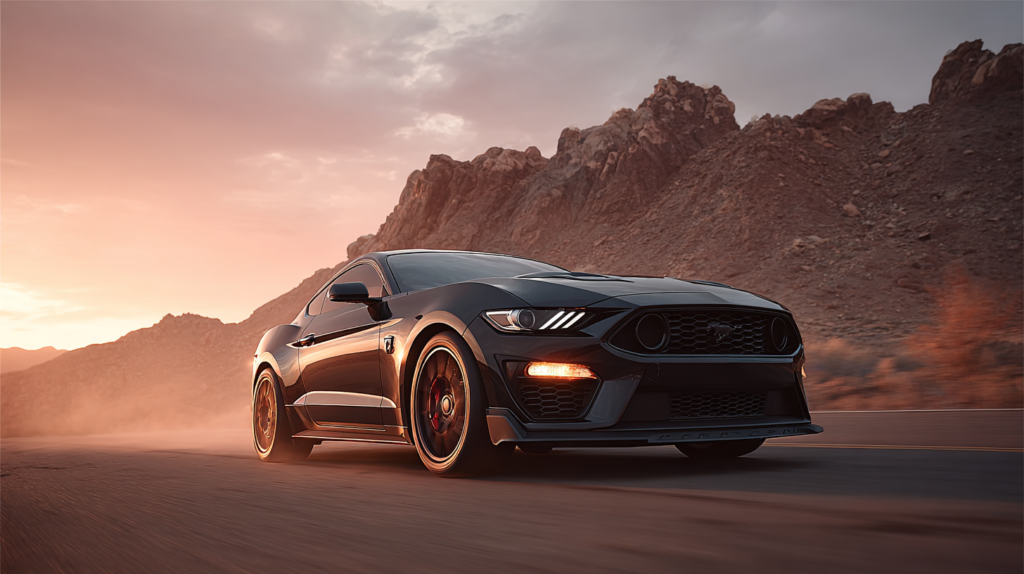
The Mustang Dark Horse’s exterior design is characterized by its aggressive stance and distinctive details. The front end features a larger grille than the GT, with a honeycomb pattern and a unique Dark Horse badge. The lower fascia incorporates large air intakes that feed cooling air to the engine and brakes.
The side profile shows the classic Mustang proportions: a long hood, a short rear deck, and a fastback roofline. The Dark Horse adds unique side skirts and a subtle rear haunch that emphasizes the car’s width.
The rear end features the large fixed wing, a prominent diffuser, and quad exhaust outlets. The taillights retain the classic Mustang triple bar design, executed with modern LED technology.
Exterior Colors
The Dark Horse is offered with a range of exterior colors, including the exclusive Blue Ember metallic that is unique to the model. Other colors include Shadow Black, Oxford White, Race Red, and Grabber Blue.
Dark Horse Specific Details
The Dark Horse features unique badging throughout, with a stylized horse emblem on the grille and rear deck. The hood vents are functional, extracting hot air from the engine bay. The side mirrors are finished in black, and the window trim is gloss black.
Interior and Accommodations
Cabin Design
The interior of the Mustang Dark Horse reflects the car’s performance focus. The seats are heavily bolstered to hold occupants during cornering, with leather and Alcantara upholstery. The front seats are power adjustable with heating and cooling.
The dashboard features a 12.4 inch digital instrument cluster that can be configured to display performance data, including g forces, lap times, and engine parameters. The 13.2 inch central touchscreen handles infotainment functions, with a SYNC 4 system that includes navigation, Apple CarPlay, and Android Auto.
The flat bottom steering wheel is wrapped in Alcantara, with a red centering stripe and integrated controls for the car’s systems. The Dark Horse specific details include unique stitching, a numbered dash plaque, and Dark Horse branding on the seats and door sills.
Seating and Space
The Mustang Dark Horse seats four passengers, though the rear seats are best suited for children or for occasional use. The front seats offer excellent support and comfort, with a driving position that is low and sporty.
The cargo area, accessed through the trunk lid, offers 13.5 cubic feet of space, sufficient for a weekend’s worth of luggage or a set of golf clubs.
Technology Features
The Dark Horse is equipped with a comprehensive suite of technology features. The infotainment system includes wireless Apple CarPlay and Android Auto, a premium Bang & Olufsen audio system, and integrated navigation. The digital instrument cluster includes a track mode that displays performance data in a format suited to circuit driving.
Driver Assistance
The Mustang Dark Horse includes a range of driver assistance features, including adaptive cruise control, lane departure warning, blind spot monitoring, and automatic emergency braking. These systems can be adjusted or disabled through the infotainment interface.
The Dark Horse Experience
On Road Character
The Mustang Dark Horse is a car that commands attention. Its V8 engine produces a distinctive rumble at idle, and the exhaust note builds to a sharp roar as the revs climb. The car’s presence on the road is substantial, with a wide stance and aggressive styling that draws looks.
In normal driving, the Dark Horse is civil and composed. The suspension absorbs road imperfections without transmitting harshness to the cabin, and the engine provides ample torque without requiring high revs. The car is comfortable enough for daily driving, though the firm suspension and wide tires produce more road noise than a standard Mustang.
When the driver presses the accelerator, the character transforms. The V8 responds with immediacy, pulling strongly from low rpm and building power to the 7,500 rpm redline. The engine’s sound fills the cabin, and the car accelerates with authority.
On Track Behavior
When driven on a track, the Mustang Dark Horse reveals the depth of its engineering. The brakes provide consistent stopping power lap after lap, with a pedal feel that inspires confidence. The chassis remains composed through corners, with the MagneRide suspension controlling body motion effectively.
The car’s weight is evident during hard cornering, but the chassis tuning and the wide tires provide substantial grip. The car is balanced and predictable, with a slight tendency toward understeer at the limit that builds driver confidence. The rear wheel drive layout allows the driver to adjust cornering attitude with the throttle, and the standard limited slip differential manages power delivery effectively.
The Handling Package, with its wider wheels and tires and additional aerodynamic elements, further sharpens the car’s track capability. The Michelin Pilot Sport Cup 2 tires provide exceptional grip, though they require warm up to reach their optimal operating temperature.
The Sound
The 5.0 liter V8’s sound is one of the Dark Horse’s defining characteristics. The engine has a deep, muscular tone at low speeds, with a sharp, aggressive note as the revs climb. The active exhaust system, with four adjustable settings, allows the driver to control the volume from subdued to track loud.
At full throttle, the engine produces a classic V8 roar that communicates power and intent. The sound is visceral and engaging, connecting the driver to the car in a way that turbocharged engines cannot match.
How the Mustang Dark Horse Stacks Up Against Rivals
Against the Chevrolet Camaro SS 1LE
The Chevrolet Camaro SS 1LE is the Mustang Dark Horse’s most direct competitor. It features a 6.2 liter naturally aspirated V8 producing 455 horsepower, a six speed manual transmission, and a track focused suspension package.
The Camaro’s advantage is its handling. The Alpha platform that underpins the Camaro is widely regarded as one of the best chassis in the segment, and the 1LE package adds adjustable dampers, wider tires, and enhanced cooling. The car is agile and responsive, with exceptional cornering grip.
The Mustang’s advantage is its engine and its livability. The 5.0 liter V8 produces more power than the Camaro’s 6.2 liter, and it revs more freely to its 7,500 rpm redline. The Mustang also offers better visibility, more interior space, and a more refined cabin than the Camaro.
In value terms, the two cars are closely matched, with the Mustang carrying a slightly higher price but offering more power and more features.
Against the BMW M2
The BMW M2 represents a different approach to the performance coupe. It features a 3.0 liter twin turbocharged inline six producing 453 horsepower, an eight speed automatic transmission, and rear wheel drive.
The M2’s advantage is its refinement and its handling. The car is smaller and lighter than the Mustang, with a chassis that is both agile and composed. The interior is more luxurious, with higher quality materials and more advanced technology. The engine, while lacking the V8’s character, delivers its power with smoothness and responsiveness.
The Mustang’s advantage is its character and its value. The V8 provides a sensory experience that the turbocharged six cannot match, and the Mustang’s price undercuts the M2 by a significant margin. The Mustang also offers more interior space and a larger trunk.
Against the Nissan Z Nismo
The Nissan Z Nismo is a front engine, rear drive coupe with a 3.0 liter twin turbocharged V6 producing 420 horsepower. It is designed as a track focused performance car, with upgraded suspension, brakes, and aerodynamics.
The Z Nismo’s advantage is its agility. The car is smaller and lighter than the Mustang, with a chassis that responds quickly to inputs. The turbocharged V6 provides strong low end torque, and the car’s handling is balanced and predictable.
The Mustang’s advantage is its power and its sound. The V8 produces 80 more horsepower than the Z’s V6, and its character is more dramatic. The Mustang also offers more interior space and a more substantial presence.
Against the Toyota GR Supra
The Toyota GR Supra is a front engine, rear drive coupe with a 3.0 liter turbocharged inline six producing 382 horsepower. It shares its platform with the BMW Z4 and is designed as a grand touring sports car.
The Supra’s advantage is its balance and its refinement. The car’s chassis is well sorted, with precise steering and composed handling. The interior is more modern than the Mustang’s, and the car’s smaller size makes it easier to maneuver in tight spaces.
The Mustang’s advantage is its power and its value. The V8 produces 118 more horsepower than the Supra’s six, and the Mustang’s price is comparable to the Supra’s. The Mustang also offers more interior space and a more dramatic presence.
Value Proposition
Pricing
The Ford Mustang Dark Horse carries a base price of approximately $65,000. The Handling Package adds approximately $4,500, and the automatic transmission adds approximately $1,600. Final prices vary based on options and dealer markup.
This pricing places the Dark Horse in the upper tier of the Mustang lineup, above the GT and below the Shelby GT500. It is competitively priced against the Chevrolet Camaro SS 1LE, the BMW M2, and the Nissan Z Nismo.
Depreciation
Mustangs traditionally hold their value reasonably well, though not as strongly as some competitors. The Dark Horse, as a limited production model, may hold its value better than standard Mustangs, particularly if production numbers are limited.
Ownership Costs
Maintaining a Mustang involves lower costs than European competitors. Service intervals are annual or every 10,000 miles, with costs that are reasonable for a performance car. The tires, particularly the 305 width tires on the Handling Package, are expensive to replace, and fuel costs are a consideration given the V8’s fuel consumption.
The Experience Factor
For many buyers, the Mustang Dark Horse’s value proposition extends beyond financial considerations. The V8 engine’s character, the car’s presence, and the connection to six decades of Mustang heritage are factors that cannot be quantified on a spreadsheet.
Specifications Summary
| Specification | Value |
|---|---|
| Engine | 5.0L naturally aspirated V8 |
| Horsepower | 500 hp at 7,250 rpm |
| Torque | 418 lb ft at 4,900 rpm |
| Transmission | 6 speed manual, 10 speed auto |
| Drive | Rear wheel drive |
| 0-60 mph | 4.1 sec (manual), 3.8 sec (auto) |
| Quarter Mile | 12.2 sec @ 118 mph (manual), 11.9 sec @ 120 mph (auto) |
| Top Speed | 166 mph (manual), 168 mph (auto) |
| Weight | 3,800 lb |
| Fuel Economy | 14 mpg city, 22 mpg highway (estimated) |
| Base Price | $65,000 |
Conclusion
The Ford Mustang Dark Horse represents a significant achievement for the Mustang nameplate. It is a car that combines the character of a traditional V8 performance car with the capability to perform on track. Its 5.0 liter V8 produces 500 horsepower and revs to 7,500 rpm, its chassis is tuned for cornering precision, and its brakes are capable of sustained track use.
Against its rivals, the Dark Horse holds its own. It offers more power than the Chevrolet Camaro SS 1LE and the BMW M2, a more engaging character than the Nissan Z Nismo, and a more substantial presence than the Toyota GR Supra. Its V8 engine provides a sensory experience that turbocharged and naturally aspirated six cylinder engines cannot match.
The Dark Horse is not the most powerful Mustang; that distinction belongs to the Shelby GT500. It is not the lightest or most agile car in its class; the BMW M2 and Nissan Z Nismo are smaller and more nimble. But it offers a combination of attributes that is difficult to find elsewhere: V8 character, track capability, and everyday usability.
For buyers who value the sound and feel of a naturally aspirated V8, who want a car that can be driven to the track, perform for a full session, and drive home comfortably, the Mustang Dark Horse makes a compelling case. It is a reminder that, even in 2026, the old school V8 still kicks.

