
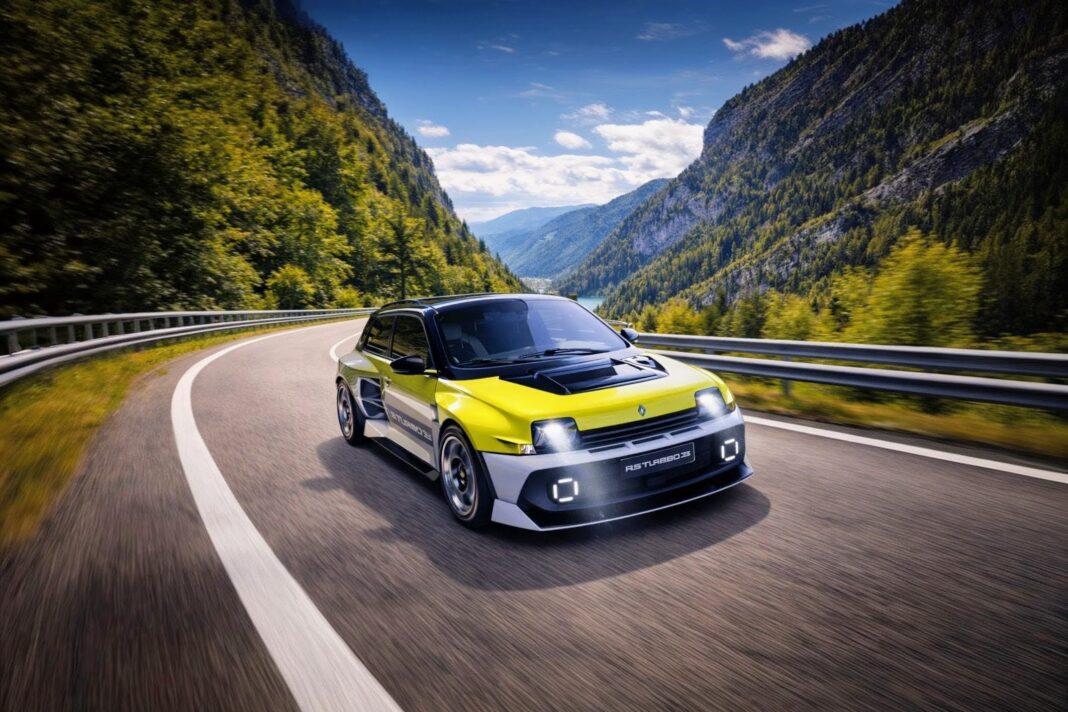
The automotive world has witnessed countless reinterpretations of classic nameplates, with varying degrees of success. Some efforts merely borrow a badge, applying it to a generic vehicle with little connection to the original. Others capture the spirit while updating the technology for a new era. The Renault R5 Turbo 3E falls decisively into the latter category, and perhaps goes several steps further.
First shown as a concept in late 2024, the production version of the R5 Turbo 3E is now moving toward customer deliveries. It represents a radical departure from the standard Renault 5 electric hatchback, sharing little more than a name and a silhouette with its more practical stablemate. With up to 555 horsepower delivered to the rear wheels through innovative in-wheel motors, a carbon fiber body, and a production run limited to 1,980 units, it is a machine that defies easy categorization.
This article provides a detailed examination of the Renault R5 Turbo 3E, its performance specifications, design philosophy, and what makes this electric reinterpretation of a rally legend stand out in 2026.
The R5 Turbo Legacy
The original Renault 5 Turbo arrived in 1980, a homologation special built to satisfy regulations for Group B rallying. Renault took the humble 5 supermini and transformed it into something entirely different. The rear seats were removed to make room for a 1.4 liter turbocharged engine mounted amidships, driving the rear wheels through a five speed gearbox. The body was widened dramatically to accommodate larger wheels and tires, and the result was a compact machine with 160 horsepower and handling characteristics that demanded respect from even the most skilled drivers.
Approximately 1,980 examples of the original Turbo and Turbo 2 were built between 1980 and 1984, creating a collectable legacy that has only grown in stature over the intervening decades. The car’s boxy, aggressive stance and rallying success cemented its place in automotive history.
The new R5 Turbo 3E pays homage to this heritage while projecting it into an electric future. The production run of 1,980 units directly references the original’s launch year, and the design language echoes the wide body, aggressive stance, and functional aesthetic of its predecessor.
From Concept to Production
Concept Debut
The R5 Turbo 3E concept first appeared in late 2024, generating immediate excitement from enthusiasts. Unlike many concept vehicles that serve primarily as design exercises with little intention of reaching production, the Turbo 3E was always intended as a reality. Renault confirmed production plans shortly after the concept’s debut, with development continuing through 2025 and 2026.
Current Status
As of 2026, the R5 Turbo 3E is in an advanced stage of development. Prototypes have been tested extensively, including demonstration runs and passenger rides at various events. Reservations are open in some markets, with first deliveries scheduled for 2027.
Production Location
Production will take place at the Alpine factory in Dieppe, France, leveraging the expertise of Renault’s performance division. This connection to Alpine is significant, as the Turbo 3E’s platform will eventually underpin the electric replacement for the Alpine A110.
Powertrain and Performance
In-Wheel Motor Technology
The most distinctive technical feature of the R5 Turbo 3E is its use of in-wheel electric motors. Rather than mounting motors within the chassis and sending power through half shafts, the Turbo 3E places two electric motors directly inside the rear wheels.
This configuration offers several advantages. It eliminates the need for a conventional transmission, reduces mechanical losses, and frees up space within the chassis for other components. More importantly, it allows for exceptionally precise torque control at each rear wheel, effectively replicating the function of a locked or limited slip differential without the mechanical complexity.
Power Output
The dual in-wheel motors produce a combined output of approximately 555 horsepower. This power output places the Turbo 3E firmly in supercar territory. Torque figures are substantial, though the exact measurement varies depending on whether wheel torque or motor torque is quoted. The availability of instant electric torque ensures devastating acceleration.
Acceleration and Top Speed
The R5 Turbo 3E accelerates from 0 to 62 miles per hour in under 3.5 seconds. This performance rivals or exceeds that of many dedicated sports cars and supercars, making it one of the quickest vehicles in its segment.
Top speed is quoted at approximately 168 miles per hour, a figure that reflects the car’s focus on acceleration and cornering rather than absolute top end.
Battery and Range
Power is drawn from a 70 kWh battery pack, which provides an estimated range of approximately 250 miles under the WLTP testing cycle. This range figure is competitive for a performance oriented electric vehicle, though real world driving, particularly on track, will reduce it significantly.
Charging Capability
The Turbo 3E utilizes an 800 volt electrical architecture, enabling DC fast charging at high power rates. Under ideal conditions, this allows a 15 to 80 percent charge in approximately 15 minutes. This charging speed makes longer journeys practical, though the car’s primary mission is clearly performance.
Chassis and Structure
Carbon Fiber Construction
The R5 Turbo 3E is built around a carbon fiber structure that provides exceptional rigidity while keeping weight in check. The curb weight is approximately 1,450 kilograms, a remarkable figure for a vehicle with a 70 kWh battery pack and the structural reinforcements required for its performance capabilities.
Suspension and Handling
The suspension has been developed with input from Alpine, with the petrol powered A110 serving as a benchmark for dynamics. Early ride impressions suggest that while there is noticeable body roll under hard cornering, grip levels are exceptionally high and the car remains playful and engaging.
The in-wheel motors contribute to handling by enabling torque vectoring that can rotate the car on corner entry and provide maximum traction on exit. A hydraulic handbrake, mounted vertically alongside the driver, allows for traditional rally style drift maneuvers.
Braking
Regenerative braking, controlled by the electric motors, captures energy during deceleration and reduces wear on the friction brakes. The integration between regenerative and friction braking is managed by a system that maintains consistent pedal feel. During testing, the brakes have demonstrated ample stopping power.
Exterior Design
Proportions and Stance
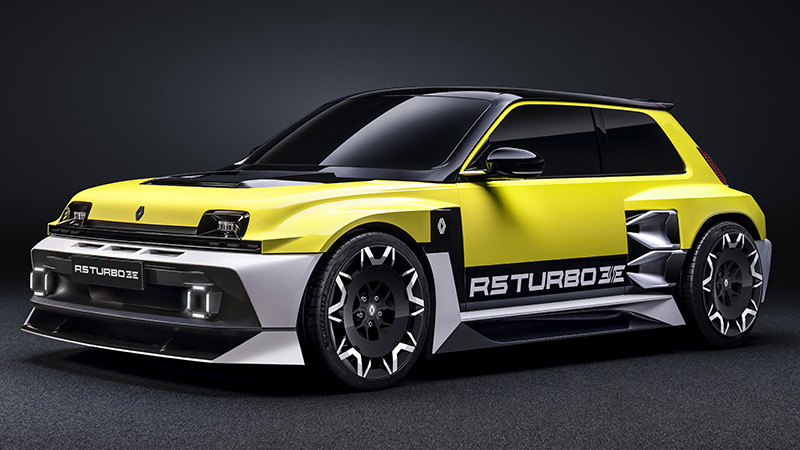
The R5 Turbo 3E measures approximately 4,080 mm in length, 2,030 mm in width, and 1,380 mm in height. At over two meters wide, it matches the track of a Lamborghini Aventador, giving it an aggressive, planted stance that is immediately distinguishable from the standard Renault 5.
The width is achieved through dramatic fender flares that house the 20 inch wheels and the in-wheel motors. The front overhang is short, the windshield is raked back, and the overall silhouette echoes the original Turbo while being thoroughly modern in execution.
Aerodynamic Elements
The bodywork incorporates numerous functional aerodynamic elements. Large air intakes ahead of the rear wheels feed cooling air to the motors and brakes. A prominent rear spoiler and diffuser manage airflow beneath the car, generating downforce at speed. The side intakes and vents are not decorative but serve genuine cooling and aerodynamic purposes.
Carbon Fiber Body Panels
The body is constructed from carbon fiber, contributing to the low overall weight while allowing for complex shapes that would be difficult to achieve in metal. The material is often left exposed, with the weave visible beneath a clear coat, creating a technical aesthetic that communicates the car’s racing DNA.
Visual Connection to the Original
Designers have incorporated numerous references to the original R5 Turbo. The boxy fender flares, the rear wing, the overall proportion of greenhouse to body all echo the 1980s original while being unmistakably contemporary. The color schemes, including the classic yellow and black combination, further reinforce the connection.
Interior Design
Racing Inspired Cockpit
The interior of the R5 Turbo 3E is stripped back and focused on the driving experience. Prototypes feature lightweight windows, exposed structural elements, and minimal sound deadening. The production version will likely add some refinement while maintaining the essential character.
Seats and Restraints
Sculpted bucket seats are equipped with multi point racing harnesses, holding driver and passenger securely during high speed maneuvers. The seating position is low and purposeful, with the driver surrounded by controls that prioritize function over luxury.
Controls and Interface
A vertical hydraulic handbrake stands alongside the driver, a nod to the car’s rally heritage and a tool for those who wish to explore its sideways capabilities. The digital instrument cluster provides essential information.
The cabin reflects the car’s prototype status in its current form, but extensive personalization options will be available to buyers, allowing each of the 1,980 units to be tailored to individual preferences.
Driving Experience
On Track Character
Passenger rides in development prototypes have revealed a machine with unique character. The acceleration is immediate, pinning occupants into their seats with force comparable to the fastest electric vehicles. The lack of engine noise means the dominant sounds are mechanical whine from the motors and the protest of tires at the limit.
Despite its low center of gravity and wide track, the prototype exhibited noticeable body roll during early testing, which is expected to be addressed in production versions. Grip levels are exceptionally high, and the torque vectoring enabled by the in-wheel motors allows for precise cornering control.
Playful Nature
The hydraulic handbrake and rear drive configuration make the Turbo 3E inherently playful. During demonstration runs, drivers have demonstrated its ability to rotate the rear end on command, holding drifts with apparent ease. This character distinguishes it from more clinical performance EVs and connects it directly to the rally heritage of the original.
Sound
Electric vehicles are often criticized for their silence, and the Turbo 3E does not attempt to fake the sound of a combustion engine. Instead, it offers a different acoustic experience: the whine of the in-wheel motors under load, the rush of air over the bodywork, the mechanical noises of brakes and suspension working hard.
What Makes the R5 Turbo 3E Stand Out in 2026
The In-Wheel Motor Technology
The use of in-wheel motors sets the Turbo 3E apart from virtually every other electric performance car on the market. This configuration enables torque vectoring capabilities that traditional drivetrains cannot match and frees up space within the chassis for other components. It represents a genuine engineering innovation, not simply a familiar formula applied to a new powertrain.
Heritage with Substance
Many retro inspired vehicles capture the look of their predecessors while missing the underlying spirit. The Turbo 3E appears to avoid this trap. Its wide body, rear drive, and playful handling directly reference the original’s character, not just its visual cues. The production run of 1,980 units honors the original’s production numbers and ensures exclusivity.
Performance Credentials
With 0 to 62 miles per hour in under 3.5 seconds and a top speed approaching 170 miles per hour, the Turbo 3E delivers genuine supercar performance in a package the size of a small hatchback. This combination of compact dimensions and extreme capability is increasingly rare and increasingly appealing to enthusiasts who value agility as much as straight line speed.
The Alpine Connection
Development by Alpine, Renault’s performance division, ensures that the Turbo 3E benefits from genuine motorsport expertise. The platform will underpin the next generation A110, suggesting that the engineering is robust enough for a dedicated sports car. This connection adds credibility to the performance claims.
Limited Production Exclusivity
With only 1,980 units planned for global production, the Turbo 3E is genuinely rare. Buyers can be confident that they will not encounter another at the local cars and coffee. The extensive personalization options will make each car unique to its owner, further enhancing the sense of exclusivity.
Production and Availability
Manufacturing Location
Production will take place at the Alpine factory in Dieppe, France, a facility with decades of experience building performance vehicles. This location ensures that the craftsmanship and attention to detail meet the standards expected of a limited edition model.
Production Timeline
First customer deliveries are scheduled for 2027, following the completion of development and validation testing. Reservations are open in some markets, with allocations expected to fill quickly given the limited production run.
Pricing
The R5 Turbo 3E carries a starting price of approximately £135,000, with extensive personalization options potentially increasing that figure. This positions it in competition with dedicated sports cars and grand tourers from established luxury brands, a testament to the perceived value of this unique machine.
Market Availability
The Turbo 3E will be sold in European markets, the Middle East, Japan, and Australia. Availability in North America has not been confirmed, reflecting the complexity of homologation and the relatively small numbers involved.
Conclusion
The Renault R5 Turbo 3E represents a remarkable achievement: a limited edition electric vehicle that honors a rally legend while pushing technological boundaries. Its in-wheel motors, carbon fiber construction, and 555 horsepower output deliver performance that rivals dedicated sports cars, while its wide body, aggressive stance, and rally inspired controls connect it directly to its heritage.
Yet the Turbo 3E is not defined solely by its specifications. It is defined by its character: playful, engaging, and unapologetically extreme. In an era when many performance vehicles prioritize numbers over feel, the Turbo 3E promises to reward drivers who value the experience as much as the statistics.
It is not a practical vehicle. The cabin is tight, the ride is firm, the real world range is limited, and the price places it far beyond the reach of ordinary enthusiasts. But that is precisely the point. The original R5 Turbo was not a practical vehicle either. It was a homologation special, a machine built to satisfy regulations and to dominate rally stages. Its appeal lay in its extremity, its focus, its refusal to compromise.
The Turbo 3E continues this tradition. It is a showcase of Renault’s ambitions, a demonstration that electric performance can be exciting, characterful, and worthy of the most revered nameplates. For the 1,980 buyers who will acquire one, it offers something genuinely unique: a piece of automotive history, reimagined for the electric age, and built to be driven, not simply collected.
And for the rest of the automotive world, it offers proof that the spirit of the hot hatch can survive electrification, and that sometimes, the most compelling way forward is to look back.

